


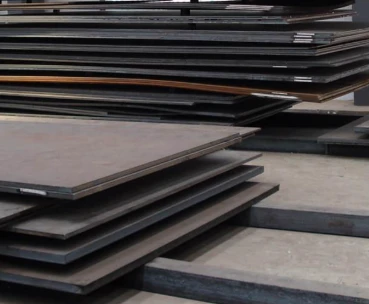
P295GH is a non-alloy pressure vessel steel manufactured according to the European standard EN 10028-2. It is specifically designed for high-temperature service environments and is characterized by excellent weldability, plasticity, and toughness. It is a core material in the fabrication of boilers, pressure vessels, and heat exchangers.
Mechanical Properties of EN 10028 – P295GH
| Type | Thickness (mm) | Yield Strength MPa (min) |
Tensile Strength MPa |
Elongation % (min) |
Impact Energy (KV J) (min) |
||
|---|---|---|---|---|---|---|---|
| -20° | 0° | +20° | |||||
| Normalized | ≤ 16 |
295 | 460 - 580 | 21 | 27 | 34 | 40 |
| 16> to ≤40 | 290 | 460 - 580 | 21 | 27 | 34 | 40 | |
| 40> to ≤60 | 285 | 460 - 580 | 21 | 27 | 34 | 40 | |
| 60> to ≤100 | 260 | 460 - 580 | 21 | 27 | 34 | 40 | |
| 100> to ≤150 | 235 | 440 - 570 | 21 | 27 | 34 | 40 | |
| 150> to ≤250 | 220 | 430 - 570 | 21 | 27 | 34 | 40 | |
Chemical Composition of EN 10028 – P295GH
| C | 0.08 to 0.20 |
| Si | ≤0.40 |
| Mn | 0.90 to 1.50 |
| P | 0.025 |
| S | 0.015 |
| Al | ≤0.020 |
| N | ≤0.012 |
| Cr | ≤0.30 |
| Cu | ≤0.30 |
| Mo | ≤0.08 |
| Nb | ≤0.020 |
| Ni | ≤0.30 |
| Ti | 0.03 |
| Vi | ≤0.02 |

P295GH Processing
P295GH has good processability, adapting to various common processing methods for pressure vessel steel. Key processing points are as follows:
Hot Working: Suitable for hot rolling, forging and hot bending. Recommended temperature range: 1100-1200℃. Avoid overheating above 1250℃ to prevent grain coarsening. Cool naturally after hot working, no rapid cooling to avoid hardening.
Welding Processing: Applicable to manual arc welding, gas shielded welding, submerged arc welding. Preheat 100-150℃ for plates >30mm; no preheating for ≤30mm. Use low-hydrogen welding materials. Control interpass temperature ≤300℃, post-weld slow cooling.
Cold Working: Can be cold bending, stamping and shearing. Cold deformation should not exceed 15% to avoid excessive stress. For severe cold forming, stress relief annealing (550-650℃) is required afterward.
Heat Treatment: Usually delivered in normalized state (890-950℃, air cooling). Post-weld heat treatment (PWHT) is optional, 580-620℃ for stress relief, holding 1-2h, slow cooling.
Cutting & Machining: Can be cut by flame, plasma or mechanical cutting. Machining with high-speed steel or cemented carbide tools, appropriate cutting speed and feed rate to ensure surface finish.
 Applications
Pressure Vessel Manufacturing: The primary application field, including storage tanks, heat exchangers, spherical tanks, and liquefied gas tanks. It is widely used in industrial pressure-bearing equipment due to good pressure and temperature resistance.
Petrochemical Industry: Applied to reactors, gas separation towers, distillation units, and oil pipelines. It adapts to corrosive and high-pressure working environments in oil refining and chemical processing.
Power Industry: Used for boiler components, steam turbines, high-pressure water pipes of hydropower stations, and condenser systems. Suitable for thermal and nuclear power plants with long-term high-temperature operation demands.
Nuclear Industry: Manufactures key components such as nuclear reactor pressure vessels and pipelines, relying on stable mechanical properties and safety compliance.
Metallurgical Industry: Applied to high-temperature and high-pressure equipment like furnace bodies and conveying pipelines, enduring harsh working conditions of high temperature and mechanical stress.
Why Choose Us :
You can get the perfect material according to your requirement at the least possible price.
We also offer Reworks, FOB, CFR, CIF, and door to door delivery prices. We suggest you to do deal for shipping which will be quite economical.
The materials we provide are completely verifiable, right from raw material test certificate to the final dimensional statement.(Reports will show on requirement)
We guarantee to give a response within 24hours(usually in the same hour)
You can get stock alternatives, mill deliveries with minimizing manufacturing time.
We are fully dedicated to our customers. If it will not possible to meet your requirements after examining all options, we will not mislead you by making false promises which will create good customer relations.

Contact us at beam@gneesteelgroup.com for pricing, technical support, or customized solutions. We are always ready to support your project.
What is the coefficient of thermal expansion of P295GH?
The linear thermal expansion coefficient of P295GH is about 11.8×10⁻⁶/℃ (20-100℃). This parameter is crucial for thermal stress calculation and structural design of equipment working under temperature changes.
What is the minimum impact energy requirement for P295GH?
The minimum impact energy (KV) of P295GH at 20℃ is 30 J (tested with V-notch specimens). For special requirements, higher impact energy can be specified when ordering, and testing at lower temperatures is available.
Can P295GH be used in petrochemical pressure vessels?
Yes, P295GH is widely used in petrochemical pressure vessels, such as storage tanks, reactors and separators. It can withstand the pressure and temperature of petrochemical media and has good compatibility with most organic media.
Is P295GH a alloy steel or non-alloy steel?
P295GH is a non-alloy carbon-manganese steel. It does not contain a large amount of alloying elements (Cr, Ni, Mo, etc.) beyond the specified limits, and its performance is mainly ensured by carbon and manganese.
What is the difference between P295GH and P295NH?
P295NH is a normalized low-temperature pressure vessel steel, while P295GH is a high-temperature resistant grade. P295NH has better low-temperature toughness (-20℃ impact energy ≥30 J), suitable for low-temperature pressure-bearing scenarios.
Can P295GH be used to make steam boilers?
Yes, P295GH is an ideal material for steam boilers. It can withstand high temperature and pressure of steam, has good thermal conductivity and creep resistance, and meets the safety requirements of boiler manufacturing standards.
What is the thermal conductivity of P295GH?
The thermal conductivity of P295GH is about 45 W/(m·K) at room temperature. It decreases slightly with increasing temperature, which is an important parameter for heat transfer calculation in boiler and heat exchanger design.
Is P295GH corrosion-resistant?
P295GH has basic corrosion resistance in atmospheric and mild corrosive environments. For harsh environments (e.g., acidic, alkaline media), anti-corrosion treatments like painting, galvanizing or selecting corrosion-resistant alloys are required.
What is the tensile strength of P295GH at high temperature?
At 400℃, the tensile strength of P295GH is about 380-550 MPa, which is lower than room temperature but still maintains sufficient strength for high-temperature pressure-bearing applications. The value decreases with increasing temperature.
What is the difference between P295GH and Q245R (Chinese standard)?
Q245R is a Chinese pressure vessel steel (GB 713), while P295GH is European standard. P295GH has higher yield strength (≥295 MPa vs ≥245 MPa) and better high-temperature performance, suitable for more demanding scenarios.