


ASTM A516 Grade 70 pressure vessel steel plate and 16Mo3 pressure vessel steel plate are both used for pressure equipment, but they belong to different standard systems and have different chemical compositions, strength requirements and elevated-temperature material properties.
ASTM A516 Grade 70 is a carbon steel plate under ASTM A516/A516M. EN 10028-2 16Mo3, material number 1.5415, is a molybdenum-alloyed pressure-equipment steel containing 0.25–0.35% Mo.

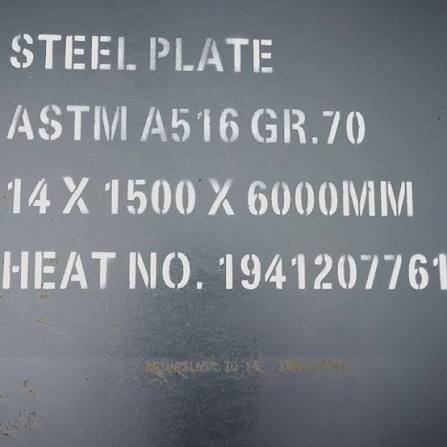
At room temperature, A516 Gr 70 has a minimum yield strength of 260 MPa and tensile strength of 485–620 MPa. For 5–16 mm 16Mo3 plate, the minimum yield strength is 275 MPa and tensile strength is 440–590 MPa.
More importantly, EN 10028-2 provides defined elevated-temperature proof-strength values for 16Mo3 up to 500°C, making temperature-dependent properties an important part of the A516 Grade 70 vs. 16Mo3 comparison.
What Is ASTM A516 Grade 70 Pressure Vessel Steel Plate?
ASTM A516 Grade 70 steel plate, often written as A516 Gr 70, is a carbon steel plate intended primarily for welded pressure vessels where improved notch toughness is important.
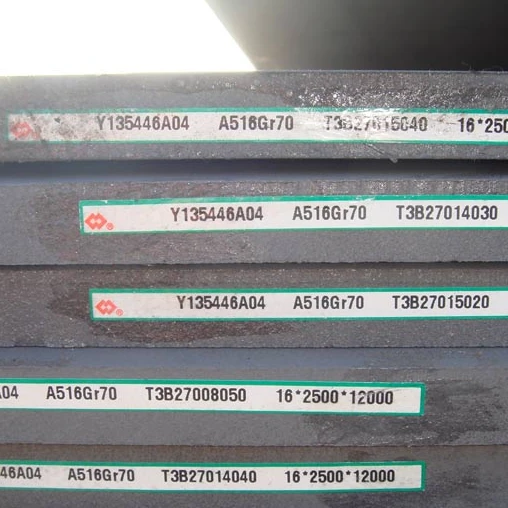
ASTM A516/A516M contains Grades 55, 60, 65 and 70. Grade 70 has a specified tensile-strength range of 485–620 MPa. ASTM also requires the steel to be killed and to meet fine austenitic grain-size requirements. In published plate data, A516 Grade 70 has a minimum yield strength of 260 MPa for 5–120 mm plate.

What Is EN 10028-2 16Mo3 Pressure Vessel Steel Plate?
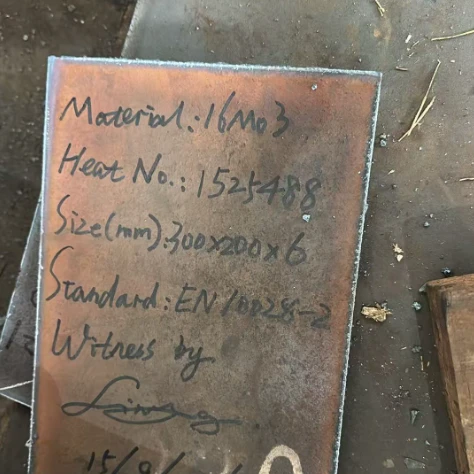
16Mo3 pressure vessel steel plate is specified under EN 10028-2 and has material number 1.5415. Its defining alloy element is molybdenum. EN material data specify 0.25–0.35% Mo, together with 0.12–0.20% C, 0.40–0.90% Mn, P ≤0.025% and S ≤0.010%.
For 5–16 mm plate, EN 10028-2 16Mo3 steel plate has a minimum yield strength of 275 MPa and tensile strength of 440–590 MPa. As thickness increases, the specified minimum yield strength decreases according to the applicable thickness range.

ASTM A516 Grade 70 vs. 16Mo3: Key Differences
| Property | ASTM A516 Grade 70 | EN 10028-2 16Mo3 |
|---|---|---|
| Standard | ASTM A516/A516M | EN 10028-2 |
| Steel Type | Carbon pressure vessel steel | Molybdenum-alloyed pressure steel |
| Minimum Yield Strength | ≥260 MPa | ≥275 MPa, 5–16 mm |
| Tensile Strength | 485–620 MPa | 440–590 MPa, 5–60 mm |
| C | ≤0.27%, 5–25 mm | 0.12–0.20% |
| Mn | 0.85–1.20% | 0.40–0.90% |
| P | ≤0.025% | ≤0.025% |
| S | ≤0.025% | ≤0.010% |
| Si | 0.15–0.40% | ≤0.35% |
| Mo | No specified Mo range in the cited A516 table | 0.25–0.35% |
The main difference is not simply the 260 MPa versus 275 MPa yield strength. A516 Grade 70 is a carbon pressure-vessel steel, while 16Mo3 is deliberately alloyed with 0.25–0.35% molybdenum and has separately specified elevated-temperature properties.
A516 Grade 70 vs. 16Mo3 Chemical Composition
One of the clearest differences between A516 Gr 70 and 16Mo3 is the alloy design.
ASTM A516 Grade 70 Carbon Content by Thickness
| A516 Gr 70 Plate Thickness | C Max. |
|---|---|
| ≤12.5 mm | 0.27% |
| >12.5–50 mm | 0.28% |
| >50–100 mm | 0.30% |
| >100–200 mm | 0.31% |
| >200 mm | 0.31% |
ASTM A516/A516M-25 lists these thickness-dependent carbon limits for Grade 70. By comparison, EN 10028-2 specifies 0.12–0.20% carbon for 16Mo3 across the referenced 5–150 mm range, together with 0.25–0.35% Mo.
Mechanical Properties of A516 Gr 70 and 16Mo3
At room temperature, the two grades also show different strength combinations.
| Mechanical Property | A516 Grade 70 | 16Mo3 |
|---|---|---|
| Minimum Yield Strength | 260 MPa | 275 MPa, ≤16 mm |
| Tensile Strength | 485–620 MPa | 440–590 MPa, ≤16 mm |
| Minimum Elongation | 21% in 50 mm | 22%, 3–16 mm, A5.65√S₀ |
| Impact Energy | Project / test requirements apply | ≥31 J at +20°C, 6–16 mm |
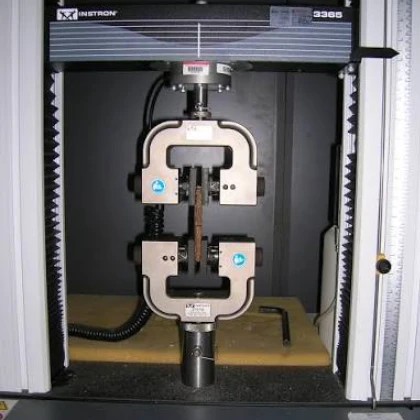
ASTM A516 Grade 70 specifies 260 MPa minimum yield strength, 485–620 MPa tensile strength and 21% minimum elongation using a 50 mm gauge length.
For 16Mo3, the corresponding EN data for ≤16 mm plate are 275 MPa minimum yield strength and 440–590 MPa tensile strength. The elongation figures should not be treated as a simple 21% versus 22% ranking because the test-gauge basis is not identical.
Why Is 16Mo3 Different at Elevated Temperatures?
This is one of the most important sections when comparing A516 Gr 70 vs. 16Mo3 pressure vessel steel plate. For ≤16 mm 16Mo3 plate, EN 10028-2 provides the following specified minimum 0.2% proof-strength values:
| Temperature | 16Mo3 Min. 0.2% Proof Strength |
|---|---|
| 50°C | 273 MPa |
| 100°C | 264 MPa |
| 150°C | 250 MPa |
| 200°C | 233 MPa |
| 250°C | 213 MPa |
| 300°C | 194 MPa |
| 350°C | 175 MPa |
| 400°C | 159 MPa |
| 450°C | 147 MPa |
| 500°C | 141 MPa |
These are EN 10028-2 material-property values for 16Mo3 rather than allowable design stresses. At 200°C, the specified minimum value is 233 MPa. At 300°C, it is 194 MPa, and at 400°C, it remains 159 MPa. This is more useful than simply describing 16Mo3 high-temperature pressure vessel steel as having "good heat resistance."
Can ASTM A516 Grade 70 Replace EN 10028-2 16Mo3?
ASTM A516 Grade 70 should not be considered a direct equivalent of 16Mo3. The room-temperature strength figures may appear relatively close:
A516 Gr 70 minimum yield strength: 260 MPa
16Mo3 minimum yield strength: 275 MPa at ≤16 mm
But their chemical compositions and material-standard requirements are different. 16Mo3 specifies 0.25–0.35% Mo, while ASTM A516 Grade 70 is specified as a carbon pressure-vessel steel and does not contain an equivalent mandatory molybdenum-alloying range in its A516 chemical-composition table.
Therefore, when a pressure vessel drawing or BOM specifies EN 10028-2 16Mo3 / 1.5415, A516 Grade 70 should not be substituted simply because the room-temperature tensile or yield figures look similar.
Any substitution should be reviewed against the governing design code, design temperature, design pressure, wall thickness, welding requirements and customer or engineering approval.
When Should You Specify 16Mo3 Pressure Vessel Steel Plate?
The selection should follow the pressure-equipment design specification. If the project is based on ASTM/ASME requirements and specifies ASTM A516 Grade 70 or ASME SA516 Grade 70, the material should be purchased and certified according to that system.
If the equipment specification requires EN 10028-2 16Mo3, particularly where defined elevated-temperature material properties and the 0.25–0.35% Mo composition are required, buyers should specify 16Mo3 / 1.5415 rather than choosing A516 Grade 70 only by comparing room-temperature strength.
For example, a 16Mo3 material requirement at 300°C can be checked against the specified 194 MPa minimum 0.2% proof strength for ≤16 mm plate. At 400°C, the corresponding value is 159 MPa.
uying EN 10028-2 16Mo3 or ASTM A516 Grade 70 Steel Plate
For pressure vessel steel procurement, a complete RFQ should identify the exact standard and grade rather than writing only "pressure vessel plate."
A typical inquiry may include:
16Mo3 / 1.5415 / EN 10028-2 or ASTM A516 Grade 70 / A516 Gr 70
together with plate thickness, width, length, quantity, delivery condition, inspection certificate and any additional testing requirements.
For 16Mo3 orders, buyers can also verify the MTC against several key values, including C 0.12–0.20%, Mo 0.25–0.35%, Mn 0.40–0.90%, as well as the mechanical properties applicable to the actual plate thickness.
Gnee supplies 16Mo3 pressure vessel steel plate and ASTM A516 Grade 70 pressure vessel steel plate for international pressure vessel, boiler, heat exchanger and industrial equipment projects.

Send your BOM or material specification with dimensions, quantity, inspection requirements and destination port for a project-based quotation.