


The main difference between P265GH and 16Mo3 pressure vessel steel plate is their alloy composition and resulting mechanical-property profile.
16Mo3 contains 0.25–0.35% Mo, while P265GH allows a maximum of 0.08% Mo. For ≤16 mm plate, 16Mo3 also has a higher specified minimum yield strength: 275 MPa versus 265 MPa.
The difference becomes more relevant when elevated-temperature properties are compared. At 200°C, 16Mo3 has a specified minimum 0.2% proof strength of 233 MPa, compared with 205 MPa for P265GH.
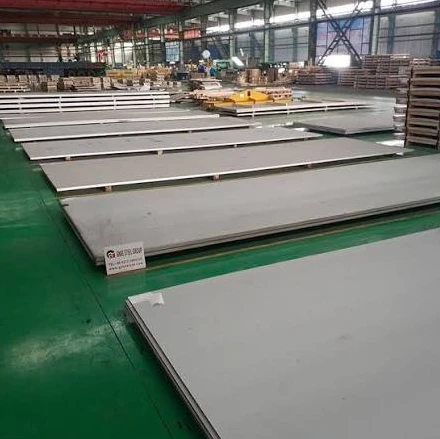
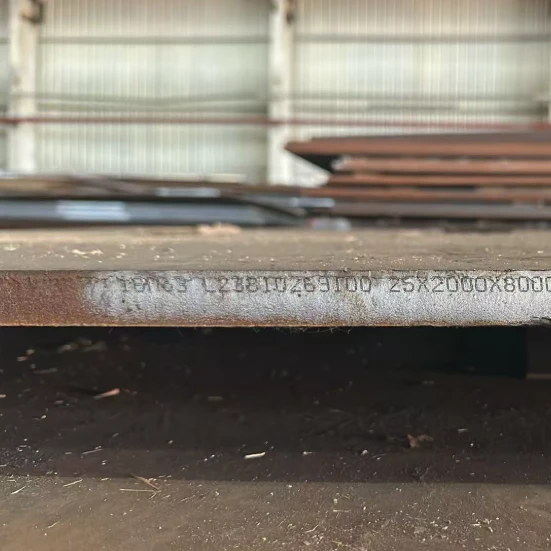
What Is 16Mo3 Pressure Vessel Steel Plate?
16Mo3 pressure vessel steel plate, material number 1.5415, is a molybdenum-alloyed steel specified in EN 10028-2 for pressure equipment with elevated-temperature properties.
One of its most important characteristics is its 0.25–0.35% molybdenum content. For plate thickness ≤16 mm, 16Mo3 has a minimum yield strength of 275 MPa, tensile strength of 440–590 MPa, and minimum elongation of 24% according to the referenced EN 10028-2 / EN 10273 material data.
16Mo3 also has specified minimum 0.2% proof-strength values at elevated temperatures: 233 MPa at 200°C, 194 MPa at 300°C, 159 MPa at 400°C and 141 MPa at 500°C for thickness ≤16 mm.
These properties make EN 10028-2 16Mo3 steel plate relevant for pressure vessels, boilers, heat exchangers and other pressure-retaining equipment where elevated-temperature material properties must be considered.
What Is P265GH Pressure Vessel Steel Plate?
P265GH, material number 1.0425, is also specified under EN 10028-2 for pressure equipment. Unlike 16Mo3, P265GH is a non-alloy quality steel.
For thickness ≤16 mm, P265GH has a minimum yield strength of 265 MPa, tensile strength of 410–530 MPa, and minimum elongation of 23% in the referenced material data.
Its specified minimum 0.2% proof strength is 205 MPa at 200°C, 173 MPa at 300°C and 150 MPa at 400°C for ≤16 mm thickness.
P265GH vs16Mo3 Chemical Composition (%)
| Element | 16Mo3 | P265GH |
|---|---|---|
| Carbon (C) | 0.12–0.20 | ≤0.20 |
| Silicon (Si) | ≤0.35 | ≤0.40 |
| Manganese (Mn) | 0.40–0.90 | 0.50–1.40 |
| Phosphorus (P) | ≤0.025 | ≤0.025 |
| Sulfur (S) | ≤0.010 | ≤0.015 |
| Nickel (Ni) | ≤0.30 | ≤0.30 |
| Chromium (Cr) | ≤0.30 | ≤0.30 |
| Copper (Cu) | ≤0.30 | ≤0.30 |
| Molybdenum (Mo) | 0.25–0.35 | ≤0.08 |
| Nitrogen (N) | ≤0.012 | ≤0.012 |
P265GH vs16Mo3 Mechanical Properties
For the same ≤16 mm thickness range, the differences can be directly quantified.
| Property | 16Mo3 | P265GH |
|---|---|---|
| Minimum Yield Strength ReH | 275 MPa | 265 MPa |
| Tensile Strength Rm | 440–590 MPa | 410–530 MPa |
| Minimum Elongation A | 24% | 23% |
| Impact Energy at +20°C | 40 J | 47 J |
For thickness >16 mm and ≤40 mm, the specified minimum yield strengths are 270 MPa for 16Mo3 and 255 MPa for P265GH.
This means 16Mo3 does not have the higher value in every single mechanical-property category. For example, P265GH has a higher specified +20°C impact-energy value in the referenced data.
For pressure-equipment material selection, the important point is the complete combination of chemical composition, thickness-dependent strength and elevated-temperature properties.
16Mo3 vs P265GH: High-Temperature Strength
The elevated-temperature comparison is particularly useful when choosing steel for pressure vessels, boilers and heat exchangers.
Minimum 0.2% Proof Strength at Elevated Temperature - Thickness ≤16 mm
| Temperature | 16Mo3 | P265GH | Difference |
|---|---|---|---|
| 50°C | 273 MPa | 256 MPa | +17 MPa |
| 100°C | 264 MPa | 241 MPa | +23 MPa |
| 150°C | 250 MPa | 223 MPa | +27 MPa |
| 200°C | 233 MPa | 205 MPa | +28 MPa |
| 250°C | 213 MPa | 188 MPa | +25 MPa |
| 300°C | 194 MPa | 173 MPa | +21 MPa |
| 350°C | 175 MPa | 160 MPa | +15 MPa |
| 400°C | 159 MPa | 150 MPa | +9 MPa |
| 450°C | 147 MPa | - | - |
| 500°C | 141 MPa | - | - |
- At 200°C, 16Mo3 reaches 233 MPa compared with 205 MPa for P265GH-a difference of 28 MPa.
- At 300°C, the values are 194 MPa and 173 MPa, respectively, a difference of 21 MPa.
- At 400°C, the gap narrows to 159 MPa versus 150 MPa.
The referenced data also provide specified values for 16Mo3 at 450°C (147 MPa) and 500°C (141 MPa).
Can P265GH Replace 16Mo3?
P265GH should not automatically replace 16Mo3 pressure vessel steel plate simply because both grades are specified under EN 10028-2.
Their Mo contents are different:
16Mo3: 0.25–0.35%
P265GH: ≤0.08%
Their elevated-temperature properties are also different. At 300°C and ≤16 mm thickness, for example, the specified minimum 0.2% proof strengths are 194 MPa for 16Mo3 and 173 MPa for P265GH.
If the vessel drawing or project specification explicitly requires 16Mo3 / 1.5415, changing to P265GH should be subject to engineering review and approval according to the applicable design requirements.
P265GH vs. 16Mo3: How to Choose?
For ordinary comparison, P265GH provides a non-alloy EN 10028-2 pressure-equipment steel option with specified elevated-temperature properties.
16Mo3 should be considered when the project specification requires a molybdenum-alloyed pressure vessel steel and its corresponding elevated-temperature property profile.
For example, if the design requires material-property verification at 300°C, the ≤16 mm values are:
16Mo3: 194 MPa
P265GH: 173 MPa
If the specified material is already 16Mo3 pressure vessel steel plate, buyers should focus on verifying the correct grade, thickness, delivery condition, MTC and project-specific inspection requirements rather than selecting an alternative grade solely by room-temperature yield strength.
What to Check When Buying EN 10028-2 16Mo3 Steel Plate
When purchasing EN 10028-2 16Mo3 steel plate for pressure vessel or boiler fabrication, buyers should verify more than the grade name and plate dimensions.
The material specification should clearly identify 16Mo3 / 1.5415, the required plate thickness, width, length, quantity and delivery condition. Material certification and additional inspection requirements should also be confirmed before production.
For example, a complete inquiry can be written as:
Material: 16Mo3 / 1.5415
Standard: EN 10028-2
Dimensions: 20 × 2000 × 6000 mm
Quantity: 50 plates
Inspection Certificate: EN 10204 3.1
Using a nominal steel density of 7,850 kg/m³, one 20 × 2000 × 6000 mm plate has a theoretical weight of approximately 1,884 kg. Fifty plates correspond to approximately 94.20 metric tons of theoretical weight.
For pressure-equipment projects, buyers should also check the actual chemical composition and mechanical properties shown on the MTC. For 16Mo3, Mo should meet the specified 0.25–0.35% range, while the required yield and tensile properties should be checked against the actual plate thickness.
If UT, impact testing, EN 10204 3.2 certification or third-party inspection is required, these requirements should be stated in the RFQ rather than added after production.

Send Your 16Mo3 Specification & Get a Quote
Gnee supplies 16Mo3 pressure vessel steel plate for international pressure vessel, boiler and industrial equipment projects. Send us your material specification or BOM with dimensions, quantity, inspection requirements and destination port to obtain a project-based quotation.