


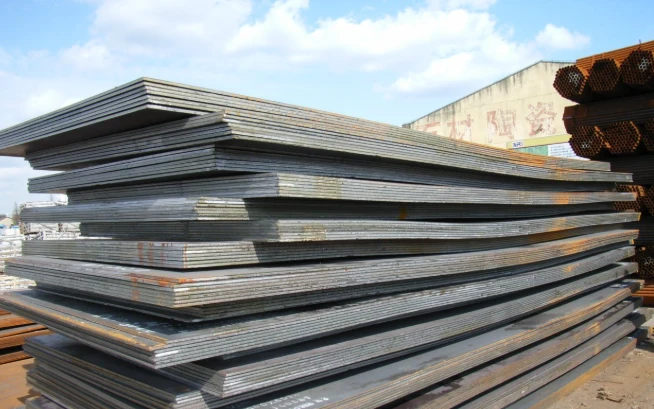
S690QL is a high-strength, quenched and tempered structural steel. It is renowned for its impressive tensile strength and toughness, making it suitable for heavy-duty applications. The "S" stands for structural steel, "690" represents the minimum yield strength in megapascals (MPa), and "QL" indicates the material is of high quality, with excellent low-temperature toughness.
S690QL - Chemical Composition
| Element | Percentage % | Element | Percentage % |
| C | 0.20 | Cu | 0.50 |
| Si | 0.80 | Mo | 0.70 |
| Mn | 1.70 | Nb* | 0.06 |
| P | 0.025 | Ni | 2.0 |
| S | 0.015 | Ti* | 0.05 |
| N | 0.015 | V* | 0.12 |
| B | 0.0050 | Zr* | 0.15 |
| Cr | 1.50 |
S690QL - Mechanical Properties
| Designation | Mechanical Properties (ambient temperature) | |||||||
| Steel Name | Steel Number | Min. Yield Strength Reh MPa | Tensile Strength Rm MPa | Min. % elongation after fracture | ||||
| Nominal thickness (mm) | Nominal thickness (mm) | |||||||
| ≥3 ≤50 | ≥50 ≤100 | ≥100 ≤150 | ≥3 ≤50 | ≥50 ≤100 | ≥100 ≤150 | |||
| S690QL | 1.8931 | 690 | 650 | 630 | 770/940 | 760/930 | 710/900 | 14 |
Applications
Construction and Infrastructure
In the construction industry, S690QL is used for building structures that require high load-bearing capacity and resilience, such as bridges, high-rise buildings, and stadiums. Its ability to withstand heavy loads without compromising structural integrity makes it an invaluable material for infrastructure projects.
Heavy Machinery and Equipment
The manufacturing of heavy machinery, including cranes, earth-moving equipment, and mining machinery, benefits from the high strength and durability of S690QL. It ensures that these machines can operate under extreme conditions and carry heavy loads efficiently.
Transportation and Automotive Industry
In the transportation sector, S690QL is used to produce components for heavy-duty trucks, trailers, and other vehicles that require enhanced strength and durability. Its use leads to safer, more reliable vehicles capable of handling demanding tasks.
If you want to learn more about (S690QL)GNEE's products, you can send an email to beam@gneesteelgroup.com. We are more than happy to assist you.
What are the key mechanical properties of S690QL?
S690QL is a quenched and tempered high-strength structural steel with a minimum yield strength of 690 MPa and good toughness, typically achieved through controlled rolling and heat treatment.
How does S690QL compare to S355JR in terms of strength and application scope?
S690QL has significantly higher yield and tensile strength than S355JR, making it suitable for weight‑saving structures such as crane booms and offshore platforms, whereas S355JR is used in general construction.
What is the typical heat treatment process for S690QL?
S690QL is usually produced by quenching followed by tempering, which refines the microstructure and balances high strength with adequate toughness.
How does the weldability of S690QL compare to S460NL?
S690QL has higher hardenability and requires more stringent preheating and interpass temperature control than S460NL to avoid cold cracking, especially in thick sections.
What are the common applications of S690QL?
S690QL is widely used in heavy‑duty applications such as mobile cranes, hydraulic supports, mining equipment, and large‑span steel structures where high strength and reduced weight are critical.
How does the toughness of S690QL compare to S690Q?
The "L" in S690QL indicates improved low-temperature toughness compared to S690Q, with lower ductile‑to‑brittle transition temperatures and better impact performance at subzero conditions.
What machining considerations apply to S690QL?
Due to its high strength, S690QL requires harder tool materials, lower cutting speeds, and effective cooling to reduce tool wear and maintain dimensional accuracy.
How does the fatigue performance of S690QL compare to conventional quenched and tempered carbon steels?
S690QL generally offers better fatigue resistance due to its higher strength and refined microstructure, but stress concentrations and weld quality become more critical factors in fatigue life.
What corrosion protection measures are recommended for S690QL?
S690QL has no inherent corrosion resistance, so protective coatings such as paint, zinc plating, or weathering steel treatments are often applied for outdoor or aggressive environments.
How does the cost‑effectiveness of S690QL compare to using thicker sections of lower‑strength steel?
Although S690QL has a higher material cost, its high strength allows for thinner sections, often leading to overall cost savings in fabrication, transportation, and assembly for weight‑sensitive structures.