


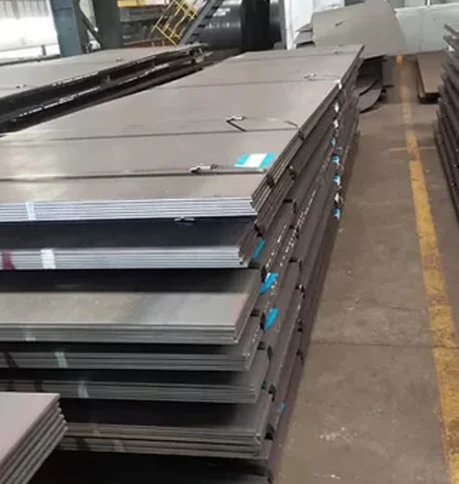
ASTM A537 Class 2 is a specification for carbon‑manganese‑silicon pressure vessel plates used in welded boilers and pressure vessels requiring improved low‑temperature toughness. Supplied quenched and tempered, it offers higher strength and toughness than standard carbon steels, along with good weldability and reliable performance under moderate to elevated pressures and temperatures. Common applications include oil, gas, petrochemical, and power generation equipment. The Class designation indicates specific strength and impact resistance requirements to avoid brittle fracture.
Chemical Composition:
| Steel Grade | Thickness (mm) |
ASTM A537 Chemical composition %. | ||||||||
|---|---|---|---|---|---|---|---|---|---|---|
| C. max |
Si | Mn | P. max |
S. max |
Cu. max |
Ni. max |
Cr. max |
Mo. max |
||
| A537 Class2 | ≤40mm | 0.24 | 0.15-0.50 | 0.70-1.35 | 0.035 | 0.035 | 0.35 | 0.25 | 0.25 | 0.08 |
| >40mm | 1.00-1.60 | |||||||||
Mechanical Property:
| Steel Grade | Thickness | Yield | Tensile | Elongation |
|---|---|---|---|---|
| A537 CLASS2 | 8-65 | 415 | 550-690 | 22 |
| 65-100 | 380 | 515-655 | 22 | |
| 100-150 | 315 | 485-620 | 20 |
Key Applications
Oil & Gas: Used in offshore platforms, large storage tanks built to API standards, long‑distance pipelines, and various refining equipment. It is chosen for its ability to withstand high pressure, temperature fluctuations, and harsh offshore or coastal environments, while maintaining good toughness at lower temperatures to prevent brittle failure.
Petrochemical: Applied in reactors, chemical processing vessels, and distillation columns where materials must handle cyclic loading, high internal pressures, and exposure to various process fluids. Its combination of strength, toughness, and weldability makes it suitable for large, complex welded structures typical in petrochemical plants.
Power Generation: Utilized in boilers, heat exchangers, and pressure vessels in thermal and combined‑cycle power plants. The steel provides reliable performance under sustained high temperatures and pressures, along with resistance to thermal fatigue and creep, ensuring long‑term structural integrity.
Chemical Industry: Used for equipment operating in corrosive and high‑stress environments, such as process tanks, pressure vessels, and specialty reactors. While not inherently corrosion‑resistant, its strength and toughness make it a base material often used with linings or coatings to handle aggressive chemicals.
Cryogenic: Employed in cryogenic storage tanks and related equipment where low‑temperature toughness is critical. Its ability to resist brittle fracture at very low temperatures ensures safe containment of liquefied gases and other cryogenic media.
Why Choose Us :
You can get the perfect material according to your requirement at the least possible price.
We also offer Reworks, FOB, CFR, CIF, and door to door delivery prices. We suggest you to do deal for shipping which will be quite economical.
The materials we provide are completely verifiable, right from raw material test certificate to the final dimensional statement.(Reports will show on requirement)
We guarantee to give a response within 24hours(usually in the same hour)
You can get stock alternatives, mill deliveries with minimizing manufacturing time.
We are fully dedicated to our customers. If it will not possible to meet your requirements after examining all options, we will not mislead you by making false promises which will create good customer relations.
If you have project requirements for ASTM A537 Class 2 , we welcome your inquiry. GNEE maintains a large inventory of commonly used high strength steel grades for your selection.For detailed mechanical properties, chemical composition, and technical data, as well as free samples, please contact our factory immediately. We offer competitive prices, stable quality, and professional service. Email:beam@gneesteelgroup.com.
What key properties does A537 Class 2 offer?
It provides good weldability, increased strength, and resistance to brittle fracture, especially at lower temperatures.
What are common applications of A537 Class 2?
It is commonly used for pressure vessels, boilers, heat exchangers, and process equipment in the oil, gas, petrochemical, and power generation industries.