


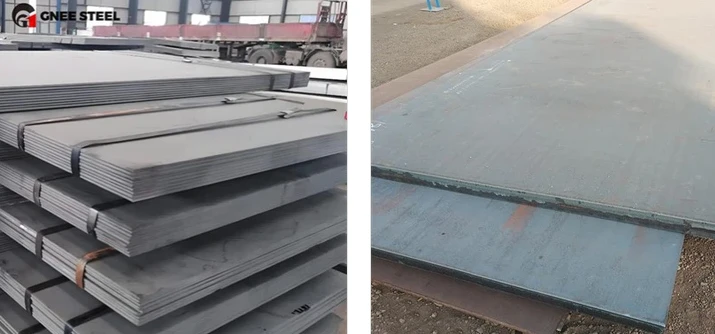
SA572 Grade 50 is a High-Strength Low-Alloy (HSLA) structural steel known for its excellent strength-to-weight ratio, good weldability, and improved atmospheric corrosion resistance, featuring a minimum yield strength of 50,000 psi (345 MPa) and used extensively in bridges, construction, and heavy equipment due to its durability and cost-effectiveness.
Key Characteristics:
Type: HSLA Steel (High-Strength Low-Alloy).
Strength: Minimum yield strength of 50 ksi (50,000 psi or 345 MPa) and tensile strength of 65 ksi (65,000 psi).
Alloying: Contains elements like columbium (niobium) and vanadium, giving it superior strength and corrosion resistance compared to plain carbon steels like A36.
Corrosion Resistance: Offers better resistance to atmospheric corrosion than standard carbon steels.
Weldability: Suitable for welded, riveted, or bolted structures, though its higher alloy content makes forming harder than A36.
Common Applications:
Construction: Structural beams, columns, and supports in buildings and bridges.
Equipment: Heavy machinery, truck frames, conveyors, and boom sections.
Infrastructure: Poles, liners, and anchoring systems.
Benefits:
Allows for lighter designs (smaller cross-sections) while maintaining load capacity, saving material.
Durable and cost-efficient for demanding structural uses.
ASTM A572 Grade 50 Specifications
| Specification | ASTM A572 / ASME SA572 |
|---|---|
| Grade | Grade 50 (A572 Gr 50) |
| Thickness | 6mm to 150mm (as per availability) |
| Width | 1000mm to 4500mm (as per availability) |
| Length | 3000mm to 18000mm (as per availability) |
| Supply Condition | As Rolled, Normalized Rolled, Thermo-Mechanically Controlled Processed (TMCP), Quenched and Tempered (Q&T) |
| Relevant Standard | ASTM A6/A6M (General Requirements for Rolled Structural Steel) |
ASTM A572 Grade 50 Chemical Composition
| Element | Max % (for plates up to 1.5″ or 40mm thick) |
|---|---|
| Carbon (C) | 0.23 |
| Manganese (Mn) | 1.35 |
| Phosphorus (P) | 0.04 |
| Sulfur (S) | 0.05 |
| Silicon (Si) | 0.40 |
| Columbium (Nb) | 0.005 – 0.05 |
| Vanadium (V) | 0.01 – 0.15 |
ASTM A572 Grade 50 Mechanical Properties
| Property | Value |
|---|---|
| Tensile Strength | 65 ksi min (450 MPa min) |
| Yield Strength | 50 ksi min (345 MPa min) |
| Elongation (in 8 in) | 18% min |
| Elongation (in 2 in) | 21% min |
ASTM A572 Grade 50 Equivalent Grades & Standards
| Standard | Grade / Designation | Notes |
|---|---|---|
| ASTM | A572 Grade 50 | Primary Standard |
| ASME | SA572 Grade 50 | Similar to ASTM for pressure vessel applications |
| EN 10025-2 | S355JR / S355J0 / S355J2 | Often considered a European equivalent, but properties and chemistries can vary. Verify specific needs. |
| Indian Standard (IS) | IS 2062 E350 (A, B, C, BR, B0) | A common ASTM A572 Grade 50 equivalent Indian Standard. Grade variations (A, B, C, BR, B0) denote different quality levels regarding impact testing and forming. |
| JIS G3106 | SM490A / SM490B / SM490YB | Japanese standard, similar strength levels. |
| DIN 17100 | St 52-3 | Older German standard, often cross-referenced with S355. |
ASTM A572 Grade 50 Sheet & Plate Thickness Tolerance
At Corten Steel Plate, we ensure our ASTM A572 Grade 50 steel plates and sheets adhere to strict dimensional tolerances as specified by the governing ASTM A6/A6M standards.
| Nominal Thickness (Inches) | Width: 132-143″ | Width: 48-59″ | Width: Thru 47″ | Width: 60-71″ | Width: 84-95″ | Width: 72-83″ | Width: 108-119″ | Width: 96-107″ | Width: 120-131″ | Width: 144-167″ |
|---|---|---|---|---|---|---|---|---|---|---|
| – under 1/4 | 0.04 | 0.03 | 0.03 | 0.03 | 0.03 | 0.03 | 0.03 | 0.03 | 0.03 | – |
| 5/16 – under 3/8 | 0.04 | 0.03 | 0.03 | 0.03 | 0.03 | 0.03 | 0.03 | 0.03 | 0.04 | 0.05 |
| 1 – under 2 | 0.10 | 0.06 | 0.06 | 0.06 | 0.06 | 0.06 | 0.08 | 0.07 | 0.10 | 0.11 |
| 3/8 – under 5/8 | 0.05 | 0.03 | 0.03 | 0.03 | 0.03 | 0.03 | 0.04 | 0.03 | 0.04 | 0.06 |
| 1/4 – under 5/16 | 0.04 | 0.03 | 0.03 | 0.03 | 0.03 | 0.03 | 0.03 | 0.03 | 0.04 | – |
| 3/4 – under 1 | 0.06 | 0.03 | 0.03 | 0.03 | 0.04 | 0.03 | 0.05 | 0.04 | 0.05 | 0.07 |
| 3 – under 4 | 0.14 | 0.11 | 0.11 | 0.11 | 0.11 | 0.11 | 0.14 | 0.13 | 0.14 | 0.15 |
| 2 – under 3 | 0.14 | 0.09 | 0.09 | 0.09 | 0.10 | 0.10 | 0.12 | 0.11 | 0.13 | 0.15 |
| 4 – under 6 | 0.15 | 0.15 | 0.15 | 0.15 | 0.15 | 0.15 | 0.15 | 0.15 | 0.15 | 0.20 |
1. What is SA572 Grade 50 steel?
SA572 Grade 50 is a high-strength low-alloy (HSLA) structural steel specified by ASTM, with a minimum yield strength of 50 ksi (345 MPa), offering better strength-to-weight ratio than standard carbon steel like A36.
2. What is the yield strength of SA572 Grade 50?
The minimum yield strength of SA572 Grade 50 is 50,000 psi (345 MPa), which applies to material thicknesses up to 4 inches (100 mm). For thicker plates, the minimum yield strength decreases to 46 ksi (315 MPa).
3. Is SA572 Grade 50 weldable?
Yes, SA572 Grade 50 has good weldability. It requires standard low-hydrogen welding practices and may need preheating for thicker sections or in cold weather to prevent hydrogen-induced cracking and maintain properties in the heat-affected zone.
4. What is the difference between A572 and A992 steel?
A572 Gr. 50 is a material specification for plates, bars, and shapes. A992 is a newer specification specifically for wide-flange structural shapes (W-beams), with a maximum yield strength (65 ksi) and a mandatory Charpy toughness requirement, making it the preferred choice for modern building frames.
5. What is SA572 Grade 50 equivalent to in Europe?
The closest European equivalent is S355JR/J0/J2 (EN 10025-2), with a nominal yield strength of 355 MPa. However, the mandatory impact toughness of the S355 sub-grade (e.g., J2 for -20°C) must be matched for a true equivalent.
6. Where is SA572 Grade 50 commonly used?
It is widely used in bridges, building frames, transmission towers, construction equipment, and other structural applications where higher strength and weight savings are advantageous over A36 steel.
7. What is the chemical composition of SA572 Grade 50?
Its chemistry includes limits for Carbon (max 0.23%), Manganese (1.35% max), Phosphorus (0.04% max), Sulfur (0.05% max), and may contain micro-alloys like Columbium (Nb) or Vanadium (V) for strength.
8. Does SA572 Grade 50 have impact toughness requirements?
Not in the base specification. Impact toughness (Charpy testing) is only required if specified by the purchaser using supplementary requirements, unlike many European grades where it is mandatory.
9. Can SA572 Grade 50 be galvanized?
Yes, it is suitable for hot-dip galvanizing. Proper steel chemistry (especially silicon and phosphorus content) and process control are necessary to ensure a uniform, adherent coating.
10. What is the difference between SA572 and A572 Grade 50?
There is no technical difference. A572 is the ASTM standard. SA572 is the identical specification adopted by the ASME Boiler and Pressure Vessel Code for use in pressure vessel and boiler construction, requiring ASME-compliant certification.
Full specification and details are available on request. The above information is provided for guidance purposes only. For specific design requirements please contact our technical sales staff.
