


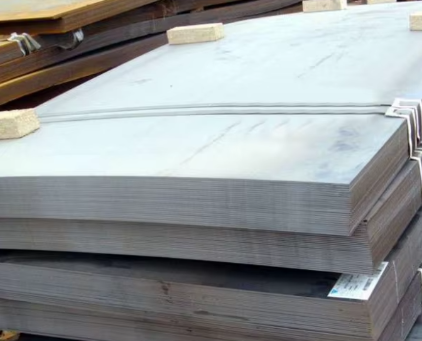
S690QL1 is a high-strength quenched and tempered structural steel grade specified in the European standard EN 10025-6, known for its excellent combination of high yield and tensile strength, good toughness, and weldability, making it suitable for heavy-duty load-bearing structures such as large cranes, bridges, offshore platforms, and other applications requiring reliable performance under demanding mechanical conditions.
Chemical Composition for S690QL1 Steel Plate
|
C |
Si |
Mn |
Ni |
P |
S |
Cr |
Mo |
V |
N |
Nb |
Ti |
Cu |
Zr |
B |
CEV |
|
max 0.2 |
max 0.8 |
max 1.7 |
max 2 |
max 0.02 |
max 0.01 |
max 1.5 |
max 0.7 |
max 0.12 |
max 0.015 |
max 0.06 |
max 0.05 |
max 0.5 |
max 0.15 |
max 0.005 |
max 0.83 |
Mechanical Properties for S690QL1 Steel Plate
|
Plate thickness |
Re |
Rm |
A% |
|
≤ 50 |
690 |
770 – 940 |
14 |
|
> 50 ≤ 100 |
650 |
760 – 930 |
14 |
|
> 100 |
630 |
710 – 900 |
14 |
Applications
Lifting & Construction:
Crane booms, jibs, lifting arms, heavy-duty frames, and high-rise building components.
Heavy Machinery:
Buckets, bulldozer blades, loaders, and frames for mining equipment.
Transportation:
Trailer frames, transport platforms, and special-purpose vehicles (improving payload/fuel efficiency).
Defense:
Military vehicles, naval ship structures, and robust components needing high strength-to-weight.
Infrastructure:
Bridges (longer spans, fewer supports) and offshore platforms.
Advantages
High Strength:
Minimum yield strength of 690 MPa for excellent load-bearing capacity.
Weight Efficiency:
High strength-to-weight ratio allows thinner sections, reducing material and transport costs.
Toughness:
Excellent impact resistance, even at low temperatures, for safe operation in harsh environments.
Weldability:
Good fabrication properties for complex, strong welded structures.
Durability:
Enhanced fatigue resistance and resistance to cracking/dent, reducing maintenance.
Versatility:
Formable into various shapes for diverse uses.
Cost-Effectiveness:
Lighter weight reduces material and transport expenses; durable for long-term value.
Sustainability:
Supports lighter, more energy-efficient designs, lowering carbon footprint.
If you have project requirements for S690QL1, we welcome your inquiry. GNEE maintains a large inventory of commonly used high strength steel grades for your selection.For detailed mechanical properties, chemical composition, and technical data, as well as free samples, please contact our factory immediately. We offer competitive prices, stable quality, and professional service. Email:beam@gneesteelgroup.com.
What is S690QL1?
S690QL1 is a high-strength quenched and tempered structural steel grade specified in EN 10025-6, offering high yield strength, good toughness, and weldability for heavy-duty applications.
What is the typical application of S690QL1?
It is commonly used in large cranes, heavy machinery, offshore structures, and other load-bearing components requiring high strength and reliable performance.
What is the difference between S690QL1 and S690Q?
S690QL1 has stricter toughness requirements at lower temperatures and often includes additional controls on impurities and microstructure compared to the standard S690Q grade.
How does S690QL1 compare to S690QL2?
S690QL1 and S690QL2 are both high-strength quenched and tempered steels, but S690QL2 typically offers improved toughness and may have different heat treatment or chemical composition limits.
How does S690QL1 differ from S460ML?
S690QL1 has significantly higher strength than S460ML, while S460ML provides better weldability and formability for less demanding structural applications.
What is the difference between S690QL1 and ASTM A514?
S690QL1 is a European high-strength structural steel with specified toughness and weldability, whereas ASTM A514 is a North American quenched and tempered alloy steel plate with similar strength levels but different chemical and mechanical property requirements.
What heat treatment is applied to S690QL1?
S690QL1 is produced by quenching and tempering to achieve a fine-grained microstructure that balances high strength with good toughness and ductility.
What is the toughness level of S690QL1?
S690QL1 exhibits good toughness at low temperatures, making it suitable for use in cold environments where impact resistance is critical.
Is S690QL1 weldable?
Yes, S690QL1 is considered weldable, but proper preheating and interpass temperature control are necessary to avoid cracking and ensure good joint quality.
What factors affect the properties of S690QL1?
The properties of S690QL1 are influenced by chemical composition, heat treatment parameters, plate thickness, and manufacturing processes, which together determine its strength, toughness, and weldability.