


SA515 Grade 70 is a carbon steel plate specification for pressure vessels, formulated by ASME. It has good tensile strength (485-655 MPa) and weldability, widely used in moderate-temperature pressure vessel applications like boilers and storage tanks.
Mechnical property for SA515 Grade 70 boiler steel plate
| Yield strength (Mpa) | Tensile strength (Mpa) | Elongation in ≥,% | |
| 260 | 485-620 | 200mm | 50mm |
| 17 | 21 | ||
Chemical composition for SA515 Grade 70 boiler steel plate (Product Analysis Max%)
| Main chemical elements composition of SA515 Grade 70 | |||||
| Thickness(mm) | C | Si | Mn | P | S |
| T≤25 | 0.24 | 0.13-0.45 | 0.98 | 0.025 | 0.025 |
| 25<T≤50 | 0.27 | ||||
| 50<T≤100 | 0.29 | ||||
| T>100 | 0.31 | ||||
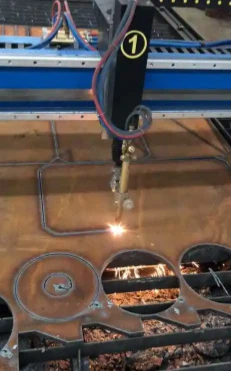 SA 515 Grade 70 Processing Characteristics
Excellent Weldability: Low carbon equivalent (≤0.42) minimizes hydrogen cracking risks during welding. It adapts to various welding methods (manual arc, gas metal arc, submerged arc) without strict pre-heating requirements (only 80-150℃ for thick plates), ensuring stable weld joints with good toughness and strength.
Good Formability: The material has moderate hardness and high ductility, enabling smooth cold and hot forming. Cold forming is feasible for thin plates, while hot forming (200-350℃) reduces resistance for thick plates, avoiding deformation and cracking. Post-forming stress relief is simple and effective.
Easy Cutting Performance: It can be processed by plasma, oxy-fuel, or mechanical cutting. No excessive pre-heating is needed for thin to medium plates, ensuring high cutting efficiency and smooth edges. Thick plates only require low-temperature pre-heating to prevent edge brittleness.
Stable Heat Treatment Response: It responds well to normalization and stress relief annealing. Normalization refines grains uniformly, enhancing strength and toughness. Stress relief annealing effectively eliminates residual stress from processing, improving dimensional stability of finished components.
Compatible Surface Treatment: It easily adapts to sandblasting, pickling, and coating processes. Oxide scales and impurities can be removed efficiently, ensuring good adhesion of anti-corrosion coatings and extending service life in harsh environments.

Core Industrial Applications
Boiler Manufacturing: Used extensively for constructing boiler shells, steam drums, mud drums, and tubesheets due to its ability to withstand the extreme pressures and temperatures of combustion.
Pressure Vessels: Ideal for welded pressure vessels that store and transport liquids or gases under high pressure, specifically in environments where temperatures range between 450°C and 550°C.
Heat Transfer Equipment: Commonly fabricated into heat exchangers, condensers, and calorifiers for thermal power plants and chemical processing.
Why SA515 Gr 70?
The coarse grain structure of SA515 Grade 70 is a deliberate manufacturing choice that provides better creep resistance at elevated temperatures compared to fine-grained steels like SA516. This makes it the preferred choice for high-heat steam piping and stationary pressure parts.
For more details about GNEE's steel products, contact us at beam@gneesteelgroup.com. We look forward to working with you.
Is SA515 Grade 70 suitable for high-pressure applications?
Yes, it is suitable for moderate to high-pressure applications. Its tensile and yield strength meet ASME requirements for pressure vessels, making it ideal for systems with operating pressures up to several megapascals.
What is the specification code for SA515 Grade 70 in Europe?
The European equivalent specification for SA515 Grade 70 is EN 10028-2 P265GH. Both are carbon steel plates for pressure vessels, with similar chemical compositions and mechanical properties, but comply with different regional standards.
Can SA515 Grade 70 be bent or formed?
Yes, SA515 Grade 70 has good formability. It can be bent, rolled, and shaped into various pressure vessel components (e.g., cylinders, heads) using standard forming processes, provided proper temperature control is maintained.
What is the impact toughness of SA515 Grade 70?
The impact toughness (Charpy V-notch) of SA515 Grade 70 is typically ≥27 J at room temperature. This ensures the material can absorb energy without brittle fracture under sudden impact loads, critical for safety.
What are the storage requirements for SA515 Grade 70 plates?
They should be stored in a dry, well-ventilated area to prevent rust. Plates should be stacked on wooden supports, separated from moisture and corrosive substances, and covered with waterproof materials if stored outdoors.
What is the maximum carbon content allowed in SA515 Grade 70?
The maximum carbon content allowed in SA515 Grade 70 is 0.31%, as per ASME SA515 standard. Controlling carbon content ensures good weldability and toughness, avoiding excessive hardness that may cause brittleness.
Can SA515 Grade 70 be used in steam boiler applications?
Yes, it is widely used in steam boiler applications, such as boiler drums and steam headers. It can withstand the moderate temperature and pressure of steam systems, meeting the safety requirements of boiler operations.
What is the difference between SA515 Grade 60 and Grade 70?
The main difference is tensile strength: Grade 60 has a min tensile strength of 415 MPa, while Grade 70 is 485 MPa. Grade 70 also has higher yield strength, making it suitable for higher-pressure applications than Grade 60.
Is SA515 Grade 70 available in coil form?
SA515 Grade 70 is mainly supplied as plates, but it can also be produced in coil form for specific applications. Coils are typically used for manufacturing small-diameter pressure vessels or components requiring continuous processing.
What quality certificates are provided for SA515 Grade 70?
Common quality certificates include EN 10204 3.1 or 3.2, which verify chemical composition, mechanical properties, and non-destructive testing results. These certificates ensure the material meets ASME SA515 and project requirements.