


The HEB260 S355JR H-beam has specific dimensions of 260 mm in height, 260 mm in width, 10 mm web thickness, and 17.5 mm flange thickness. In the field of steel structure engineering, structural steel is a core material for building frameworks.

HEB260 S355JR H-beam
Among them, European standard H-beams are widely used in international projects due to their standardized dimensions and mechanical properties.
This is a typical wide-flange H-beam, belonging to the "HEB" series within the European standard system. The series is characterized by flange widths that are similar to or equal to the section height, providing excellent bending resistance and stability along both principal axes (X and Y).
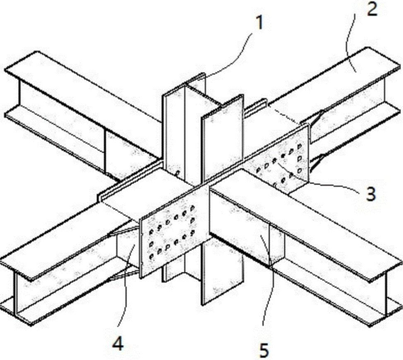
The numerical designation of the profile represents, in order, the section height, flange width, web thickness, and flange thickness, all in millimeters.
S355JR H Beam is a European standard non-alloy structural steel. "S" stands for structural steel, "355" indicates a minimum yield strength of 355 MPa, "J" specifies an impact energy requirement of 27 J at 0°C, and "R" denotes impact performance at room temperature. This combination of material and section ensures reliable performance of the H-beam under both static loads and dynamic stresses.
Contact now to get the S355JR H Beam Quote
Basic Dimensions of HEB260 S355JR H-Beam
| Parameter | Value | Unit |
|---|---|---|
| Section Height (h) | 260 | mm |
| Flange Width (b) | 260 | mm |
| Web Thickness (tw) | 10 | mm |
| Flange Thickness (tf) | 17.5 | mm |
| Root Radius (r) | 14 | mm |
| Weight per Meter | ~57.1 | kg/m |
Mechanical Properties of HEB260 S355JR H-Beam
| Property | Value | Test Condition / Note |
|---|---|---|
| Yield Strength (ReH) | ≥355 | MPa, room temperature |
| Tensile Strength (Rm) | 470–630 | MPa, room temperature |
| Elongation (A) | ≥20 | % |
| Impact Energy (KV) | ≥27 | J, -20°C |
| Hardness | ≤180 | HB (Brinell) |
| Density | 7.85 | g/cm³ |
Sectional Properties of HEB260 S355JR H-Beam
| Property | Value | Unit | Note |
|---|---|---|---|
| Cross-Sectional Area (A) | 70.8 | cm² | Approximate |
| Moment of Inertia about Strong Axis (Ix) | 9190 | cm⁴ | Bending about Y-axis |
| Moment of Inertia about Weak Axis (Iy) | 3590 | cm⁴ | Bending about X-axis |
| Section Modulus (Wx) | 707 | cm³ | Strong axis |
| Section Modulus (Wy) | 276 | cm³ | Weak axis |
| Radius of Gyration (rx) | 11.4 | cm | Strong axis |
| Radius of Gyration (ry) | 7.1 | cm | Weak axis |
Why is HEB260 S355JR H Beam chosen in the project?
The HEB260 S355JR H-beam has a well-balanced cross-section, and its wide-flange design provides a large moment of inertia and section modulus. This means that under vertical loads (such as floor weights) or horizontal loads (such as wind), HEB260 S355JR H-beams can effectively resist bending deformation and prevent excessive structural deflection.
Compared with narrow-flange H-beams, HEB260 S355JR H-beams exhibit significantly improved stability along the weak axis (i.e., the axis perpendicular to the flange width).
Therefore, HEB260 S355JR H-beams are often used as columns requiring minimal lateral bracing or with wide bracing spacing. They are also suitable for beams that require stiffness in both directions.
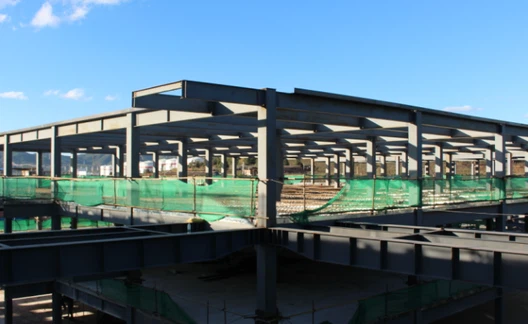
The yield strength of 355 MPa ensures that S355JR H-profile steel undergoes elastic deformation up to this stress level, transitioning into plastic deformation beyond it. This behavior provides a clear structural safety margin.

The impact energy indicators ("J" and "R") ensure that S355JR H-profiles possess sufficient toughness. In low-temperature environments or under sudden impacts, the steel can absorb energy without brittle fracture. This property is crucial for the safety of building structures, particularly in areas that may be subjected to seismic loads or accidental impacts.
HEB260 S355JR H-Beam Case
Columns in Industrial and Commercial Buildings: In our projects, such as factories, warehouses, or commercial buildings, HEB260 H-beams are commonly used as primary vertical load-bearing members, carrying axial loads and bending moments from the superstructure.

Main or Secondary Beams in Heavy-Duty Work Platforms: HEB260 S355JR H-profiles are also used in our industrial platform construction projects. In platforms that need to support heavy equipment or concentrated loads, their excellent bending resistance is fully utilized.
Auxiliary Components or Support Systems in Bridges: Certain secondary members or support systems in our bridge projects employ HEB260 S355JR H-profiles. While main girders may use larger profiles or composite sections, HEB260 beams are suitable for crossbeams, bracing, and other auxiliary elements.
Compression or Tension Members in Towers and Trusses: In some tower and truss projects, HEB260 S355JR H-profiles are used for compression or tension members. Their stable cross-sectional form makes them suitable for members subjected to combined axial forces and bending moments.
Contact now to get the S355JR H Beam Quote
What is the US equivalent of S355JR?
Common equivalents include: S235JR: Equivalent to ASTM A36. S275JR: Equivalent to ASTM A572 Grade 42. S355JR/J2: Equivalent to ASTM A572 Grade 50.
What is grade S355JR?
S355JR steel has a high strength-to-weight ratio, making it suitable for use in load-bearing structures such as bridges, buildings, and offshore structures. It has a minimum yield strength of 355 N/mm², making it one of the strongest steel grades available.
Is S355J2 better than S355JR?
The primary evolution within this trio is: Basic toughness at room temperature (S355JR) → Enhanced toughness for cold climates (S355J2) → Enhanced toughness PLUS improved properties for critical fabrication (S355J2+N). Key Metric: Charpy V-Notch Impact Energy ≥ 27 Joules at +20°C.
What is the difference between S275JR and S355JR?
As to S275JR VS S355JR, actually they are totally not same thing. S275JR is carbon steel, while S355JR is low alloy steel. Both carbon steel S275JR and S355JR low alloy steel are under EN10025-2 standard. The S355JR low alloy steel is higher steel grade than carbon steel S275JR.
What type of steel is S355JR?
Steel grade S355JR is used to manufacture hot-rolled flat and long products, which are subsequently used when producing steel building structures. Classification: Non-alloy structural steel. Products: Flat and long products, semi-finished products.