


 Q345R is a GB 713-standard pressure vessel steel plate, widely used for boilers, pressure vessels and other pressure-bearing equipment requiring good strength, toughness and weldability. In English technical documents, it is usually called "Q345R pressure vessel steel plate" (GB standard). As a China-specific grade, it has no direct equivalent in ASTM, EN and other international standards, but is often compared to ASTM A516 Grade 70 or EN 10028-2 P355GH in engineering.
Nomenclature and Standards
"Q" (Qu): Represents the yield strength.
"345": Indicates a minimum yield strength of 345 MPa (for plate thickness ≤16mm).
"R" (Rong): Signifies its designation for pressure vessels (Rongqi).
Historical Context: This grade was established by merging several older grades, including 16MnR, 16Mng, and 19Mng, to unify the standards for boiler and pressure vessel steel.
Q345R material chemical composition:
| Grade | C % | Si % | Mn % | Cu % | Ni % | Cr% | Mo % | V % | Ti % | Alt % | P % | S % | Nb |
| Q345R | 0.20 | 0.55 | 1.2-1.7 | 0.30 | 0.30 | 0.30 | 0.08 | 0.050 | 0.030 | 0.020 | 0.025 | 0.010 | 0.050 |
Q345R material mechnical property:
| Thickness (mm) | > 3 ≤ 16 | > 16 ≤ 36 | > 36 ≤ 60 | >60 ≤ 100 | >100 ≤ 150 | >150 |
| Yield strength (≥Mpa) | 345 | 325 | 315 | 305 | 285 | 265 |
| Tensile strength (Mpa) | 510-640 | 500-630 | 490-620 | 480-610 | 470-600 | |
Main Applications
Boiler Manufacturing:
Core components like boiler drums, water walls, superheater headers, and economizers. It adapts to high-temperature and high-pressure working environments of industrial boilers and power plant boilers (below 400℃, medium and low pressure levels).
Pressure Vessel Fabrication:
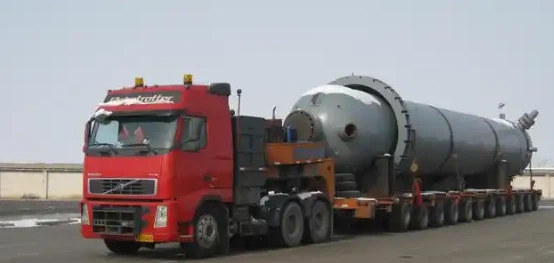
Widely used in petroleum, chemical, pharmaceutical, and food industries for vessels such as storage tanks (for oil, gas, chemicals), reaction vessels (for chemical synthesis reactions), heat exchangers (for fluid heat transfer), and separators (for material separation).
Petrochemical and Pipeline Equipment:
Low-pressure and medium-pressure pipelines, pipe fittings, and pressure-bearing supports in oil refining, chemical processing, and natural gas transmission systems, especially for medium-temperature and medium-pressure fluid transportation.
Other Industrial Fields:
Pressure-bearing structures in thermal power plants, nuclear power auxiliary equipment (non-core pressure parts), marine pressure vessels, and heavy machinery hydraulic tanks, meeting the strength and toughness requirements of pressure-bearing operations.
Application Conditions
Temperature Range:
Suitable for normal temperature to medium-high temperature environments, generally -20℃ to 400℃. It maintains stable mechanical properties within this range; above 400℃, its strength decreases significantly, and below -20℃, it may lose toughness (brittleness risk), so low-temperature modification is needed for cryogenic applications.
Pressure Requirement:
Designed for low-pressure to medium-pressure working conditions (usually ≤10 MPa). For high-pressure equipment (above 10 MPa), it needs to be matched with thicker plates or combined with other high-strength steels, and strict flaw detection and quality control are required.
Medium Compatibility:
Applicable to non-strongly corrosive media, such as water, steam, oil, natural gas, and weak acid/alkali solutions. In strong corrosive environments (e.g., concentrated acid, strong alkali, chloride-containing media), anti-corrosion treatment (coating, lining) or matching with corrosion-resistant alloys is necessary.
Fabrication and Inspection Conditions:
Must be processed by qualified welding methods (SMAW, GMAW, SAW, etc.) with strict welding procedure qualification; post-weld heat treatment (PWHT) is required for thick plates (above 12mm) to eliminate welding stress. Before use, non-destructive testing (UT, RT, MT) must be carried out to ensure no internal defects affecting pressure-bearing safety.
Standard Compliance:
Must meet GB 713 national standard requirements for chemical composition, mechanical properties, and flaw detection. It is not applicable to special working conditions such as ultra-high temperature, ultra-high pressure, strong corrosion, or radiation without special modification and certification.
 Processing Flow
Raw Material Preparation:
Select Q345R steel plates that meet GB 713 standards, check dimensions (thickness, width, length) and quality certificates to ensure compliance with processing requirements.
Cutting and Blanking:
Adopt flame cutting, plasma cutting or shearing to cut the steel plates into the required shape and size according to the design drawings, and remove burrs and sharp edges after cutting.
Forming Processing:
Use bending, rolling or pressing equipment to shape the blank into the desired structure (e.g., cylinder, header, curved plate) for pressure vessel and boiler components.
Welding Operation:
Perform welding via SMAW, GMAW or SAW. Conduct pre-welding preheating (60-150℃) and post-weld heat treatment (PWHT) for thick plates to eliminate stress and ensure weld quality.
Surface Treatment:
Remove welding spatter, rust and oil stains through grinding, pickling or shot blasting to improve surface cleanliness and corrosion resistance.
Inspection and Testing:
Carry out non-destructive testing (UT, RT, MT) on welds and base metal, and verify dimensional accuracy and appearance quality to confirm compliance with application standards.
Final Finishing and Delivery:
Perform final trimming, coating (if required) and packaging, then deliver qualified products after passing comprehensive inspection.
Contact us at beam@gneesteelgroup.com for pricing, technical support, or customized solutions. We are always ready to support your project.
Can Q345R steel be cold-formed? What precautions should be taken?
Q345R can be cold-formed, but it is necessary to control the forming speed and deformation amount to avoid excessive stress. After cold forming, stress relief annealing should be performed to restore toughness and eliminate residual stress.
What are the requirements for the surface quality of Q345R steel plates?
Q345R steel plate surface should be free of cracks, folds, delaminations, bubbles and other defects. Minor surface defects can be ground, but the grinding depth shall not exceed the allowable deviation of the plate thickness, ensuring structural integrity.
What are the delivery states of Q345R steel plates?
The common delivery states of Q345R are normalizing (N), annealing (A) or hot rolling (AR). Normalizing is the most common state, which ensures uniform structure and stable mechanical properties, meeting pressure vessel requirements.
What is the density of Q345R steel?
The density of Q345R steel is about 7.85 g/cm³, the same as ordinary carbon steel and most low-alloy steels. This density value is used for weight calculation in equipment design, transportation and installation.
How to judge the quality of Q345R steel plates?
Judge Q345R quality by checking chemical composition (via spectrum analysis), mechanical properties (tensile, impact tests), surface quality, internal defects (ultrasonic testing), and verifying compliance with GB/T 713-2014 standard.
Can Q345R steel be used in high-temperature pressure vessels? What is the maximum temperature limit?
Q345R can be used in high-temperature pressure vessels, with a general maximum temperature limit of 450℃. Beyond this temperature, its strength will decrease significantly, and high-temperature alloy steel should be used instead to ensure safety.
Can Q345R steel be welded with stainless steel?
Yes, Q345R can be welded with stainless steel, but it is necessary to use transition electrodes or fillers to avoid carbon migration and brittle phases. Control welding parameters strictly to ensure weld strength and corrosion resistance.
Can Q345R steel be used in hydrogen-containing environments?
Q345R can be used in low-pressure hydrogen-containing environments, but it needs to avoid hydrogen embrittlement. It is necessary to control the hydrogen partial pressure, temperature and stress, and conduct hydrogen embrittlement testing if necessary to ensure safe operation.
What is the melting point range of Q345R steel?
The melting point range of Q345R steel is approximately 1450℃ to 1500℃. This range is an important parameter for welding and heat treatment processes, ensuring that the steel is processed within a reasonable temperature range.