


P460QL1 is a quenched and tempered alloy structural steel, primarily utilized in the manufacture of low-temperature pressure vessels and boilers. It boasts excellent low-temperature toughness, high strength, and superior weldability, enabling it to perform reliably in harsh operating environments.

Mechnical property for P460QL1 steel plate:
| Thickness (mm) | |||
| P460QL1 | ≤ 50 | > 50 ≤ 100 | > 100 |
| Yield strength (≥Mpa) | 460 | 440 | 400 |
| ≤ 100 | > 100 | ||
| Tensile strength (Mpa) | 550-720 | 500-670 | |
Chemical composition for P460QL1 steel plate (Heat Analysis Max%)
| Main chemical elements composition of P460QL1 steel plate | |||||||
| C | Si | Mn | P | S | B | N | Cr |
| 0.18 | 0.50 | 1.70 | 0.020 | 0.010 | 0.005 | 0.015 | 0.50 |
| Cu | Mo | Nb | Ni | Ti | V | Zr | |
| 0.30 | 0.50 | 0.05 | 1.00 | 0.03 | 0.08 | 0.05 | |
Common specifications and dimensions of P460QL1
Thickness range: Typically supplied in thicknesses from 6 mm to 150 mm, with some producers able to offer plates up to 200 mm for special applications.
Width range: Commonly available in widths from 1500 mm to 4000 mm, depending on the rolling mill capacity.
Length range: Standard lengths are usually between 6000 mm and 12000 mm, with longer lengths available on request.
Plate sizes: Common stock sizes include 1500×6000 mm, 2000×6000 mm, 2500×12000 mm, and 3000×12000 mm, though custom sizes can be produced.
Tolerances: Thickness tolerances generally comply with EN 10028-2, with tighter tolerances available for special requirements. Width and length tolerances follow mill standards.
Form: Primarily supplied as flat plates, but can also be provided as slabs, sheets, or cut-to-size blanks according to customer specifications.
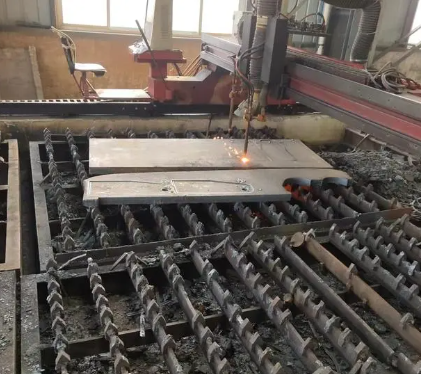 Processes adopted for P460QL1
Quenching and tempering (Q&T):
P460QL1 is supplied in the quenched and tempered condition. Quenching is carried out at a temperature typically between 880°C and 950°C, followed by rapid cooling in water or oil to achieve a fully martensitic or bainitic microstructure. Tempering is then performed at 550°C to 650°C to improve toughness, reduce hardness, and relieve residual stresses, resulting in a fine-grained, high-strength structure.
Thermo-mechanical controlled processing (TMCP):
Some producers use TMCP to refine the grain size and enhance mechanical properties. This involves controlled rolling at temperatures below the austenite recrystallization region, followed by accelerated cooling to achieve a uniform, fine microstructure with good strength and toughness.
Clean steelmaking processes:
Advanced steelmaking techniques such as basic oxygen furnace (BOF) or electric arc furnace (EAF) with secondary refining (LF, VD, or RH) are employed to reduce impurities like sulfur and phosphorus, control carbon content, and improve purity. This ensures good weldability and resistance to brittle fracture.
Precision rolling:
The steel is rolled with strict control over temperature, reduction ratio, and finishing temperature to ensure uniform thickness, good surface quality, and consistent mechanical properties across the plate.
Heat treatment after welding:
Post-weld heat treatment (PWHT) is often applied to reduce residual stresses and improve toughness in the heat-affected zone (HAZ). Typical PWHT temperatures range from 550°C to 680°C, depending on plate thickness and welding conditions.
Surface treatment:
Shot blasting or pickling is used to remove scale and contaminants, followed by the application of protective coatings such as epoxy or polyurethane paints to enhance corrosion resistance and extend service life.
 applications
Pressure vessels and storage tanks:
P460QL1 is widely used in the fabrication of pressure vessels, including spherical tanks, cylindrical tanks, and large storage tanks for oil, gas, and chemical products. Its high yield strength and good low-temperature toughness make it suitable for operating conditions with high internal pressure and low ambient temperatures.
Petrochemical and chemical equipment:
It is used to manufacture reactors, heat exchangers, separators, and other key equipment in refineries, chemical plants, and gas processing facilities. The steel's excellent weldability and resistance to brittle fracture ensure the reliability and safety of these critical components.
Power industry applications:
P460QL1 is applied in the construction of boilers, pressure parts of steam generators, and high-pressure pipelines in thermal power plants and nuclear power plants. It can withstand high temperatures and pressures while maintaining good mechanical properties.
Offshore and marine structures:
Due to its good toughness at low temperatures and high strength, P460QL1 is used in offshore platforms, FPSO units, and other marine structures exposed to harsh environments such as low temperatures, high winds, and corrosive seawater.
General heavy engineering:
It is also used in heavy machinery, large-diameter pipes, and structural components that require high strength, good weldability, and excellent impact resistance, such as in the construction of bridges, cranes, and mining equipment.
Comparison with Similar Grades
P460QL2: Similar to QL1 but tested at even lower temperatures (-60°C).
S460QL1: A structural steel (EN 10025-6) with the same strength but not certified for pressure vessel use.
ASTM Equivalent: Roughly equivalent to ASTM A517 or A537 Class 2/3 depending on the specific application requirements.
Request a professional quotation for P460QL1 from GNEE Steel.
What is the elongation of P460QL1?
The minimum elongation of P460QL1 is 20% (after tensile test). Good elongation means that the material has good plastic deformation ability, which can absorb energy when subjected to external forces and avoid sudden fracture.
Can P460QL1 be welded with other steels?
Yes, P460QL1 can be welded with other steels (such as carbon steel, other alloy steels), but it is necessary to select matching welding materials and adjust welding parameters to ensure the compatibility and strength of the welding joint.
What is the hardness of P460QL1?
The Brinell hardness of P460QL1 is about 160-220 HB at room temperature. The appropriate hardness ensures that the material has both strength and wear resistance, and is easy to process and form.
What are the storage requirements for P460QL1 plates?
P460QL1 plates should be stored in a dry, ventilated and rainproof warehouse to avoid moisture and rust. They should be placed horizontally, separated from the ground by sleepers, and avoid collision and scratch on the surface.
Can P460QL1 be used in high-pressure pipelines?
Yes, P460QL1 is suitable for manufacturing high-pressure pipelines. Its high yield strength and good toughness can withstand the high pressure of the medium in the pipeline, and it can adapt to the temperature changes during pipeline operation.
What is the metallographic structure of P460QL1?
The metallographic structure of P460QL1 after quenching and tempering is mainly tempered sorbite. This structure has the characteristics of high strength and good toughness, which is the key to ensuring the comprehensive performance of the material.
Does P460QL1 need to be tested for hydrogen induced cracking?
Yes, for P460QL1 used in hydrogen-containing environments or important pressure vessels, hydrogen induced cracking (HIC) testing is usually required to ensure that the material will not crack due to hydrogen absorption during use.
What is the maximum working pressure that P460QL1 can bear?
The maximum working pressure depends on the thickness of the material, the working temperature and the structural design of the equipment. Generally, it can bear working pressures above 10 MPa when used in pressure vessels with reasonable design.
Can P460QL1 be machined?
Yes, P460QL1 has good machinability. It can be processed by turning, milling, drilling, planing and other machining methods, but it is necessary to select appropriate cutting tools and cutting parameters to improve processing efficiency and surface quality.
What are the quality inspection items for P460QL1?
The quality inspection items for P460QL1 mainly include chemical composition analysis, mechanical property tests (tensile, impact, hardness), metallographic inspection, surface defect detection and dimensional deviation verification, all to ensure the material meets relevant standard requirements.