


P420M is a quenched and tempered high-strength pressure vessel steel plate specified in the European standard EN 10028-6. It is designed for use in the fabrication of pressure vessels and boilers operating at elevated temperatures, offering excellent mechanical properties such as high tensile strength, good toughness, and satisfactory weldability. With a minimum yield strength of 420 MPa, P420M is suitable for applications requiring reliable performance under high pressure and harsh service conditions.
|
EN10028-5 P420MChemical Composition |
|||||||
|
Grade |
The Element Max (%) |
||||||
|
C |
Si |
Mn |
P |
S |
Al |
N |
|
|
P420M |
0,16 |
0,50 |
1,70 |
0,025 |
0,020 |
0,020 |
0,020 |
|
Nb |
V |
Ti |
Ni |
Mo |
|
|
|
|
0,05 |
0,10 |
0,05 |
0,50 |
0,20 |
|
|
|
|
Grade |
P420MMechanical Property |
|||
|
Thickness |
Yield |
Tensile |
Elongation |
|
|
P420M |
mm |
Min Mpa |
Mpa |
Min % |
|
6-16 |
420 |
500-660 |
19% |
|
|
16-40 |
400 |
500-660 |
19% |
|
|
40-63 |
390 |
500-660 |
19% |
|
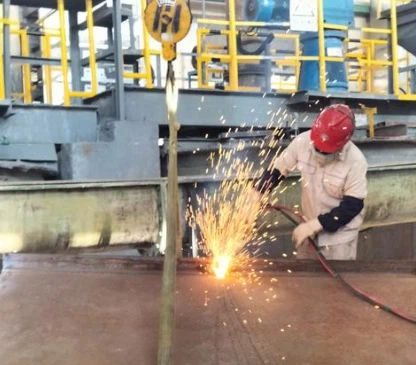 P420M Process Characteristics
Controlled Heating and Rolling: Adopts precise temperature control during heating (1100–1250℃) and rolling processes. The controlled rolling refines the grain structure effectively, enhancing the steel's tensile strength and toughness while ensuring uniform mechanical properties across the plate.
Quenching-Tempering (QT) Heat Treatment: Features a strict QT process as the core. Rapid quenching forms a fine martensitic structure, while subsequent tempering (550–650℃) relieves internal stresses, balances hardness and toughness, and achieves the required 420MPa minimum yield strength.
Strict Weldability Assurance: Requires preheating (100–150℃) and post-weld heat treatment (PWHT) to avoid welding cracks. Matched welding materials and standardized processes ensure good weld joint performance, meeting pressure vessel service demands.
High-Precision Surface and Dimensional Control: Employs shot blasting or pickling for descaling, ensuring a clean surface with good coating adhesion. The rolling and cutting processes maintain tight dimensional tolerances, adapting to precise fabrication of pressure-bearing components.
Full-Stage Quality Supervision: Incorporates multi-stage inspection, including chemical composition analysis, ultrasonic flaw detection, and mechanical property testing. Each process step complies with EN 10028-6 standards, guaranteeing stable product quality and safe application.
advantages
High Strength and Good Toughness: P420M provides a minimum yield strength of 420 MPa, combined with excellent low-temperature toughness. This allows it to withstand high pressure and heavy loading while maintaining structural integrity, making it suitable for critical pressure vessel applications.
Excellent Weldability: When using appropriate preheating and post-weld heat treatment procedures, P420M demonstrates good weldability. This ensures reliable joint quality and reduces the risk of cold cracking, which is essential for fabricating large and complex pressure equipment.
Superior Heat Resistance: The steel maintains stable mechanical properties at elevated temperatures, typically up to around 400°C. This makes it ideal for boilers, heat exchangers, and other high-temperature service conditions.
Good Corrosion Resistance: While not a stainless steel, P420M offers reasonable resistance to mild corrosive environments, especially when properly coated or protected. This extends service life and reduces maintenance requirements.
Consistent Quality and Reliability: Produced under strict quality control in accordance with EN 10028-6, P420M ensures uniform microstructure, stable performance, and high dimensional accuracy. This reliability is crucial for safety‑critical applications.
Cost-Effective Performance: Compared to higher-alloyed steels, P420M provides an excellent balance of strength, toughness, and cost, making it a cost-effective choice for pressure vessel and boiler manufacturers.

Why Choose Us :
You can get the perfect material according to your requirement at the least possible price.
We also offer Reworks, FOB, CFR, CIF, and door to door delivery prices. We suggest you to do deal for shipping which will be quite economical.
The materials we provide are completely verifiable, right from raw material test certificate to the final dimensional statement.(Reports will show on requirement)
We guarantee to give a response within 24hours(usually in the same hour)
You can get stock alternatives, mill deliveries with minimizing manufacturing time.
We are fully dedicated to our customers. If it will not possible to meet your requirements after examining all options, we will not mislead you by making false promises which will create good customer relations.
Full specification and details are available on request. The above information is provided for guidance purposes only. For specific design requirements please contact our technical sales staff.
What is the impact toughness requirement for P420M?
P420M typically requires a minimum Charpy V-notch impact energy of 40 J at -20°C, although some specifications may demand testing at -40°C for arctic or cold-region service. The impact toughness ensures resistance to brittle fracture under dynamic loading, a critical safety consideration in offshore platforms and other large structures.
What is the maximum service temperature for P420M?
P420M is typically used at service temperatures ranging from -40°C to around 300°C. At higher temperatures, its strength and toughness may degrade, and creep becomes a concern. For elevated-temperature applications, other grades or heat-resistant alloys may be more suitable, depending on the specific design and loading conditions.
How does P420M perform under high-stress conditions?
P420M maintains good performance under high-stress conditions due to its high yield and tensile strength, combined with adequate ductility and toughness. Its fine-grained microstructure and low impurity content help prevent premature failure, even under dynamic or cyclic loading, making it suitable for critical structural components in offshore and heavy engineering.
What are the advantages of using P420M in weight-sensitive structures?
The high strength of P420M allows designers to reduce plate thickness and overall weight while maintaining structural integrity. This results in cost savings in materials, transportation, and installation, particularly in offshore platforms and large equipment. Its good weldability and toughness also simplify fabrication and enhance reliability in weight-sensitive applications.
What is the hardness range of P420M?
P420M generally has a Brinell hardness range of 180 to 240 HB, depending on thickness and heat treatment. This range balances strength and toughness, providing sufficient hardness for wear resistance while avoiding excessive hardness that could impair weldability and toughness in thick sections.
What future developments are expected for P420M and similar grades?
Future developments for P420M and related offshore steels may include improved toughness at lower temperatures, higher strength-to-weight ratios, and enhanced weldability. Advancements in microalloying and thermomechanical processing could lead to more cost-effective production and expanded applications in arctic environments and deepwater offshore projects, improving safety and efficiency.
How is P420M stored and handled to prevent degradation?
P420M plates should be stored in a dry, covered area to prevent moisture absorption and surface corrosion. They should be handled with care to avoid impact damage, especially in cold weather when toughness may be reduced. Proper lifting and stacking practices help prevent deformation and ensure the material remains in specification until fabrication.
What are the typical dimensions of P420M plates?
P420M plates are produced in various widths and lengths, commonly ranging from 1500 mm to 4000 mm in width and 6000 mm to 12000 mm in length, depending on the mill's capabilities. Thicknesses from 6 mm to 150 mm are standard. These dimensions provide flexibility for fabricating large offshore structures and heavy equipment components.
What is the weldability classification of P420M?
P420M is considered to have good weldability, suitable for use in welded offshore structures. It is often classified as a readily weldable high-strength steel when proper preheating, low-hydrogen consumables, and controlled heat input are applied. This classification reflects its ability to form sound joints with acceptable toughness and strength.