


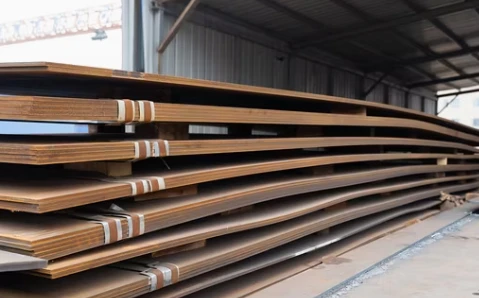
S960Q is a high‑strength quenched and tempered structural steel to EN 10025‑6, offering very high yield strength together with good toughness and controlled weldability through low carbon, restricted impurities, and alloying additions. It provides high strength and ductility, with properties reducing slightly in thicker sections. The steel is widely used in heavy‑duty equipment such as mining machinery, hydraulic supports, large excavators, and heavy lifting systems, and may also be applied in certain high‑load bridge and specialized vehicle components. Welding requires careful control of preheat and interpass temperatures to prevent cold cracking, and the material is normally supplied in the quenched and tempered condition.
|
S960QChemical Composition |
||||||||
|
Grade |
The Element Max (%) |
|||||||
|
C |
Si |
Mn |
P |
S |
N |
B |
Cr |
|
|
S960 Q |
0.20 |
0.80 |
1.70 |
0.020-0.025 |
0.010-0.015 |
0.015 |
0.005 |
1.50 |
|
Cu |
Mo |
Nb |
Ni |
Ti |
V |
Zr |
|
|
|
0.50 |
0.70 |
0.06 |
2.0 |
0.05 |
0.12 |
0.15 |
|
|
|
Grade |
S960QMechanical Property |
|||||
|
Thickness |
Yield |
Tensile |
Elongation |
Min Impact Energy
|
||
|
S960 Q |
mm |
Min Mpa |
Mpa |
Min % |
-20 |
30J |
|
3<t≦50 |
960 |
980-1150 |
10 |
-20 |
30J |
|
|
50<t≦100 |
910 |
920-1000 |
10 |
-20 |
30J |
|
|
100<t≦150 |
860 |
870-980 |
10 |
-20 |
30J |
|
applications
Construction & Infrastructure
In modern civil engineering, S960Q is essential for long-span bridges and high-rise towers. By utilizing its extreme strength, engineers can design thinner structural sections that reduce the overall dead weight of a bridge, leading to significant savings in foundation costs. In skyscrapers, it is used for core columns and tension members, allowing for sleeker architectural designs while maximizing usable floor space.
Heavy Machinery
This is the most dominant sector for S960Q. It is the primary material for telescopic cranes and crawler crane booms, where a high strength-to-weight ratio allows for greater lifting heights and capacities. It is also vital for mining equipment, such as excavator dipper sticks and large dump truck frames, providing the durability needed to withstand immense impact and fatigue in harsh environments.
Transportation
For the logistics and railway sectors, S960Q is a game-changer for payload optimization. By using this steel for truck chassis, heavy-duty trailers, and low-loaders, manufacturers can reduce vehicle tare weight. This allows for higher legal cargo limits and improved fuel efficiency. In the railway industry, it is used for critical structural components in freight wagons and high-speed rail frames.
Offshore & Renewable Energy
In the offshore sector, S960Q is used for jack-up rig legs and subsea structures that must endure extreme dynamic loads. Its role in renewable energy has expanded significantly; it is now used for the towers and support frames of next-generation ultra-large wind turbines. The use of S960Q minimizes material consumption while ensuring the towers can support the increasing weight of larger turbines and blades.
General & Process Engineering
In the petrochemical and paper industries, S960Q is utilized for high-pressure vessels and turbine scroll cases. Its ability to maintain structural integrity under extreme pressure-and its availability in variants like S960QL (tested for toughness down to -40°C)-makes it indispensable for projects in arctic or extreme cold-climate environments.
Request a professional quotation for S960Q from GNEE Steel.
What is S960Q?
S960Q is a high-strength quenched and tempered structural steel grade specified in the European standard EN 10025-6, known for its very high yield strength and good toughness.
What does the designation "S960Q" mean?
The "S" indicates structural steel, the number represents a very high minimum yield strength level, and "Q" signifies that the steel is supplied in the quenched and tempered condition.
What is the typical delivery condition of S960Q?
S960Q is usually delivered in the quenched and tempered (Q&T) condition to achieve its combination of high strength and toughness.
Is S960Q suitable for cold-forming operations?
S960Q has limited cold-formability due to its high strength, so forming is often performed at room temperature with careful control of bending radii and avoiding excessive strain.
What quality control tests are commonly performed on S960Q?
Common tests include tensile testing, Charpy impact testing at low temperatures, hardness testing, ultrasonic inspection, and examination of microstructure.
What is the typical microstructure of S960Q?
S960Q generally has a fine-grained microstructure, often consisting of tempered martensite or a mixture of martensite and bainite, which provides high strength and toughness.
How does S960Q differ from ASTM A514 in terms of application?
Both are high-strength quenched and tempered steels, but S960Q is commonly used in European and global heavy machinery, while A514 is more typical in North American construction and equipment.
How does the weldability of S960Q compare to that of lower-strength structural steels?
S960Q has more demanding welding requirements than lower-strength steels, often requiring higher preheat temperatures and stricter control of hydrogen to prevent cracking.
What are the differences in microstructure and properties between S960Q and hot-rolled high-strength steels?
S960Q has a fully heat-treated, fine-grained microstructure with higher strength and toughness, whereas hot-rolled high-strength steels rely more on microalloying and controlled rolling, resulting in lower strength levels but often better formability.