


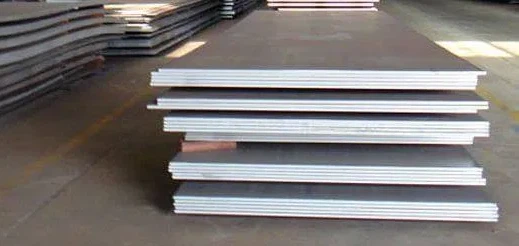
Chemical Composition (mass%, maximum values unless specified)
Its composition is scientifically formulated to reconcile strength and processability, with strict control over harmful elements. Key components are as follows: C ≤0.20, Si ≤0.80, Mn ≤1.70, P ≤0.020, S ≤0.010. It also contains alloying elements such as Cr ≤1.50, Ni ≤2.00, Mo ≤0.70, V ≤0.12, Nb ≤0.06, and Ti ≤0.05. The addition of Ni improves low-temperature toughness, while Cr and Mo enhance tempering stability. Trace Nb, V, and Ti refine the grain structure, further optimizing the steel's comprehensive performance.
Core Advantages
Excellent full-thickness hardenability: Even for 80mm thick plates, the yield strength at the core can reach no less than 650MPa, which is far superior to ordinary high-strength steel and can meet the performance requirements of thick-walled structural components.
Reliable welding joint performance: With a carbon equivalent (CEV) of ≤0.45%, it has good weldability. After proper welding, the impact energy of the weld joint at -40°C can reach over 27J, and even up to more than 60J in actual measurements, ensuring the integrity of the welded structure.
Strong environmental adaptability: It performs well in harsh environments such as low temperatures and salt spray. Its low-temperature impact energy can reach 40 - 55J in practical tests, and it can be further enhanced through surface treatments like hot-dip galvanizing to resist corrosion.
Typical Applications
It is widely used in fields requiring high load-bearing capacity and resistance to extreme conditions. In mining machinery, it is used to manufacture frames and cargo boxes for large electric wheel dump trucks, reducing weight by about 8 - 12% compared to conventional materials. In construction and bridge engineering, it serves as load-bearing components for long-span bridges and high-rise building trusses. It is also applied in offshore wind power conduit frames, polar research vehicle chassis, coal mine hydraulic supports, and crane booms, reliably withstanding dynamic loads and harsh environmental challenges.
Equivalent Grades
It has corresponding alternative grades in different standard systems. Domestically, it is roughly equivalent to Q690E in China's GB/T 16270 standard. Internationally, it can be referenced to grade E690 in the ISO 4950 - 2 standard and is comparable to grade F in the ASTM A514 standard, facilitating material substitution in cross-border projects.
What is S690QL material?
S690QL is a high strength quenched and tempered steel grade that complies to steel specification EN 10025. The designation S690QL refers to a minimum yield strength of 690 MPa.
What is the equivalent of S690QL steel?
Approximate equivalents
ASTM A514, EN 10149-2 Grade S700MC, AS/NZS 3579 Grade 700, AM 700, Bisalloy 80.
What is the price of S690QL plate?
₹ 130/Kg
₹ 130/KgS690 QL plate is a high-strength, quenched, and tempered steel plate designed for use in structural applications that require high strength and excellent toughness.
What is 690 grade steel?
S690 high yield & fine grain steel plate is a high strength, quenched and tempered fine-grain structural steel. Structural steel S690 is used in structures that must withstand very heavy loads. This grade is meant for structures where weight savings is important.
What is the difference between S690Q and S690QL?
S690Q: Minimum impact toughness tested at -20°C (30J average). → Typical Use: Cranes in temperate climates, quarry equipment. S690QL: Certified for -40°C and below (≥40J impact toughness). → Critical Use: Arctic pipelines, offshore platforms, mining vehicles in Siberia