


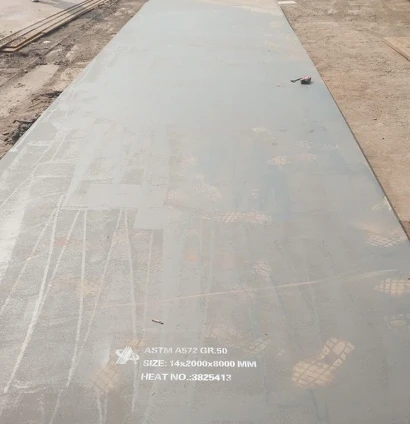
P690QL1 is a premium high-strength quenched and tempered alloy structural steel that belongs to the European standard EN 10025-6 series. It is specially formulated with precise alloying elements to deliver excellent toughness, superior weldability, and reliable corrosion resistance, making it an ideal material for heavy machinery manufacturing, large-scale construction projects, and offshore engineering structures that demand exceptional load-bearing capacity and long-term durability even in harsh working environments.
Designation Breakdown
P: Steel for Pressure purposes.
690: Minimum yield strength of 690 MPa (for thickness ≤50mm).
Q: Quenched and Tempered delivery condition.
L1: Low-temperature quality, tested for impact energy at -40°C.
Steel Number: 1.8881.
Mechanical Properties
| Yield Rp0.2 (MPa) |
Tensile Rm (MPa) |
Impact KV/Ku (J) |
Elongation A (%) |
Reduction in cross section on fracture Z (%) |
As-Heat-Treated Condition | Brinell hardness (HBW) |
|---|---|---|---|---|---|---|
| 211 (≥) | 114 (≥) | 22 | 43 | 31 | Solution and Aging, Annealing, Ausaging, Q+T,etc | 412 |
Physical Properties
| Temperature (°C) |
Modulus of elasticity (GPa) |
Mean coefficient of thermal expansion 10-6/(°C) between 20(°C) and | Thermal conductivity (W/m·°C) |
Specific thermal capacity (J/kg·°C) |
Specific electrical resistivity (Ω mm²/m) |
Density (kg/dm³) |
Poisson's coefficient, ν |
|---|---|---|---|---|---|---|---|
| 43 | - | - | 0.24 | - | |||
| 264 | 448 | - | 11.3 | 223 | - | ||
| 252 | - | 32 | 11.2 | 343 | 142 |
Chemical composition
| C | Si | Mn | Ni | P | S | Cr | Mo | V | N | Nb | Ti | Cu | Zr | B |
| max 0.2 | max 0.8 | max 1.7 | max 2.5 | max 0.02 | max 0.008 | max 1.5 | max 0.7 | max 0.12 | max 0.015 | max 0.06 | max 0.05 | max 0.3 | max 0.15 | max 0.005 |
Advantages
1. Excellent High-Strength Performance
P690QL1 has a minimum yield strength of 690MPa, which is much higher than that of ordinary carbon steel and low-alloy steel. This high-strength characteristic enables the material to bear greater loads and pressures in the manufacturing of pressure-bearing equipment, heavy machinery components and marine structures. It can effectively reduce the thickness and weight of the equipment while ensuring structural safety, thereby achieving the goals of energy conservation and cost reduction in equipment design and manufacturing.
2. Outstanding Low-Temperature Toughness
The material can meet the impact performance requirements at -40℃ after quenching and tempering treatment. In low-temperature working environments such as polar regions, high-altitude areas and low-temperature medium storage and transportation, it can avoid brittle fracture of the structure, which is crucial for ensuring the safe operation of equipment in extreme low-temperature conditions. Compared with materials with poor low-temperature toughness, P690QL1 has stronger environmental adaptability.
3. Good Corrosion Resistance
P690QL1 contains appropriate alloying elements, which can form a dense oxide film on the surface to resist the corrosion of harmful media such as hydrogen, hydrogen sulfide, salt spray and chemical reagents. This advantage makes it widely used in petrochemical, marine engineering and other fields that are prone to corrosion, effectively extending the service life of equipment and reducing the frequency of maintenance and replacement.
4. Excellent Weldability
The material has good weldability after reasonable chemical composition design and heat treatment. It can form high-quality weld joints without obvious welding defects such as cracks and pores under standard welding processes. This ensures the integrity and structural stability of large-scale equipment and components during the welding process, reducing the difficulty and risk of construction and improving the efficiency of equipment manufacturing.
5. Stable Mechanical Properties
Through strict quenching and tempering process control, the mechanical properties of P690QL1 are uniform and stable, with small differences in strength, toughness and hardness in different parts of the material. This stable performance ensures that the equipment can maintain consistent working status in the process of long-term use and heavy-load operation, avoiding potential safety hazards caused by uneven performance of materials.

Applications
1. Petrochemical Industry
It is mainly applied to the manufacturing of core pressure-bearing equipment in the whole industrial chain of oil and gas exploration, refining and chemical processing. Typical applications include reactors, heat exchangers, separators and other equipment that need to withstand high temperature, high pressure and corrosive media (such as hydrogen, hydrogen sulfide). In addition, it is also used to produce large oil and gas storage tanks, liquefied petroleum gas (LPG) transport tanks and pipeline components, ensuring the safe storage and efficient transportation of petrochemical media.
2. Energy and Power Industry
It covers thermal power, hydropower, nuclear power and other sub-fields. In thermal power plants, it is used for boiler drums, high-pressure water walls and superheater headers to resist the impact of high-temperature and high-pressure steam. In hydropower projects, it is used to manufacture turbine volutes and high-pressure water transmission pipelines, adapting to the high-load working environment of water flow. In nuclear power plants, it is applied to reactor pressure vessel supports and steam generator key components, meeting the strict requirements of low impurity content and radiation resistance.
3. Marine Engineering Industry
It is a key material for offshore engineering equipment due to its strong corrosion resistance and impact resistance. It is mainly used in the manufacture of jack-up offshore platform legs, platform main columns, offshore crane booms and base turntables. At the same time, it is also suitable for marine liquid cargo tanks and hull key stress-bearing structures, which can effectively resist marine salt spray corrosion, wave impact and low-temperature environment, ensuring the stability and safety of offshore operations.
4. Heavy Machinery and Infrastructure
It is widely used in the field of heavy-load mechanical equipment and large-scale infrastructure. In mining machinery, it is used for core load-bearing components such as crusher housings and excavator booms. In wind power generation, it is applied to wind turbine tower tube flanges and connection structures, adapting to the outdoor harsh environment and heavy-load operation. In large-scale bridge projects, it is used for key stress-bearing components, improving the overall structural strength and service life of the bridge.
5. Low-Temperature Storage and Transportation Equipment
Relying on its outstanding low-temperature toughness (meeting -40℃ impact requirements), it is used to manufacture low-temperature storage and transportation equipment for liquefied natural gas (LNG), liquid nitrogen and other media. It can avoid brittle fracture of equipment in extreme low-temperature environments, ensuring the safe storage and transportation of low-temperature media in polar regions, high-altitude areas and other scenarios.
Get an valued quotation for P690QL1 , Contact GNEE Steel.
Can P690QL1 be used in offshore engineering?
Yes, P690QL1 is widely used in offshore engineering. Its high strength, excellent impact toughness and corrosion resistance can withstand harsh marine environments (high humidity, salt spray, wind and wave loads).
What is the preheating temperature for P690QL1 welding?
The preheating temperature for P690QL1 welding is usually 80-150℃. Preheating can reduce the temperature gradient of the weld zone, prevent cold cracks, and improve the quality of the weld joint.
What post-weld heat treatment is needed for P690QL1?
After welding P690QL1, stress relief annealing is usually required, with a temperature of 550-650℃. This treatment relieves welding residual stress, improves toughness and reduces the risk of post-weld cracking.
What is the difference between P690QL1 and Q690 steel?
P690QL1 is a European standard steel (EN 10025-6), while Q690 is a Chinese standard steel (GB/T 1591). The former has stricter low-temperature impact toughness requirements, and the chemical composition and test methods also differ slightly.
Is P690QL1 a quenched and tempered steel?
Yes, P690QL1 is a quenched and tempered high-strength steel. Quenching (rapid cooling after heating to austenitizing temperature) and tempering (heating to a certain temperature and cooling) give it excellent strength and toughness matching.
What is the fatigue strength of P690QL1?
The fatigue strength of P690QL1 (under 10⁷ cycles) is about 300-350 MPa. Proper surface treatment (such as grinding, shot peening) can improve its fatigue resistance and extend the service life of components.
Can P690QL1 be used to make pressure vessels?
Yes, P690QL1 can be used to make medium and low pressure vessels. Its high strength and good toughness can meet the pressure-bearing requirements of vessels, but it needs to pass strict quality inspection and certification.
What is the surface quality requirement of P690QL1?
The surface of P690QL1 should be free of cracks, folds, scars, delaminations and other defects. Minor surface defects can be repaired by grinding, but the thickness after repair should not be less than the minimum allowable value.
How to test the mechanical properties of P690QL1?
The mechanical properties of P690QL1 are tested by tensile test, impact test and hardness test. Tensile test measures yield strength and tensile strength; impact test evaluates toughness; hardness test reflects hardness level.
What is the service temperature range of P690QL1?
The service temperature range of P690QL1 is generally -20℃ to 500℃. Beyond this range, its mechanical properties may decline, so it should be used within the specified temperature range in engineering applications.