


What are the mechanical properties of SA204 Grade B?
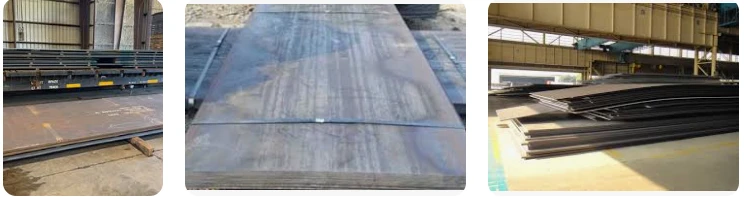
SA204 Grade B is a molybdenum alloy steel used for welded boilers and pressure vessels, offering higher strength than Grade A due to its carbon content, with key specs including a yield strength of at least 275 MPa (40 ksi) and tensile strength of 485-620 MPa (70-90 ksi), known for good weldability in moderate temperature applications but with slightly less elongation than Grade A.
The mechanical properties for SA204 Grade B are defined by the ASME SA-204/SA-204M specification. Below are the key properties for common plate thickness ranges.
Key Mechanical Properties (ASME SA-204/SA-204M)
1. Tensile Properties (for plates ≤ 2 in / 50 mm thick):
Tensile Strength: 65 – 85 ksi (450 – 585 MPa)
Yield Strength (Minimum): 37 ksi (255 MPa)
Elongation (Minimum in 2 in / 50 mm):
23% for longitudinal specimens
17% for transverse specimens
2. Tensile Properties for Thicker Plates:
Properties decrease with increasing thickness per the standard's tables.
For plates > 2 to 4 in (50 to 100 mm):
Tensile Strength: 65 – 85 ksi (450 – 585 MPa)
Yield Strength (Min): 35 ksi (240 MPa)
For plates > 4 to 8 in (100 to 200 mm):
Tensile Strength: 63 – 83 ksi (435 – 570 MPa)
Yield Strength (Min): 33 ksi (230 MPa)
3. Impact Toughness (Charpy V-Notch):
Impact testing is not a mandatory requirement of the base SA-204 specification.
It can be specified as an additional requirement by the purchaser (e.g., for low-temperature applications). If specified, the test temperature and acceptance values (e.g., at -50°F / -45°C) must be agreed upon.
Summary Table (for plates ≤ 2 in / 50 mm)
| Property | Imperial Value | Metric Value | Note |
|---|---|---|---|
| Tensile Strength | 65 – 85 ksi | 450 – 585 MPa | Range |
| Yield Strength (Min) | 37 ksi | 255 MPa | |
| Elongation (Min), Longitudinal | 23% | 23% | In 2 in / 50 mm |
| Elongation (Min), Transverse | 17% | 17% | In 2 in / 50 mm |
| Charpy Impact Test | Not Required | Not Required | Must be specified by purchaser |
Important Application Notes:
Heat Treatment: SA204 Grade B is supplied in the normalized or normalized and tempered condition to achieve these properties.
Primary Design Driver: Its primary selection is for moderate elevated temperature service (typically up to ~850°F / 454°C), where its molybdenum content provides improved strength compared to carbon steel. Its moderate room-temperature strength is secondary.
Thickness Effect: Always use the property values corresponding to the actual plate thickness from the ASME SA-204M table for design calculations.
Lack of Mandatory Toughness: Unlike steels for low-temperature service (e.g., SA203, A537), SA204 does not inherently guarantee impact toughness. If the vessel design requires notch toughness (e.g., for low startup temperatures), Charpy testing must be explicitly specified on the purchase order.
In essence, the mechanical profile of SA204 Grade B is characterized by moderate strength at room temperature, with its true value being its performance retention at elevated temperatures, as governed by its molybdenum alloy content.
1.What is SA204 Grade B?
SA204 Grade B is a molybdenum alloy steel plate designed for service in welded boilers and other pressure vessels operating at moderate to high temperatures.
2.What is the chemical composition of SA204 Grade B?
Its composition includes Molybdenum (0.45-0.60%), Carbon (max 0.20%), Manganese (0.55-0.85%), Silicon (0.15-0.40%), and controlled Phosphorus and Sulfur.
3.What are the mechanical properties of SA204 Grade B?
For plates up to 2 inches thick, key properties include a minimum tensile strength of 65-85 ksi (450-585 MPa) and a minimum yield strength of 37 ksi (255 MPa).
4.Is SA204 Grade B a carbon steel or alloy steel?
It is classified as an alloy steel due to its intentional and specified molybdenum content, which provides enhanced strength at elevated temperatures.
5.What is the primary application of SA204 Grade B?
It is primarily used for parts of boilers and pressure vessels where moderate elevated temperature strength and resistance to creep are required.
6.What is the maximum service temperature for SA204 Grade B?
It is commonly used for service temperatures up to approximately 850°F (454°C) in applications such as boiler drums and shells.
7.How does SA204 Grade B compare to SA204 Grade A and C?
Grade B has higher molybdenum content than Grade A, providing better elevated temperature strength. Grade C has even higher molybdenum content (0.90-1.10%) for the highest strength.
8.Is SA204 Grade B suitable for hydrogen service?
It can be used in certain hydrogen service applications, but its suitability depends on specific temperature, pressure, and hydrogen partial pressure conditions. Often, chrome-molybdenum steels like SA387 are preferred for severe service.
9.What is the heat treatment for SA204 Grade B?
SA204 Grade B plates are typically supplied in the normalized or normalized and tempered condition to achieve the required mechanical properties.
10.Can SA204 Grade B be welded easily?
Yes, it has good weldability. Welding should follow standard practices for low-alloy steels, including proper preheat and post-weld heat treatment (PWHT) for thicker sections to maintain properties.
Full specification and details are available on request. The above information is provided for guidance purposes only. For specific design requirements please contact our technical sales staff.
