


What are the mechanical properties of A537 Class 2?
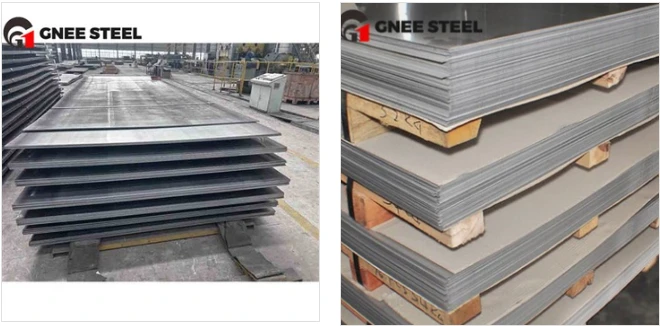
ASTM A537 Class 2 is a heat-treated, carbon-manganese-silicon steel plate, specified for fusion-welded pressure vessels and structures like tanks, offering higher yield and tensile strength than Class 1 due to quenching and tempering, making it suitable for demanding applications in oil, gas, and chemical industries requiring strength at higher pressures and temperatures. It provides excellent toughness and weldability (with proper procedures) for heavy-duty service, with minimum yield strength of 60 ksi (415 MPa) for typical thicknesses.
Key Mechanical Properties (Typical for plates up to 2.5 inches / 63.5 mm thick):
Yield Strength (Minimum):
80 ksi (550 MPa)
Tensile Strength (Minimum):
95 ksi (655 MPa)
Tensile Strength (Maximum):
There is typically no specified maximum in the standard for Class 2, but the expected range is approximately 95-115 ksi (655-795 MPa).
Elongation (Minimum):
18% in 2 inches (50 mm) for standard rectangular tensile specimens.
Important Notes on Thickness and Heat Treatment:
Thickness Effect: The specified minimum yield and tensile strengths decrease for plates over 2.5 inches (63.5 mm) thick. The standard provides tables with reduced strength values for thicker plates (e.g., over 2.5 to 4 inches, over 4 to 6 inches, etc.).
Heat Treatment: These mechanical properties are achieved through a quenching and tempering heat treatment process. This process is mandatory for Class 2 and is what differentiates it from the lower-strength Class 1 (which is normalized or stress-relieved).
Impact Toughness: While not a direct mechanical property like strength, Charpy V-Notch impact testing is often specified. A common requirement is a minimum average absorbed energy of 40 ft-lbf (54 J) at -50°F (-46°C) for plates over a certain thickness (e.g., 0.75 in / 19 mm). This gives A537 Class 2 its reputation for good low-temperature toughness.
Summary Table (for plates ≤ 2.5 in / 63.5 mm):
| Property | Imperial (ksi) | Metric (MPa) |
|---|---|---|
| Yield Strength (Min) | 80 ksi | 550 MPa |
| Tensile Strength (Min) | 95 ksi | 655 MPa |
| Elongation (Min) | 18% | 18% |
| Typical Process | Quenched & Tempered | Quenched & Tempered |
For precise design values, always consult the latest official ASTM A537/A537M specification and the relevant material certification for the specific plate thickness in question.
1.What is A537 Class 2 steel?
A537 Class 2 is a high-strength, heat-treated carbon-manganese-silicon steel plate primarily used for welded pressure vessels and structural applications requiring good low-temperature toughness.
2.What are the mechanical properties of A537 Class 2?
For plates up to 2.5 inches thick, typical properties include a minimum tensile strength of 95-115 ksi (655-795 MPa) and a minimum yield strength of 80 ksi (550 MPa), achieved through quenching and tempering.
3.What is the chemical composition of A537 Class 2?
It features a carbon-manganese-silicon composition, with maximums typically around 0.24% Carbon, 1.60% Manganese, and 0.15-0.50% Silicon, along with controlled levels of phosphorus and sulfur.
4.What is the difference between A537 Class 1 and Class 2?
The key difference is heat treatment and strength. Class 2 is quenched and tempered, offering significantly higher strength, while Class 1 is normalized or stress-relieved with lower strength values.
5.Is A537 Class 2 a carbon steel or alloy steel?
It is classified as a high-strength carbon steel (specifically carbon-manganese-silicon steel), with its enhanced properties derived from heat treatment rather than high alloy content.
6.What is the Charpy impact requirement for A537 Class 2?
It typically requires Charpy V-Notch impact testing at -50°F (-46°C) with minimum average energy absorption often specified as 40 ft-lbs (54 J) for plates over certain thicknesses.
7.Can A537 Class 2 be welded?
Yes, but it requires careful welding procedures due to its quenched and tempered microstructure. Use of low-hydrogen electrodes, proper preheat, and control of heat input are essential to maintain properties.
8.What are common applications for A537 Class 2 steel?
It's widely used in pressure vessels, storage tanks, offshore structures, mining equipment, and other applications where high strength and good low-temperature toughness are required.
9.What is the heat treatment for A537 Class 2 plates?
A537 Class 2 plates are supplied in the quenched (rapidly cooled) and tempered (reheated) condition, which gives them their high strength and toughness combination.
10.Is A537 Class 2 suitable for low-temperature service?
Yes, due to its quenched and tempered microstructure, A537 Class 2 offers excellent notch toughness and is commonly specified for service temperatures down to -50°F (-46°C) and below.