


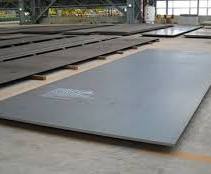
S690QL1 is a high-strength, quenched and tempered (Q+T) structural steel plate, standardized under the EN 10025-6 standard. It offers excellent yield strength (minimum 690 MPa), toughness, weldability, and good impact properties at low temperatures, making it ideal for heavy-duty applications like cranes, earthmoving equipment, and bridges where lighter, stronger designs are needed.
Chemical composition % of steel S690QL1 (1.8988): EN 10025-6-2004
| C | Si | Mn | Ni | P | S | Cr | Mo | V | N | Nb | Ti | Cu | Zr | B | CEV |
| max 0.2 | max 0.8 | max 1.7 | max 2 | max 0.02 | max 0.01 | max 1.5 | max 0.7 | max 0.12 | max 0.015 | max 0.06 | max 0.05 | max 0.5 | max 0.15 | max 0.005 | max 0.83 |
Mechanical properties of steel S690QL1 (1.8988)
| Nominal thickness (mm): | 3 - 50 | 50 - 100 | 100 - 150 |
| Rm - Tensile strength (MPa) | 770-940 | 760-930 | 710-900 |
| Nominal thickness (mm): | 3 - 50 | 50 - 100 | 100 - 150 |
| ReH - Minimum yield strength (MPa) | 690 | 650 | 630 |
| KV - Impact energy (J) longitud., | 0° 60 |
-20° 50 |
-40° 40 |
-60° 30 |
| A - Min. elongation Lo = 5,65 √ So (%) | 14 |
Key Application Areas:
Heavy Transportation
S690QL is widely used in chassis, trailer frames, dumper bodies, and articulated haulers. Its high strength allows designers to reduce material thickness while maintaining structural integrity, resulting in lighter vehicles that can carry larger payloads and achieve better fuel efficiency. This makes it especially valuable in long-haul and off-road transportation, where performance and operating costs are critical factors.
Lifting & Construction Equipment
The steel is a preferred choice for crane booms, jibs, buckets, jaw crushers, and support structures for heavy machinery. Its combination of high yield strength and good toughness ensures reliable performance under dynamic and cyclic loads, while its reduced weight helps improve lifting capacity and maneuverability. These properties are essential in construction and material-handling applications where equipment must operate safely and efficiently under harsh conditions.
Structural Engineering
In structural engineering, S690QL is used for columns, beams, and support members in buildings, bridges, and large steel constructions. Its high strength enables engineers to design structures with fewer supports and longer spans, leading to more open and flexible layouts. By reducing the overall weight of the structure, it also helps lower material and construction costs, making it an economical solution for modern, large-scale projects.
Mining Industry
S690QL is well-suited for mining equipment such as screens, crushers, and heavy-duty vehicle parts. These components are exposed to extreme impact, abrasion, and vibration, and the steel's toughness and high strength help ensure long service life and resistance to premature failure. Its durability makes it a reliable choice for the demanding conditions of mining operations.
Defense
Due to its high strength, toughness, and good weldability, S690QL is used in military vehicles, naval structures, and various defense equipment. It provides the protection and structural performance required in critical defense applications, where reliability under extreme conditions is essential. Its ability to withstand high stress and impact makes it a valuable material for enhancing the safety and performance of defense systems.
Request a professional quotation for S690QL1 from GNEE Steel.
What grade of steel is S690?
S690 QL is a high yield structural steel grade produced in compliance with EN 10025:6:2004. The material is heat treated using the quench and temper process and has good bending and welding properties.
What grade is S690QL material?
S690QL is a high strength quenched and tempered steel grade that complies to steel specification EN 10025. The designation S690QL refers to a minimum yield strength of 690 MPa.
What is the equivalent of S690QL steel?
ASTM A514, EN 10149-2 Grade S700MC, AS/NZS 3579 Grade 700, AM 700, Bisalloy 80.
What is the difference in yield strength and application scenarios between S690QL1 and S355JR?
S690QL1's yield strength (≥690MPa) is nearly double that of S355JR (≥355MPa). S355JR is for general low-load structures, while S690QL1 fits heavy-duty scenarios like heavy machinery and wind towers.
How does the weldability of S690QL1 compare with that of Q690D?
Both have good weldability. S690QL1 has stricter impurity control and stabler weld toughness, needing low-hydrogen weld materials. Q690D adapts to more weld materials; S690QL1 performs better in low-temperature welding.
What are the differences in low-temperature toughness and applicable environments between S690QL1 and S690QL2?
S690QL1 has -20℃ impact test (≥40J), suitable for above -20℃ environments. S690QL2 (impact at -40℃, ≥40J) fits harsher low-temperature conditions like polar regions.
How does the cost and wear resistance of S690QL1 compare with that of HARDOX 450?
HARDOX 450 has better wear resistance but higher cost. S690QL1 is more cost-effective, focusing on high strength rather than wear resistance, suitable for load-bearing instead of wear scenarios.
What is the yield strength of S690QL1 steel?
S690QL1 is a high-strength quenched and tempered structural steel defined in EN 10025-6, with a nominal minimum yield strength of 690 MPa for plates up to 50 mm thick; for thicker sections, the minimum yield strength decreases to 650 MPa for thicknesses above 50 to 100 mm and to 630 MPa for thicknesses above 100 to 150 mm, reflecting the typical reduction in strength with increasing plate thickness due to heat treatment limitations.