


SA387 Grade 11 Class 2 is a chromium-molybdenum alloy steel plate for high-temperature pressure vessels and boilers, offering good strength and corrosion resistance due to its ~1% Chromium (~Cr) and ~0.5% Molybdenum (~Mo) content, with the 'Class 2' designation indicating higher tensile strength (75-100 ksi) compared to Class 1. It's used in oil, gas, and chemical industries for elevated temperature service, providing resistance to oxidation and sour gas environments, and is certified to both ASME and ASTM standards.
Equivalents
| BS | EN | ASTM/ASME | DIN |
| 621 B | ––– | SA387-11-2 | ––– |
Specifications for ASME SA387 Grade 11 Alloy Steel Plates
| Designation | Nominal Chromium Content (%) |
Nominal Molybdenum Content (%) |
| SA387 Grade 11 | 1.25% | 0.50% |
Tensile Requirements for ASME SA387 Grade 11 Alloy Steel Plates Class 2 Plates
| Designation: | Requirement: | Grade 11 |
| SA387 Grade 11 | Tensile strength, ksi [MPa] | 75 to 100 [515 to 690] |
| Yield strength, min, ksi [MPa]/(0.2% offset) | 43 [310] | |
| Elongation in 8 in. [200mm], min % | 18 | |
| Elongation in 2 in. [50mm], min, % | 22 | |
| Reduction of area, min % | ––– |
Chemical Requirements for ASME SA387 Grade 11 Alloy Steel Plates
| Element | Chemical Composition (%) | |
| SA387 Grade 11 | ||
| Carbon: | Heat Analysis: | 0.05 - 0.17 |
| Product Analysis: | 0.04 - 0.17 | |
| Manganese: | Heat Analysis: | 0.40 - 0.65 |
| Product Analysis: | 0.35 - 0.73 | |
| Phosphorus: | Heat Analysis: | 0.035 |
| Product Analysis: | 0.035 | |
| Sulphur (max): | Heat Analysis: | 0.035 |
| Product Analysis: | 0.035 | |
| Silicon: | Heat Analysis: | 0.50 - 0.80 |
| Product Analysis: | 0.44 - 0.86 | |
| Chromium: | Heat Analysis: | 1.00 - 1.50 |
| Product Analysis: | 0.94 - 1.56 | |
| Molybdenum: | Heat Analysis: | 0.45 - 0.65 |
| Product Analysis: | 0.45 - 0.70 |
 Key Processing Aspects
Material Composition:
This grade contains approximately 1% chromium and 0.5% molybdenum, which significantly enhance its high-temperature strength and oxidation resistance. The controlled alloy content also improves creep resistance and stability under prolonged thermal exposure, making it suitable for elevated-temperature service in pressure equipment and heat transfer applications.
Heat Treatment:
It is typically supplied in either Normalized and Tempered (N&T) or Quenched and Tempered (Q&T) condition, which differs from Class 1. These heat treatment cycles are designed to optimize strength and toughness, refine the microstructure, and ensure consistent mechanical properties across the thickness, especially for heavy-wall components.
Mechanical Properties:
Class 2 offers higher tensile and yield strength compared to Class 1, providing greater load-carrying capacity and resistance to deformation under stress. Although Class 1 has higher elongation and better ductility, Class 2 is preferred for more severe service conditions where strength and structural integrity are the primary concerns.
Fabrication:
This material exhibits excellent weldability when proper procedures are followed, including preheat and interpass temperature control. It is widely used in the fabrication of boilers, heat exchangers, and pressure vessels, where reliable performance under high pressure and temperature is essential for safe and efficient operation.
Manufacturing & Testing
Production: Made from high-quality raw materials and advanced technology.
Quality Control: Undergoes stringent tests, including:
Tensile, Elongation, Impact tests
Spectrographic (Chemical) analysis
Radiography (X-ray) and Hydrostatic tests
Hardness and Flattening tests
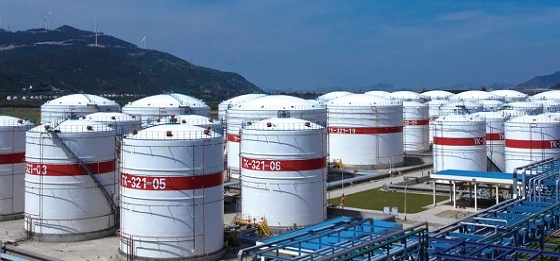
applications
1. Oil, Gas, and Petrochemical Industries
This steel is widely utilized for equipment that processes hazardous or high-temperature media.
Pressure Vessels & Separators: Used in the fabrication of large vessels that store liquids and gases under high pressure.
Hydrotreating & Hydrogenation Reactors: Specifically chosen for its resistance to High-Temperature Hydrogen Attack (HTHA) and hydrogen-induced cracking (HIC).
Fractionation Columns: Its thermal stability makes it ideal for the continuous operation of refining units.
Sour Gas Service: The elevated chromium content (1.00–1.50%) provides essential resistance to oxidation and corrosion in environments containing hydrogen sulfide (𝐻2𝑆).
2. Power Generation
Its strength at elevated temperatures (typically 350°C to 480°C) is leveraged in thermal and nuclear power plants.
Boiler Drums & Headers: Essential for components subjected to prolonged thermal and mechanical stress.
Steam Piping Systems: Used for high-temperature ducting and piping that carries steam to turbines.
Steam Turbines: Applied in turbine components that require high creep resistance.
3. Heat Transfer Equipment
SA387 Grade 11 Class 2 is a preferred material for equipment involving thermal exchange.
Heat Exchangers: Used in shell-and-tube designs that must withstand continuous thermal cycling without deforming.
Furnace Components: Employed in parts of industrial furnaces where high-heat tolerance is required.
4. Specialized Fittings and Components
Beyond large plates, this grade is processed into critical auxiliary hardware:
Flanges and Valves: For secure connections in high-pressure pipelines.
Pipe Clamps and Fittings: To support high-temperature piping systems.
For more details about GNEE's steel products, contact us at beam@gneesteelgroup.com. We look forward to working with you.
What material category does SA387 Grade 11 Class 2 belong to?
It is a low-alloy chromium-molybdenum steel, mainly used for pressure vessel applications. It has excellent high-temperature strength and corrosion resistance, suitable for harsh working environments.
What is the main chemical composition of SA387 Grade 11 Class 2?
Its key components include 0.05-0.17% carbon, 0.40-0.65% manganese, 1.00-1.50% chromium, and 0.45-0.65% molybdenum, ensuring its mechanical properties.
What is the minimum tensile strength of SA387 Grade 11 Class 2?
The minimum tensile strength is 415 MPa (60 ksi). This strength level allows it to withstand high pressure in industrial equipment operations.
How to ensure the surface quality of SA387 Grade 11 Class 2 during fabrication?
Clean surfaces before processing, avoid scratches, and use proper welding techniques. Post-fabrication grinding can also improve surface smoothness.
What is the standard heat treatment for SA387 Grade 11 Class 2?
It typically undergoes normalizing (890-925°C) followed by tempering (595-705°C). This process enhances toughness and reduces internal stresses.
Why is post-weld heat treatment necessary for SA387 Grade 11 Class 2?
It relieves weld-induced residual stresses, improves ductility, and prevents intergranular corrosion. This ensures long-term reliability of welded joints.
What happens if SA387 Grade 11 Class 2 is over-tempered?
Over-tempering reduces its hardness and strength, affecting load-bearing capacity. It may also cause microstructural changes leading to performance degradation.
What are the main applications of SA387 Grade 11 Class 2?
It is widely used in pressure vessels, boilers, and heat exchangers in oil, gas, and petrochemical industries, especially for high-temperature and high-pressure services.
Can SA387 Grade 11 Class 2 be used in low-temperature environments?
It is not ideal for extremely low temperatures. It performs best at -29°C to 593°C, beyond which its toughness may decrease significantly.
Is SA387 Grade 11 Class 2 suitable for corrosive media?
It resists mild to moderate corrosion, especially from organic acids and steam. For severe corrosion, additional coatings or alloys are needed.