Q235 steel is a widely used carbon structural steel in the construction and manufacturing industries, valued for its versatility, durability, and cost-effectiveness.
Its popularity stems from its excellent mechanical properties and adaptability, making it ideal for applications ranging from structural frameworks to machinery parts.
Henan Jiyuan Iron and Steel (Group) Co., Ltd., established in 1958, offers extensive experience in production and R&D. They provide one-stop steel solutions and welcome global consultations.
What is Q235 Steel
Q235 steel is a low-carbon steel with a nominal carbon content of approximately 0.2%, classified under the Chinese GB standard for carbon structural steel. Known for high plasticity and weldability, it is a versatile material suitable for a wide range of construction and engineering projects.
Variants
Q235 steel includes four grades: Q235A, Q235B, Q235C, and Q235D, differing primarily in quality requirements such as impact resistance and chemical composition. The grade selection depends on the working environment and mechanical demands.
Chemical Composition
| Element | Composition (%) | Purpose |
|---|---|---|
| Carbon (C) | ≤ 0.22 | Provides strength while maintaining ductility |
| Silicon (Si) | ≤ 0.35 | Improves elasticity and contributes to strength |
| Manganese (Mn) | ≤ 1.40 | Enhances toughness and hardness |
| Phosphorus (P) | ≤ 0.045 | Low levels improve corrosion resistance and ductility |
| Sulfur (S) | ≤ 0.045 | Low levels improve weldability and reduce brittleness |
| Iron (Fe) | Balance | Primary element of the alloy |
This controlled composition ensures an excellent balance of strength, flexibility, and weldability.
Mechanical Properties
| Property | Value | Notes |
|---|---|---|
| Yield Strength | 235 MPa | Can withstand substantial loads before permanent deformation |
| Tensile Strength | 370–500 MPa | Provides durability under tension |
| Elongation | ≥26% (thicker plates), ≥20% (thinner plates) | High plasticity for molding and shaping |
| Hardness | Moderate | Suitable for machining and welding |
Advantages of Q235 Steel
High Versatility – Suitable for a wide range of industries, from construction to manufacturing.
Excellent Weldability – Low carbon content minimizes cracking risk during welding.
Cost-Effective – Provides strength and durability at an economical price.
Availability – Common in China and globally, ensuring timely supply.
Standards Compatibility – Meets international standards such as ASTM A36 and EN S235JR.
Applications of Q235 Steel
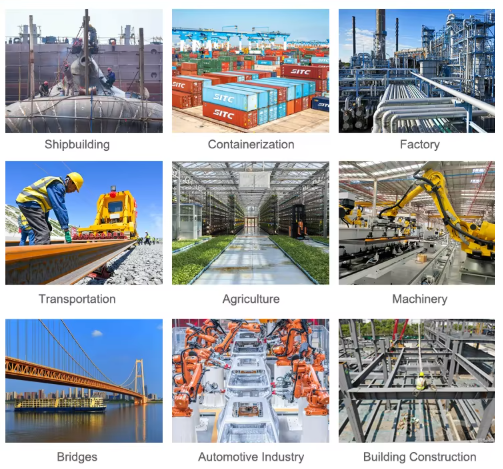
Construction: Structural frameworks for buildings, bridges, and towers; beams, plates, and bars.
Automotive Industry: Chassis components and support structures.
Machinery & Equipment: General machinery, tools, and accessories.
Pipelines & Storage Tanks: Low-pressure containers.
Shipbuilding: Non-critical ship components and structural supports.
Other Uses: Rebars, scaffolding, brackets, nuts, bolts, and mechanical parts.
Comparison with Similar Steels
| Property | Q235 Steel | ASTM A36 | EN S235JR |
|---|---|---|---|
| Standard | GB (China) | ASTM (USA) | EN (Europe) |
| Yield Strength (MPa) | 235 | 250 | 235 |
| Tensile Strength (MPa) | 370–500 | 400–550 | 360–510 |
| Weldability | Excellent | Excellent | Excellent |
| Corrosion Resistance | Moderate | Moderate | Moderate |
Q235 steel shares mechanical similarities with international counterparts, making it a reliable choice in global projects.
Q235 steel is a versatile and reliable carbon structural steel that balances strength, ductility, and cost-efficiency. Its chemical composition and mechanical properties allow it to perform well across construction, manufacturing, automotive, and mechanical applications. Understanding Q235's properties and comparing it to equivalent steels ensures informed material selection for engineering projects.
As industries continue to prioritize efficiency and sustainability, Q235 steel remains a cornerstone material, offering durability, weldability, and economic value.
FAQ
What is Q235 steel commonly used for?
Q235 steel is commonly used for construction frameworks, automotive parts, machinery components, and storage tanks.
How does Q235 steel compare to ASTM A36 steel?
Both are low-carbon structural steels with similar properties. However, ASTM A36 has slightly higher tensile strength, while Q235 steel is more cost-effective in certain regions.
Is Q235 steel suitable for welding?
Yes, Q235 steel is highly weldable due to its low carbon content, making it ideal for structural applications.
What are the different grades of Q235 steel?
Q235 steel comes in grades A, B, C, and D, which differ in quality and impact resistance.
Can Q235 steel be used in corrosive environments?
Q235 steel has moderate corrosion resistance. For highly corrosive environments, additional treatments or coatings are recommended.
Is Q235 steel recyclable?
Yes, Q235 steel is recyclable, making it an environmentally friendly material for construction and manufacturing.
What standards does Q235 steel comply with?
Q235 steel complies with the Chinese GB standard and is equivalent to ASTM A36 and EN S235JR in international markets.
How is Q235 steel produced?
Q235 steel is produced through processes such as basic oxygen steelmaking (BOS) or electric arc furnace (EAF) methods, followed by rolling or casting.