


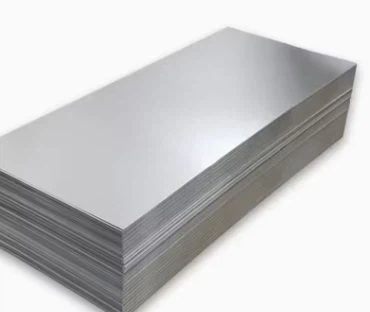
 P460NH is a high-strength, fine-grain alloy steel plate designed for pressure vessel purposes, according to the European standard EN 10028-3.
Key Identification
EN Numeric Designation: 1.8935.
P: Denotes "Pressure purposes".
460: Refers to the minimum yield strength of 460 MPa (for thicknesses ≤ 16mm).
NH: Indicates suitability for high-temperature (elevated temperature) conditions and that the material is Normalized (N)
P460NH Vessel Plate Chemical Composition:
| C | Si | Mn | Ni | P | S | Cr | Mo | V | N | Nb | Ti | Al | Cu | - |
| max 0.2 | max 0.6 | 1.1 - 1.7 | max 0.8 | max 0.025 | max 0.015 | max 0.3 | max 0.1 | max 0.2 | max 0.025 | max 0.05 | max 0.03 | max 0.02 | max 0.7 | Nb+Ti+V < 0.22 |
P460NH Boiler Plate Mechanical Properties:
| Grade | Thickness mm | Yield strength ReH MPa min. | Tensile strength MPa | Elongation % min. |
| P460NH | ≤16 | 460 | 570~730 | 17 |
| 16 | 445 | 570~720 | 17 | |
| 40 | 430 | 570~720 | 17 | |
| 60 | 400 | 540~710 | - | |
| 100 | - | - | - |
 Applications
Petrochemical & Chemical Industry: Core components of pressure vessels, including reactors, heat exchangers, and storage tanks for crude oil, natural gas, and chemical reagents. It withstands high pressure and corrosive media, ensuring stable operation of refining and chemical processes.
Power Generation Industry: Critical parts of thermal power plants, such as boiler drums, steam headers, and pressure pipelines. It maintains structural integrity under long-term high-temperature and high-pressure steam erosion, supporting continuous power supply.
Offshore & Marine Engineering: Structural components of offshore platforms, subsea pipelines, and floating production units. Its low-temperature toughness resists harsh marine environments, including low temperatures, salt spray corrosion, and wave impact.
Heavy Engineering & Machinery: Large-diameter pressure pipes, pressure-containing structures, and high-load components in mining machinery and construction equipment. Its high yield strength reduces structural weight while ensuring load-bearing capacity.
Food & Pharmaceutical Industry: High-pressure autoclaves and sterilization vessels. It meets food-grade and pharmaceutical-grade hygiene requirements, with good weldability to ensure sealed and safe equipment operation.
Application Conditions
Temperature Conditions: Suitable for continuous service at -20°C to 400°C. It retains stable strength and toughness at low temperatures (minimum impact energy 40J at -20°C) and resists creep deformation at high temperatures, avoiding structural failure under thermal cycling.
Pressure Conditions: Designed for high-pressure scenarios, with a minimum yield strength of 460MPa and tensile strength of 570-720MPa. It is applicable to equipment with internal pressures up to 10MPa, such as high-pressure reactors and steam pipelines.
Medium Conditions: Adaptable to non-strong corrosive media, including steam, natural gas, crude oil, and neutral aqueous solutions. For corrosive environments (e.g., salt spray, acidic media), additional anti-corrosion coatings or post-processing are required.
Structural Conditions: Mainly used in welded structures. The base material and weld joints must maintain consistent mechanical properties, requiring strict control of welding residual stress to avoid hydrogen-induced cracking.
Service Environment Conditions: Suitable for harsh environments such as offshore high humidity, industrial area dust, and outdoor temperature fluctuations. It has good weather resistance and can operate stably for a long time without obvious performance degradation.
 Adopted Processes
Heating & Forming Process: Hot forming is preferred, with heating temperature controlled at 850-1100°C for uniform heating. Forming operations (bending, rolling) are completed within the temperature range, followed by controlled cooling to retain the normalized microstructure and avoid cold cracking.
Welding Process: Adopt standard methods such as SMAW (manual arc welding), GMAW (gas metal arc welding), and SAW (submerged arc welding). Preheat to 100-200°C (adjust based on plate thickness) to reduce hydrogen content; control interpass temperature below 300°C and perform post-weld heat treatment (PWHT) for thick sections to relieve residual stress.
Heat Treatment Process: Supplied in the normalized condition (heating to 890-950°C, holding for a certain time, air cooling). PWHT (600-650°C, heat preservation, slow cooling) is required for critical components to improve toughness and reduce welding stress.
Cutting & Machining Process: Use flame cutting, plasma cutting, or shearing for cutting; perform edge grinding to ensure smoothness. Machining with high-speed steel or cemented carbide tools, adopt appropriate cutting speed and feed rate to reduce tool wear.
Inspection & Surface Treatment Process: Conduct non-destructive testing (ultrasonic, radiographic inspection) on welds and base material. Clean surfaces (derusting, degreasing) before welding/coating; apply anti-corrosion coatings (epoxy resin, galvanizing) for harsh environments to enhance service life.
If you want to learn more about GNEE's products, you can send an email to beam@gneesteelgroup.com. We are more than happy to assist you.
Can P460NH be used for high-pressure vessels?
Yes, P460NH is suitable for high-pressure vessels operating at moderate temperatures. Its high yield and tensile strength can withstand high internal pressure, ensuring the safety and reliability of the vessel.
What is the grain size of P460NH?
P460NH has a fine-grained structure (grain size ≥5 according to ASTM E112). Fine grains improve the material's strength, toughness, and weldability, reducing the risk of grain boundary cracking.
How to store P460NH plates?
P460NH plates should be stored in a dry, well-ventilated warehouse to avoid moisture and corrosion. They should be placed on wooden supports to prevent contact with the ground and covered with waterproof cloth.
What welding consumables are suitable for P460NH?
Suitable welding consumables for P460NH include E7018 (SMAW), ER70S-6 (GMAW), and ER70S-G (GTAW). These consumables match the material's strength and ensure weld joint performance.
Can P460NH be cold-formed?
P460NH can be cold-formed under certain conditions. For thick plates or complex shapes, preheating may be required to reduce forming stress and avoid cracks. Post-forming heat treatment may be needed for critical components.
What is the thermal conductivity of P460NH?
The thermal conductivity of P460NH is about 50 W/(m·K) at room temperature. This property is important for heat transfer calculation in heat exchangers and boiler equipment.
What is the coefficient of thermal expansion of P460NH?
The linear coefficient of thermal expansion of P460NH is approximately 11.5×10⁻⁶ /°C (20-100°C). It is used in thermal stress calculation during equipment design and operation.
Is P460NH a alloy steel?
No, P460NH is a non-alloy steel. It mainly consists of carbon, silicon, manganese, and trace impurities, without adding large amounts of alloying elements like Cr, Ni, Mo. It belongs to fine-grained structural steel.
What is the hardness of P460NH?
The Brinell hardness (HB) of P460NH is typically 137-187. This moderate hardness balances strength and machinability, making it easy to process into various components.
Can P460NH be used in the petrochemical industry?
Yes, P460NH is widely used in the petrochemical industry. It is suitable for manufacturing reactors, separators, storage tanks, and pipelines that handle oil, gas, and chemical media at moderate temperatures and pressures.