


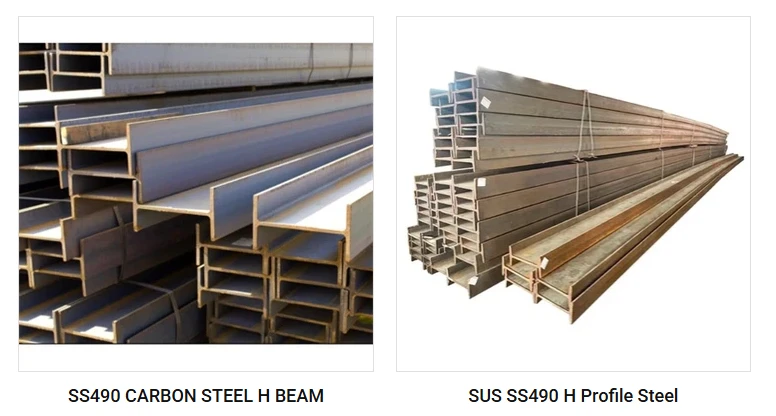
Correctly selecting the thickness of SS490 (or its equivalent, like Q355B) according to design load is a fundamental engineering process governed by structural design codes. It is not a simple table lookup but a systematic iterative process of calculation and verification.
Here is a step-by-step professional workflow:
Step-by-Step Selection Process
1. Define Input Parameters
Design Loads: Determine all acting loads (dead load, live load, wind, snow, seismic, etc.) and their combinations per the relevant code (e.g., GB 50017, Eurocode 3, AISC).
Material Properties: Use the minimum guaranteed properties of SS490:
Yield Strength, fy=325 MPafy=325MPa
Tensile Strength, fu=490 MPafu=490MPa
Modulus of Elasticity, E=205,000 MPaE=205,000MPa
Structural Configuration: Span, support conditions (fixed, pinned), member type (beam, column, plate), and connection details.
Safety Factors: Apply partial safety factors (γM0,γM1,γM2γM0,γM1,γM2) for resistance as specified in the design code.
2. Preliminary Sizing (Estimation)
For Beams: Based on bending moment MM, estimate section modulus WplWpl required:
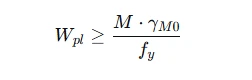
Choose a standard section (I-beam, channel) from a catalog that meets this.
For Plates/Sheets: Often governed by deflection or shear. Use simplified rules (e.g., span/24 for floor plates) or empirical tables from design handbooks for initial thickness.
For Columns: Based on axial load NN, estimate cross-sectional area AA required:

(This is a crude estimate; buckling will control later).
3. Perform Detailed Design Checks (The Core Iterative Process)
For the initially selected thickness/section, verify all limit states:
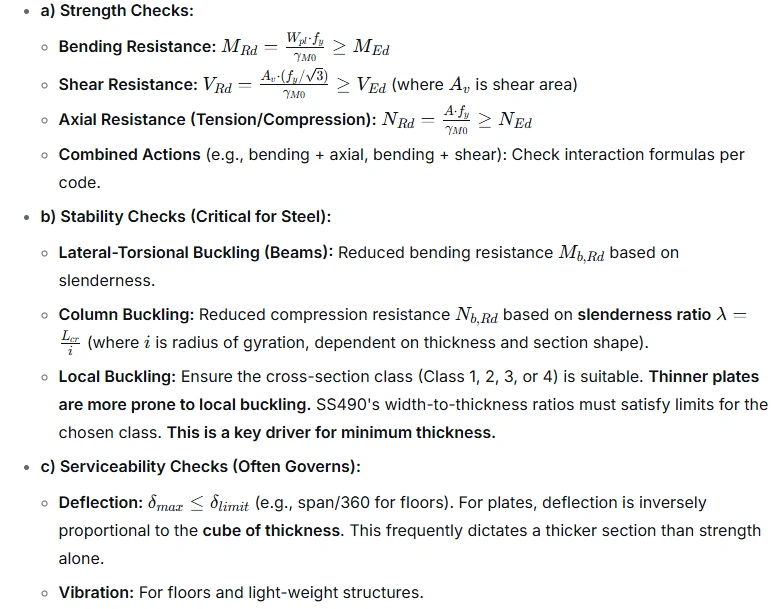
Vibration: For floors and light-weight structures.
4. Optimize and Iterate
If any check fails, increase thickness or change section geometry.
If checks are overly satisfied, consider reducing thickness to save material and cost.
Use engineering software (e.g., SAP2000, ANSYS, or design-specific tools) to automate iterations.
5. Consider Fabrication and Corrosion
Minimum Practical Thickness: For plates, usually ≥ 6 mm for handling and welding distortion.
Corrosion Allowance: SS490 has no corrosion resistance. Add a corrosion margin (typically 1–3 mm) to the calculated thickness if exposed to moisture. This is mandatory for marine or industrial environments.
Standard Available Sizes: Select final thickness from standard mill production lists (e.g., 6, 8, 10, 12, 16, 20, 25 mm, etc.) to avoid custom rolling costs.
Practical Example: Selecting Floor Plate Thickness
Scenario: A platform floor plate, span = 1.5m, simply supported, live load = 5 kN/m².
Step 1 – Load: Calculate design bending moment MEdMEd.
Step 2 – Strength: Solve for required thickness tt based on MRdMRd.
May yield t≈10 mmt≈10mm.
Step 3 – Deflection: Check deflection limit (e.g., span/200). Often governs, may require t≈14 mmt≈14mm.
Step 4 – Buckling: Check plate local buckling under compression.
Step 5 – Final: Choose t = 16 mm as the nearest standard size, including a 2mm corrosion allowance.
Key Professional Tools & References
Design Codes: Always follow the legally binding national code (e.g., GB 50017 in China, Eurocode 3 in EU, AISC 360 in USA).
Steel Section Handbooks: Contain pre-calculated properties (A, I, W, i) for standard sections.
Software: Finite Element Analysis (FEA) for complex geometries or loadings.
Critical Warnings
Do NOT select thickness based solely on load divided by yield strength. Buckling and deflection will govern in most thin-plate and slender member applications.
SS490's lack of toughness means extra caution is needed for dynamic or low-temperature applications, potentially requiring thicker sections to lower stress levels.
Always involve a licensed structural engineer for final design verification.
In summary, selecting SS490 thickness is an iterative process of verifying strength, stability, and serviceability limit states under design loads, while also accounting for practical fabrication and corrosion needs. The governing factor often shifts from strength to stability (buckling) or deflection as members become more slender.