


Compare AR500 vs AR600 steel plate hardness, wear resistance, fabrication, cost, and ballistic performance. Learn when to choose AR500 or AR600 and request mill-certified plates from Gnee.
AR600 delivers higher surface hardness and greater abrasion and ballistic resistance than AR500, making it the preferred choice when maximum wear life, thinner/lighter sections, or higher-velocity ballistic protection are required.
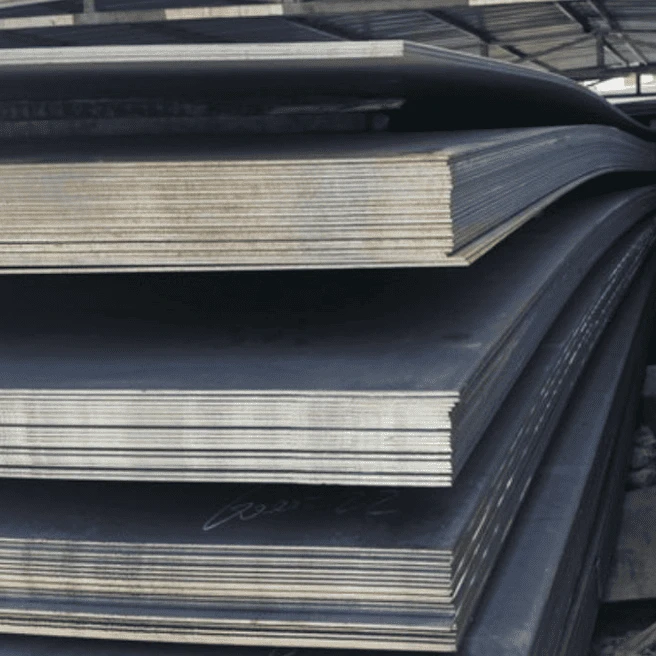
AR600
However, AR600 is generally harder to form, more expensive, and may exhibit lower ductility than AR500. For many heavy-wear, impact-tolerant applications where cost control, weldability, and toughness matter, AR500 remains the practical and cost-effective option.
Understanding the differences between AR500 and AR600 helps engineers, fabricators, and procurement teams select the right plate for performance, safety, and total system cost.
Typical Mechanical Properties: AR500 vs AR600
The values below represent commonly reported mill-typical ranges, compiled from reputable producers and distributors. Always rely on MTRs for project acceptance.
| Property | AR500 (Typical) | AR600 (Typical) | Notes |
|---|---|---|---|
| Surface Hardness | ~470–540 HBW (often 477–534) | ~570–650 HBW (often 580–670) | AR600 is significantly harder |
| Tensile Strength | ~1650 MPa (≈240 ksi) | ~1825–1830 MPa (≈265 ksi) | Higher hardness usually increases tensile |
| Yield Strength | ~1480 MPa (≈215 ksi) | ~1516–1518 MPa (≈220 ksi) | Varies by heat treatment |
| Elongation | ~6–12% (mill/thickness dependent) | Often lower; may be single digits | AR600 less ductile |
| Toughness / Charpy | Mill-dependent | Lower at higher hardness | Validate for low-temp / ballistic use |
Metallurgy: How AR Plates Get Their Properties
AR steel plates are typically produced using quenching and tempering. This process creates:
A very hard wear-resistant surface
A tougher supporting core
Carbon, manganese, and controlled alloying (Cr, Mo, Ni, sometimes B) are used to reach the target hardness while retaining usable toughness.
For AR600, mills generally use:
Higher carbon and alloy content
More aggressive quench & temper cycles
This increases wear resistance but also reduces ductility and increases cracking sensitivity if fabrication is not controlled.
Practical Fabrication and Welding Considerations
Welding
AR500 and AR600 can be welded, but procedures must match hardness and thickness.
Key considerations:
Use low-hydrogen consumables
Apply appropriate preheat and interpass control
Select filler metals suitable for dissimilar steel joints
Control cooling rates to avoid excessive HAZ hardness
AR600 requires tighter control than AR500 and experienced welders.
Cutting
Plasma and laser cutting are common for both grades
AR600 causes faster wear of consumables
Parameter optimization is more critical as hardness increases
Forming & Bending
AR500: more forgiving, suitable for moderate bending
AR600: limited formability; larger bend radii required
Some AR600 products are supplied with mill-certified bend limits - always confirm before forming.
Thermal Treatment After Fabrication
Localized heating from welding or grinding can alter hardness and microstructure.
For critical applications:
Avoid stress relieving unless approved
Perform post-fabrication hardness inspection when required
Ballistic Applications: AR500 vs AR600
In ballistic and target-steel applications, hardness directly affects projectile deformation.
AR600 can defeat higher-velocity rifle rounds at thinner areal density
AR500 offers better toughness and multi-hit tolerance in many cases
Very hard plates may spall more unless properly backed and coated.
Cost, Availability, and Lead Times
Material Cost
AR600 costs more per kg due to alloying, processing, and lower production volume
Thinner AR600 sections can sometimes offset system-level cost
Availability
AR500: widely stocked globally
AR600: smaller inventories; often made to order
For urgent projects, AR500 is usually faster to source.
When to Choose AR500 vs AR600
| Decision Factor | Choose AR500 When… | Choose AR600 When… |
|---|---|---|
| Cost | Budget-sensitive projects | Performance justifies higher cost |
| Forming | Bending/forming required | Minimal or no forming |
| Welding | Extensive fabrication | Limited, controlled welding |
| Ballistics | Low–moderate threats | High-velocity, weight-critical |
| Abrasion | Heavy but economical wear | Extreme sliding & gouging wear |
What Engineers Should Specify
To avoid "hard but brittle" material, specifications should include:
Brinell hardness testing (ASTM E10)
Tensile testing (ASTM A370)
Charpy impact values at defined temperature
Full Mill Test Reports (MTRs) with chemistry, hardness locations, and heat treatment
Gnee Advantage in AR500 & AR600 Supply
At Gnee, we work directly with qualified Chinese mills and maintain stock for common AR500 and AR600 thicknesses.
We provide:
Factory-direct pricing
Mill-certified MTRs
Heat treatment traceability
Expedited shipping for stocked sizes
For quotations, simply provide thickness, length, and quantity.
Typical stocked thicknesses range from 6 mm to 50 mm, depending on grade.
AR500 and AR600 are both high-performance abrasion resistant steels, but they serve different engineering priorities.
AR500 balances toughness, cost, and fabricability, while AR600 delivers maximum hardness and wear or ballistic performance where weight and service life matter most.
Contact gnee for AR500 or AR600 steel plate pricing, availability, and mill-certified technical support.
Contact us for latest AR 600 steel plate price list

Packing
What is AR600 steel plate?
AR600 steel plate is an ultra-high hardness abrasion resistant steel with a typical Brinell hardness of around 570–640 HBW. It is designed to provide exceptional wear resistance in extremely harsh working conditions where standard AR400 or AR500 plates are no longer sufficient.
What are the main applications of AR600 steel plate?
AR600 steel plate is widely used in severe abrasion environments such as mining liners, rock crushers, chutes, hoppers, dump truck bodies, quarry equipment, and heavy-duty material handling systems where impact and sliding wear are extremely high.
How does AR600 compare to AR500 steel plate?
Compared with AR500, AR600 offers significantly higher hardness and longer service life under severe wear conditions. However, AR600 has lower formability and weldability, making it more suitable for flat or minimally fabricated components rather than complex formed structures.
Can AR600 steel plate be cut or machined?
AR600 steel plate can be cut using plasma, laser, or water jet cutting methods. Conventional machining is difficult due to its extreme hardness, so carbide or ceramic tools are recommended, and water jet cutting is often preferred to avoid heat-affected zones.
What is the typical hardness of AR600 steel plate?
The typical hardness range of AR600 steel plate is 570–640 HBW, depending on plate thickness and production process. This high hardness is the key factor behind its outstanding abrasion resistance.
Is AR600 steel plate suitable for cold forming or bending?
Cold forming of AR600 steel plate is generally not recommended. Due to its ultra-high hardness and low ductility, bending can lead to cracking. If forming is required, alternative grades with lower hardness should be considered.