


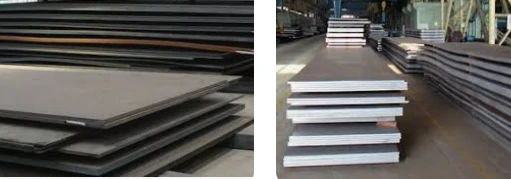
S690QL is a high-yield strength structural steel (HSLA) known for its exceptional strength (minimum 690 MPa yield) and toughness, produced to the EN 10025-6 standard using a quench and temper heat treatment, allowing for lighter, more efficient designs in heavy-duty applications like cranes, bridges, and earthmoving equipment, with excellent weldability and formability despite needing careful handling due to its strength. Its name signifies "Structural" (S), "690 MPa" minimum yield, "Quenching" (Q), and "Low" temperature toughness (L).
Key Characteristics
High Strength: Minimum yield strength of 690 MPa (for thinner sections), enabling lighter structures and increased payload capacity.
Quenched & Tempered (Q+T): Heat treatment provides superior strength, toughness, and durability.
Excellent Toughness: Good impact strength even at low temperatures (indicated by 'L').
Good Weldability & Formability: Allows for complex fabrications when proper procedures are followed.
Composition (Typical Max Values)
Carbon (C): ~0.20%
Manganese (Mn): ~1.70%
Silicon (Si): ~0.80%
Chromium (Cr): ~1.50%
Molybdenum (Mo): ~0.70%
Nickel (Ni): ~2.0%
Grain Refiners: Contains V, Nb, Ti, Zr (min 0.015%) for fine grain structure.
Applications
Mobile cranes and lifting equipment
Bridges and heavy-duty construction
Earthmoving and mining machinery (dump trucks, drilling rigs)
Wind turbine towers

Can S690QL be machined easily?
No, S690QL cannot be machined easily. Due to its very high strength (690 MPa yield) and hardness (typically 240-300 HBW), it is classified as a difficult-to-machine material compared to mild or standard alloy steels. Specialized techniques and tools are required to achieve good results without excessive tool wear or damage to the workpiece.
Here are the key challenges and guidelines for machining S690QL:
Main Challenges:
High Cutting Forces: The material's strength demands robust machinery and rigid setups to avoid vibration and chatter.
Rapid Tool Wear: The hardness and abrasiveness of S690QL (especially surface scale) cause accelerated wear on cutting edges.
Heat Generation: High cutting forces and friction generate significant heat, which can further degrade tool life and potentially alter the material's properties if not controlled.
Work Hardening: Improper machining (e.g., using worn tools or incorrect parameters) can harden the surface, making subsequent passes even more difficult.
Essential Machining Guidelines:
Tooling: Use high-performance carbide grades (C2/C3), ceramic-coated carbides, or cermet inserts. Tools must be sharp and have a positive rake geometry to reduce cutting forces.
Cutting Parameters:
Cutting Speed (Vc): Moderate to low – typically 80–150 m/min for turning with carbide tools.
Feed Rate: Use sufficient feed to prevent rubbing and work hardening.
Depth of Cut: Adequate to cut beneath any hardened layer.
Coolant: High-pressure, high-quality coolant is essential to dissipate heat, improve tool life, and aid chip evacuation.
Rigidity: Ensure maximum stability in the machine, workpiece clamping, and tool holder to minimize deflection.
Preparatory Step: Remove the hard, decarburized surface scale (often present on as-delivered plate) by rough machining or abrasive methods before finish machining, as it is highly abrasive.
Summary:
While S690QL is machinable, it requires:
Powerful, rigid machine tools
Premium-grade cutting tools
Precise, optimized cutting parameters
Effective cooling
Experienced operators
For critical components, consultation with tooling suppliers and test runs is strongly recommended to develop a stable, cost-effective machining process.
EN10025-6 S690Q quenched and tempered steel plate Chemical composition
| Grade | C % | Si % | Mn % | P % | S % | N % | B % | Cr % |
| S690Q | 0.200 | 0.800 | 1.700 | 0.025 | 0.015 | 0.015 | 0.005 | 1.500 |
| Cu % | Mo % | Nb % | Ni % | Ti % | V % | Zr % | ||
| 0.500 | 0.700 | 0.060 | 2.000 | 0.050 | 0.120 | 0.150 |
EN10025-6 S690Q quenched and tempered steel plate mechanical properties
| Grade | Thickness | Min Yield | Tensile | Elongation | Min Impact Energy | |
| S690Q | 8mm-50mm | Min 690Mpa | 770-940Mpa | 14% | -20 | Min 30J |
| 51mm-100mm | Min 650Mpa | 760-930Mpa | 14% | -20 | Min 30J | |
| 101mm-150mm | Min 630Mpa | 710-900Mpa | 14% | -20 | Min 30J |
1. What is S690QL steel?
S690QL is a high-strength, quenched and tempered structural steel grade with a minimum yield strength of 690 MPa, specifically optimized for low-temperature toughness down to -40°C.
2. What does the "L" stand for in S690QL?
The "L" stands for "Low temperature," indicating the steel is certified for enhanced impact toughness at temperatures as low as -40°C.
3. What are the typical applications of S690QL?
It is commonly used in extreme environments such as Arctic construction, offshore platforms, high-latitude mining equipment, and mobile cranes operating in freezing conditions.
4. How does S690QL differ from S690Q?
The key difference is that S690QL guarantees higher impact toughness at -40°C, while standard S690Q is typically tested at 0°C, making S690QL better suited for freezing climates.
5. What is the chemical composition of S690QL?
It is a low-alloy steel containing carbon, manganese, silicon, and micro-alloys like niobium, vanadium, and titanium, with strict control of phosphorus and sulfur to ensure weldability and toughness.
6. What welding procedures are required for S690QL?
Welding requires low-hydrogen electrodes, strict preheating (often 100-150°C), controlled heat input, and often post-weld stress relief to maintain toughness and prevent cracking.
7. Is S690QL corrosion resistant?
No, S690QL is not inherently corrosion-resistant. Like other high-strength structural steels, it requires protective coatings (e.g., painting or galvanizing) for use in corrosive environments.
8. What standards cover S690QL material?
It is primarily defined by the European standard EN 10025-6, with equivalent specifications in other systems (e.g., ASTM, ISO).
9. Can S690QL be machined easily?
Machining S690QL is challenging due to its high strength and hardness; it requires robust tooling, adequate cooling, and optimized cutting parameters to avoid excessive tool wear.
Full specification and details are available on request. The above information is provided for guidance purposes only. For specific design requirements please contact our technical sales staff.
