


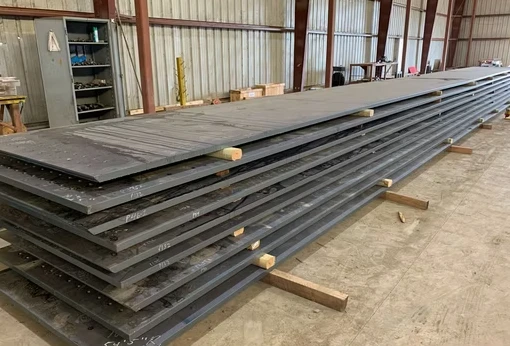
 ASTM A517 Grade B is a quenched and tempered high-strength alloy steel plate covered by ASTM A517/A517M. It is primarily used in the fabrication of welded pressure vessels, storage tanks, heat exchangers, and other structural components that demand high strength, good toughness, and reliable weldability. The steel is alloyed with chromium, molybdenum, vanadium, and small amounts of boron to achieve high yield strength along with satisfactory low-temperature impact properties. Plates are typically supplied in the quenched and tempered condition, which refines the microstructure and ensures consistent mechanical performance across a range of thicknesses. Thanks to its balanced combination of strength, toughness, and weldability, ASTM A517 Grade B is widely applied in heavy machinery, offshore structures, and pressure-containing equipment operating under severe service conditions.
Chemical Requirements
| Elements | Grade B % |
|---|---|
| Carbon | |
| Heat analysis | 0.15-0.21 |
| Product analysis | 0.13-0.23 |
| Manganese | |
| Heat analysis | 0.70-1.00 |
| Product analysis | 0.64-1.10 |
| Phosphorus, max | 0.025 |
| Sulfur, max | 0.025 |
| Silicon | |
| Heat analysis | 0.15-0.35 |
| Product analysis | 0.13-0.37 |
| Nickel | |
| Heat analysis | – |
| Product analysis | – |
| Chromium | |
| Heat analysis | 0.40-0.65 |
| Product analysis | 0.36-0.69 |
| Molybdenum | |
| Heat analysis | 0.15-0.25 |
Tensile Requirements
| 2.50 in. [65 mm] and Under | Over 2.50 to 6 in. [65 to 150 mm] | |
|---|---|---|
| Tensile strength | 115-135 [795-930] | 105-135 [725-930] |
| Yield strength, min, ksi [MPa] | 100 [690] | 90 [620] |
| Elongation in 2 in. [50 mm], min, % | 16 | 14 |
| Reduction of area, min, %: | ||
| Rectangular specimens | 35 | – |
| Round specimens | 45 | 45 |
processing
Melting and Refining:
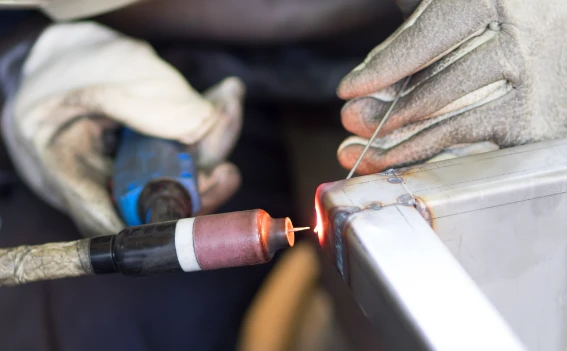
The production of ASTM A517 Grade B begins with melting high-quality scrap and alloys in an electric arc furnace or basic oxygen furnace. The steel is refined to control carbon, manganese, chromium, molybdenum, vanadium, and boron within strict limits, ensuring the desired hardenability and weldability.
Casting:
After refining, the molten steel is cast into ingots or continuous-cast slabs. These semi-finished products are inspected for surface defects and internal soundness to prevent quality issues in later stages.
Reheating and Hot Rolling:
The slabs are reheated to a precise temperature and then hot-rolled into plates of the required thickness, width, and length. Controlled rolling practices are used to develop a fine, uniform grain structure, which enhances strength and toughness.
Quenching:
Following rolling, the plates are rapidly quenched, usually in water or a controlled quenchant. This rapid cooling transforms the microstructure into martensite, a hard and strong phase that forms the basis of the steel's high strength.
Tempering:
After quenching, the plates are tempered at a moderate temperature. This step relieves internal stresses, improves ductility and toughness, and stabilizes the mechanical properties while maintaining the high yield and tensile strength typical of A517 Grade B.
Straightening and Inspection:
The heat-treated plates are straightened to ensure flatness and dimensional accuracy. They then undergo non-destructive testing, such as ultrasonic inspection, to detect any internal flaws.
Finishing Operations:
The final steps include shot blasting to clean the surface, edge trimming for precise dimensions, and sometimes applying a protective coating. The plates are then ready for delivery or further fabrication.
 applications
Pressure Vessels and Storage Tanks: ASTM A517 Grade B is widely used in the construction of welded pressure vessels, including those for oil and gas processing, chemical plants, and power generation. Its high yield strength and good weldability allow designers to reduce plate thickness while maintaining structural integrity, resulting in lighter and more cost-effective equipment.
Heat Exchangers and Process Equipment: The steel's combination of strength and toughness makes it suitable for heat exchangers, boilers, and other process equipment operating under high pressure and temperature. Its ability to withstand thermal cycling and resist creep ensures reliable performance in demanding industrial environments.
Heavy Machinery and Structural Components: It is commonly employed in the manufacturing of heavy machinery, such as cranes, excavators, and offshore platforms. Key structural parts, including boom sections, chassis components, and load-bearing members, benefit from the material's high strength-to-weight ratio and excellent fatigue resistance.
Offshore and Subsea Structures: Due to its good low-temperature toughness and resistance to harsh marine conditions, ASTM A517 Grade B is used in offshore structures, including jackets, decks, and pipeline components. It provides the necessary strength to withstand wind, wave, and operational loads.
Bridges and High-Rise Buildings: In civil engineering, it is used for critical structural elements in bridges and high-rise buildings where high strength and durability are essential. Its use helps optimize design, reduce material weight, and enhance overall structural performance.
Why Choose Us
You can get the perfect material according to your requirement at the least possible price.
We also offer Reworks, FOB, CFR, CIF, and door to door delivery prices. We suggest you to do deal for shipping which will be quite economical.
The materials we provide are completely verifiable, right from raw material test certificate to the final dimensional statement.(Reports will show on requirement)
We guarantee to give a response within 24hours(usually in the same hour)
You can get stock alternatives, mill deliveries with minimizing manufacturing time.
We are fully dedicated to our customers. If it will not possible to meet your requirements after examining all options, we will not mislead you by making false promises which will create good customer relations.
If you have project requirements for a517 grade b, we welcome your inquiry. GNEE maintains a large inventory of commonly used high strength steel grades for your selection.For detailed mechanical properties, chemical composition, and technical data, as well as free samples, please contact our factory immediately. We offer competitive prices, stable quality, and professional service. Email:beam@gneesteelgroup.com.
Can A517 Grade B be cold-formed?
It can be cold-formed with caution. Due to its high strength, cold forming requires higher forces, and post-forming heat treatment may be necessary to restore toughness and reduce residual stresses.
Can A517 Grade B be used in pressure vessel manufacturing?
Yes, it is a preferred material for pressure vessel manufacturing. Its high strength, good toughness and excellent weldability make it suitable for vessels carrying high-pressure fluids or gases.
What is the melting point of A517 Grade B?
The melting point of A517 Grade B is around 1450-1500°C (2642-2732°F), similar to other alloy steels. This parameter is crucial for casting and welding processes.
Can A517 Grade B be used in low-temperature environments?
Yes, it is suitable for low-temperature environments. Its good low-temperature toughness can effectively prevent brittle fracture, making it ideal for cold regions or low-temperature pressure systems.
What is the difference between A517 Grade B and A516 Grade 70?
A517 Grade B is high-strength quenched and tempered steel, while A516 Grade 70 is carbon steel. The former has higher tensile/yield strength and better toughness, suitable for more demanding working conditions.
Can A517 Grade B be machined easily?
It can be machined with proper tools and parameters. Due to its high strength, compared with ordinary carbon steel, it may require higher cutting forces and wear-resistant machining tools.
What is the purpose of post-weld heat treatment for A517 Grade B?
Post-weld heat treatment can relieve residual stresses in the weld zone, improve weld toughness, reduce the risk of weld cracking, and ensure the overall performance of the welded component.
What is the modulus of elasticity of A517 Grade B?
The modulus of elasticity of A517 Grade B is approximately 200 GPa (29×10⁶ psi) at room temperature, which reflects its stiffness and ability to resist elastic deformation.
What industries commonly use A517 Grade B?
It is widely used in oil and gas, petrochemical, power generation, marine engineering and heavy machinery industries, where high-strength and durable materials are in great demand.