


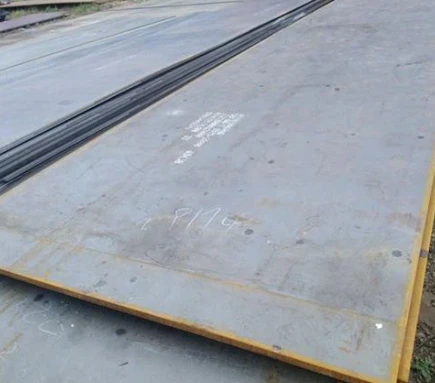
SA517 Grade E is a high-strength, quenched and tempered alloy steel plate. It is mainly used for pressure vessels and boilers, featuring excellent toughness and weldability, suitable for low-temperature and high-pressure working environments.
Chemical Requirements
| Elements | Grade E % |
|---|---|
| Carbon | |
| Heat analysis | 0.12-0.20 |
| Product analysis | 0.10-0.22 |
| Manganese | |
| Heat analysis | 0.40-0.70 |
| Product analysis | 0.35-0.78 |
| Phosphorus, max | 0.025 |
| Sulfur, max | 0.025 |
| Silicon | |
| Heat analysis | 0.10-0.40 |
| Product analysis | 0.08-0.45 |
| Nickel | |
| Heat analysis | – |
| Product analysis | – |
| Chromium | |
| Heat analysis | 1.40-2.00 |
| Product analysis | 1.34-2.06 |
| Molybdenum | |
| Heat analysis | 0.40-0.60 |
Tensile Requirements
| 2.50 in. [65 mm] and Under | Over 2.50 to 6 in. [65 to 150 mm] | |
|---|---|---|
| Tensile strength | 115-135 [795-930] | 105-135 [725-930] |
| Yield strength, min, ksi [MPa] | 100 [690] | 90 [620] |
| Elongation in 2 in. [50 mm], min, % | 16 | 14 |
| Reduction of area, min, %: | ||
| Rectangular specimens | 35 | – |
| Round specimens | 45 | 45 |
SA517 Grade E Advantages
Mechanical Performance
Exceptionally high tensile and yield strength combined with excellent low-temperature toughness, maintaining structural integrity under extreme dynamic and cyclic pressure/thermal stress conditions without brittle fracture.
Heat & Corrosion Resistance
Superior high-temperature stability for long-term service under elevated thermal conditions; good resistance to general industrial corrosion and hydrogen embrittlement, petrochemical and offshore harsh media environments.
Weldability & Fabricability
Excellent weldable properties with minimal preheating requirements, ensuring high-quality weld joints and structural homogeneity; good formability for cold/hot working, easy to fabricate into complex pressure components.
Structural Reliability
Strict manufacturing and quality control standards, consistent material properties across the whole plate; high fatigue resistance, suitable for long-term cyclic load applications in power and pipeline systems.
Industrial Adaptability
Meets international pressure vessel material specifications, compatible with various industrial processing technologies; versatile for multi-scenario use with stable performance in marine, nuclear, and high-temperature industrial environments.
 SA517 Grade E Processing
Cutting & Forming
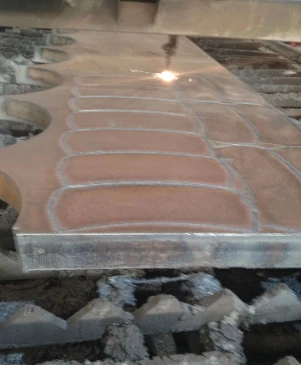
Excellent cold/hot formability for bending, rolling and stamping into complex pressure vessel geometries; oxy-fuel, plasma and laser cutting all applicable with clean, precise edges and minimal post-cut finishing required.
Welding
Low preheating demand (typically 100–150℃) for common welding processes (GMAW, SMAW, SAW); weld joints retain high strength and toughness matching base metal, no obvious post-weld embrittlement, easy to achieve structural homogeneity.
Heat Treatment
Normalizing + tempering as standard heat treatment to optimize strength-toughness balance; stress relief annealing available post-welding/forming to eliminate residual stresses, avoid deformation and ensure dimensional stability.
Machining
Good machinability for turning, milling and drilling; stable chip formation during processing, low tool wear rate, ensures high precision of pressure-bearing component sealing faces and connection parts.
Surface Treatment
Compatible with shot blasting, painting and anti-corrosion coating; uniform surface adhesion after treatment, enhances resistance to industrial and marine corrosion, extends service life of finished products.
If you have project requirements for SA517 Grade E, we welcome your inquiry. GNEE maintains a large inventory of commonly used high strength steel grades for your selection.For detailed mechanical properties, chemical composition, and technical data, as well as free samples, please contact our factory immediately. We offer competitive prices, stable quality, and professional service. Email:beam@gneesteelgroup.com.
What standard specifies the requirements for SA517 Grade E?
SA517 Grade E is specified by the ASME Boiler and Pressure Vessel Code (Section II, Part A). This standard defines its chemical composition, mechanical properties, heat treatment, and testing requirements.
What is the impact toughness requirement of SA517 Grade E?
It requires a minimum Charpy V-notch (CVN) impact energy of 27 J (20 ft-lb) at -18°C (0°F). This ensures good toughness even in low-temperature working conditions.
Can SA517 Grade E be used in low-temperature environments?
Yes, it is suitable for low-temperature environments. With excellent low-temperature impact toughness (CVN ≥27 J at -18°C), it resists brittle fracture in cold operating conditions.
What is the density of SA517 Grade E?
The density of SA517 Grade E is approximately 7.85 g/cm³ (0.283 lb/in³), the same as most carbon and low-alloy steels, which is a key parameter for weight calculation in engineering design.
What is the melting point range of SA517 Grade E?
Its melting point range is about 1450°C to 1500°C (2642°F to 2732°F). This range is important for casting, forging, and welding processes that involve melting the material.
What is the hardness of SA517 Grade E after heat treatment?
After quenching and tempering, its Brinell hardness (HB) is typically 220-260. This hardness level balances strength and machinability for subsequent processing.
Is SA517 Grade E resistant to corrosion?
It has moderate corrosion resistance in atmospheric and mild corrosive environments. For harsh corrosive conditions (e.g., marine, chemical), additional protection (coating, galvanizing) is needed.
What machining processes are suitable for SA517 Grade E?
It can be machined via turning, milling, drilling, and grinding. Using high-speed steel or carbide tools with proper cutting fluids is recommended to ensure machining efficiency and surface quality.
What is the elongation requirement of SA517 Grade E?
The minimum elongation at break is 16% (in 50 mm gauge length). This ductility ensures the material can deform plastically before fracture, enhancing structural safety.
What is the reduction of area requirement for SA517 Grade E?
The minimum reduction of area is 40%. This parameter reflects the material's ability to deform uniformly under tension, indicating good ductility and toughness.