


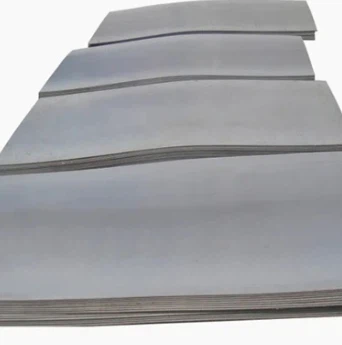
 ASME SA516 Grade 70 is the industry-standard carbon steel plate for welded pressure vessels and boilers operating at moderate to lower temperatures.
Core Specifications
Designation: Often dual-certified as ASTM A516 Grade 70 (the material standard) and ASME SA516 Grade 70 (the boiler and pressure vessel code standard).
Normalizing (70N): While supplied "as-rolled" for thinner plates, sections over 1.5 inches (38mm) must be normalized (designated as Gr 70N) to improve grain structure and impact resistance.
Density: Approximately 7850 kg/m³ (0.284 lb/in³).
Mechanical Properties of ASME SA516 Grade 70
| Description | Grade 70 |
|---|---|
| Tensile strength (ksi) | 70-90 |
| Tensile strength (MPa) | 485-620 |
| Yield strength (ksi) | 38 |
| Yield strength (MPa) | 260 |
| Elongation in 200mm (min)(%) | 17 |
| Elongation in 50mm (min) (%) | 21 |
Chemical Composition of ASME SA516 Grade 70
| Carbon (C) | % |
| 12.5mm or less 12.5 - 50mm 50 - 100mm 100 - 200mm > 200mm |
0.27 0.28 0.30 0.31 0.31 |
Manganese (Mn) |
% |
| 12.5mm or less • Heat Analysis : • Product Analysis : Over 12.5mm • Heat Analysis : • Product Analysis : |
0.85-1.20 0.79-1.30 0.85-1.20 0.79-1.30 |
Phosphorus (P) |
% |
| (max) | 0.035 |
Sulphur (S) |
% |
| (max) | 0.035 |
Silicon (Si) |
% |
| • Heat Analysis : • Product Analysis : |
0.15-0.40 0.13-0.45 |
advantages
1. High Tensile Strength
Maximum Strength in Class: Out of the four grades in the A516 family (55, 60, 65, and 70), Grade 70 offers the highest tensile strength (485–620 MPa), making it ideal for high-pressure applications.
Structural Integrity: Its high yield strength (minimum 260 MPa) ensures superior resistance to deformation under stress.
2. Exceptional Notch Toughness
Low-Temperature Performance: It is specifically designed to maintain high impact energy in cold environments. It typically passes Charpy V-notch tests at temperatures as low as -46°C (-50°F).
Brittle Fracture Resistance: The fine-grain structure (often achieved through normalizing) provides critical resistance to sudden cracking in hazardous industrial settings.
3. Excellent Weldability
Low Carbon Content: Its chemistry is strictly controlled (Carbon ≤ 0.27-0.31%) to ensure excellent weldability using common processes like SMAW, GTAW, and SAW.
Reduced Cracking Risk: The low carbon equivalent minimizes the risk of hydrogen-induced cracking in the heat-affected zone (HAZ).
4. Specialized Resistance (Sour Service)
HIC Resistance: When manufactured to specific NACE standards, it exhibits exceptional resistance to Hydrogen Induced Cracking (HIC), making it safe for sour gas environments containing H₂S.
Corrosion Tolerance: Higher manganese and silicon content provide improved oxidation and corrosion resistance compared to standard structural steels like A36.
5. Commercial Availability & Versatility
Industry Standard: Because it is globally recognized by the ASME Boiler and Pressure Vessel Code, it is readily available in a wide range of thicknesses (6mm to over 200mm).
Wide Application: It serves as a cost-effective solution for everything from storage tanks and heat exchangers to nuclear reactors and steam drums.

Key Industries
The material is widely used across several demanding sectors:
Oil and Gas: Used extensively in upstream and downstream processing equipment.
Petrochemical/Chemical Processing: Ideal for containing corrosive chemicals and sour gas (H₂S) when specified with supplementary HIC testing.
Power Generation: Used in traditional and nuclear power stations for critical high-pressure steam systems.
Construction & Transportation: Also applied in structural projects like bridges and buildings, as well as automotive and rail components, due to its strength.
Specific Equipment Applications
The plate's excellent weldability, strength, and notch toughness make it suitable for manufacturing a variety of vital components:
Pressure Vessels: The primary application, covering a vast range of containers for gases, vapors, and liquids under pressure.
Boilers & Boiler Drums: Used in the fabrication of industrial boilers that must withstand high pressures and varying temperatures.
Heat Exchangers & Condensers: Used in components that facilitate heat transfer in industrial processes.
Storage Tanks: Especially for large-scale or spherical tanks used for storing LPG, propane, and other liquids/gases at moderate or lower temperatures.
Reactors and Separators: Key components in chemical processing and refining operations.
Piping Components: Includes use in high-pressure water pipes, flanges, fittings, and pipe caps.
Cryogenic Equipment: Suitable for certain very low-temperature applications like LNG storage tanks when normalized.
If you want to learn more about GNEE's products, you can send an email to beam@gneesteelgroup.com. We are more than happy to assist you.
Is SA516 Grade 70 resistant to corrosion?
SA516 Grade 70 has moderate corrosion resistance in mild environments. It is not suitable for highly corrosive media (e.g., strong acids, alkalis). For corrosive conditions, it may need corrosion-resistant coatings or liners.
What is the maximum carbon content allowed in SA516 Grade 70?
The maximum carbon content allowed in SA516 Grade 70 is 0.33%. Controlling carbon content is critical to maintain good weldability and toughness, as excessive carbon can increase brittleness and reduce weld quality.
What is the manganese content range of SA516 Grade 70?
The manganese content range of SA516 Grade 70 is 0.79% to 1.06%. Manganese improves the material's strength and toughness, enhances weldability, and helps reduce the harmful effects of sulfur.
Are there any restrictions on phosphorus and sulfur in SA516 Grade 70?
Yes, phosphorus (P) and sulfur (S) are restricted to a maximum of 0.035% each. These elements are impurities; excessive amounts can reduce toughness, increase brittleness, and cause weld defects like hot cracking.
What is the difference between SA516 Grade 70 and A36 steel?
SA516 Gr. 70 is designed for pressure vessels with higher strength (tensile 485 MPa vs. 400 MPa for A36) and stricter toughness/quality requirements. A36 is a structural steel used for general construction, not pressure vessels.
Can SA516 Grade 70 be heat-treated to improve its properties?
SA516 Grade 70 is typically supplied in the as-rolled or normalized condition. While it can be heat-treated (e.g., quenching and tempering), this is not common, as its as-supplied properties meet most pressure vessel requirements.
What non-destructive testing (NDT) methods are used for SA516 Grade 70?
Common NDT methods include ultrasonic testing (UT) for internal defects, radiographic testing (RT) for weld quality, magnetic particle testing (MT), and liquid penetrant testing (PT) for surface defects.
What is the standard length and width of SA516 Grade 70 plates?
Standard lengths are 2400 mm, 3000 mm, 6000 mm (8 ft, 10 ft, 20 ft), and widths are 1200 mm, 1500 mm, 1800 mm (4 ft, 5 ft, 6 ft). Custom sizes are available upon request from manufacturers.
Is SA516 Grade 70 approved for use in boiler applications?
Yes, SA516 Grade 70 is approved for boiler applications under the ASME BPVC. It is used to manufacture boiler shells, headers, and other components that withstand high pressure and temperature.
What are the key quality control requirements for SA516 Grade 70 production?
Key quality control requirements include chemical composition analysis, mechanical property testing (tensile, yield, elongation, impact), NDT for defects, dimensional inspection, and compliance with ASME standard manufacturing processes.