


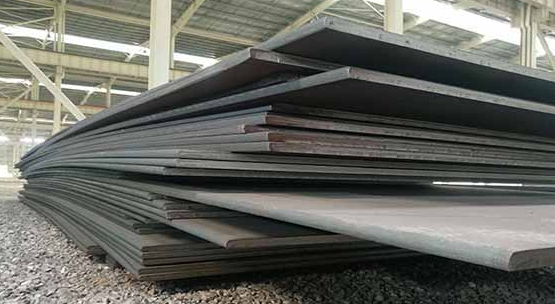
SA 387 Grade 12 Class 2 is a chromium-molybdenum alloy steel plate specifically designed for use in weldable pressure vessels and industrial boilers operating at elevated temperatures.
Equivalents
| BS | EN | ASTM/ASME | DIN |
| 620 B | 13 CRMO 45 | SA387-12-2 | 13 CRMO 44 |
Specifications for ASME SA387 Grade 12 Alloy Steel Plates
| Designation | Nominal Chromium Content (%) |
Nominal Molybdenum Content (%) |
| SA387 Grade 12 | 1.00% | 0.50% |
Tensile Requirements for ASME SA387 Grade 12 Alloy Steel Plates Class 2 Plates
| Designation: | Requirement: | Grade 12 |
| SA387 Grade 12 | Tensile strength, ksi [MPA] | 65 to 85 [450 to 585] |
| Yield strength, min, ksi [MPa]/(0.2% offset) | 40 [275] | |
| Elongation in 8 in. [200mm], min % | 19 | |
| Elongation in 2 in. [50mm], min, % | 22 | |
| Reduction of area, min % | ––– |
Chemical Requirements for ASME SA387 Grade 12 Alloy Steel Plates
| Element | Chemical Composition (%) | |
| ASME SA387 Grade 12 | ||
| Carbon: | Heat Analysis: | 0.05 - 0.17 |
| Product Analysis: | 0.04 - 0.17 | |
| Manganese: | Heat Analysis: | 0.40 - 0.65 |
| Product Analysis: | 0.35 - 0.73 | |
| Phosphorus: | Heat Analysis: | 0.035 |
| Product Analysis: | 0.035 | |
| Sulphur (max): | Heat Analysis: | 0.035 |
| Product Analysis: | 0.035 | |
| Silicon: | Heat Analysis: | 0.15 - 0.40 |
| Product Analysis: | 0.13 - 0.45 | |
| Chromium: | Heat Analysis: | 0.80 - 1.15 |
| Product Analysis: | 0.74 - 1.21 | |
| Molybdenum: | Heat Analysis: | 0.45 - 0.60 |
| Product Analysis: | 0.40 - 0.65 |
SA 387 Grade 12 Class 2 is a chromium‑molybdenum alloy steel plate used in high‑temperature and high‑pressure vessels. Its key processing requirement lies in normalizing + tempering or normalizing + accelerated cooling + tempering to achieve the required strength (Class 2) along with good toughness and resistance to hydrogen embrittlement. The focus is on optimizing the carbon content (C) and achieving an appropriate grain size to ensure reliable service in severe medium‑temperature hydrogen‑containing environments such as those found in refinery and petrochemical plants.
Key Processing Requirements
Raw Material Control
Strict control of chemical composition, especially Cr (0.80–1.15%) and Mo (0.45–0.65%), as well as low carbon (0.05–0.17%) to prevent intergranular corrosion.
Heat Treatment Process
Normalizing: Heat the steel plate above the austenitizing temperature and air‑cool to refine the grain structure, eliminate casting/rolling microstructures, and improve mechanical properties.
Tempering: After normalizing, reheat to a specific temperature (typically 600–700°C) and air‑cool to reduce hardness, enhance ductility and toughness, while maintaining sufficient strength.
Accelerated Cooling + Tempering: For thicker plates or specific requirements, accelerated cooling to near room temperature after normalizing may be applied before tempering to more precisely control microstructure and properties.
Property Requirements (Class 2)
Class 2 corresponds to higher tensile and yield strength compared to Class 1, with stricter requirements to ensure resistance to hydrogen embrittlement, hydrogen attack, and sulfide corrosion in high‑temperature hydrogen‑containing environments.
Inspection and Testing
Tensile testing, Charpy V‑notch impact testing, hardness testing, and macro/microstructural examination (including grain size) must be performed to meet ASME/ASTM standards.

Application Background
Widely used in the fabrication of petrochemical equipment, ammonia synthesis reactors, coal gasifiers, nuclear power plant pressure vessels, etc.
Demonstrates excellent performance in medium‑temperature hydrogen‑containing environments (350–480°C), such as hydroprocessing units.
For more details about GNEE's steel products, contact us at beam@gneesteelgroup.com. We look forward to working with you.
What is the maximum service temperature for SA 387 Grade 12 Class 2?
SA 387 Grade 12 Class 2 is suitable for continuous service at elevated temperatures up to approximately 593°C (1100°F). Beyond this temperature, its creep strength and oxidation resistance may degrade, limiting its long-term performance.
What are the common applications of SA 387 Grade 12 Class 2?
It is widely used in high-temperature, high-pressure industrial equipment, including: Boiler drums and headers, Pressure vessels for petrochemical, refinery, and power generation industries, Piping systems for steam and process fluids, Furnace components, and Heat exchangers.
How does SA 387 Grade 12 Class 2 differ from Class 1 of the same grade?
The key difference lies in toughness requirements. SA 387 Grade 12 Class 2 has stricter Charpy V-notch (CVN) impact toughness requirements compared to Class 1. Class 2 typically requires a minimum CVN value of 27 J (20 ft-lb) at -18°C (0°F), while Class 1 may have lower or no mandatory impact requirements, depending on the application.
Is SA 387 Grade 12 Class 2 weldable?
Yes, it is weldable, but proper welding procedures are critical due to its Cr-Mo composition. Preheating (typically 150-260°C / 300-500°F) is required to prevent cold cracking, and post-weld heat treatment (PWHT) is necessary to relieve residual stresses and restore material toughness. Compatible welding consumables include E7018-B2, E8018-B2, or ER80S-B2 for GTAW/SMAW processes.
What is the standard thickness range for SA 387 Grade 12 Class 2 plates?
Plates are typically available in thicknesses from 6 mm (0.25 in) up to 200 mm (8 in), depending on the manufacturer. For thicker plates, additional quality control tests (such as ultrasonic inspection) may be required to ensure internal integrity.
What is the equivalent international standard for SA 387 Grade 12 Class 2?
Equivalent standards include: EN 10028-2: P235GH (similar but not identical), GB/T 19189: 12Cr1MoVg (Chinese standard, close Cr-Mo composition), and JIS G 3103: STBA 12 (Japanese standard for Cr-Mo steel plates for pressure vessels).
What quality control and inspection requirements apply to SA 387 Grade 12 Class 2?
The specification requires: Chemical composition analysis (spectroscopic or wet chemical), Mechanical property testing (tensile, impact, hardness), Ultrasonic inspection (per ASME Section V, Article 4) for internal defects, Visual inspection of surface quality, and Heat treatment verification to confirm compliance with temperature requirements.
Does SA 387 Grade 12 Class 2 require PWHT after welding?
Yes, PWHT is mandatory for most applications. The recommended PWHT temperature is 620-675°C (1150-1250°F), with a holding time based on plate thickness (typically 1 hour per 25 mm of thickness). PWHT reduces residual welding stresses, improves ductility, and minimizes the risk of hydrogen-induced cracking.
Can SA 387 Grade 12 Class 2 be used in corrosive environments?
It has moderate corrosion resistance due to its Cr-Mo content, suitable for mild corrosive environments (e.g., steam, natural gas). However, it is not recommended for highly corrosive media (e.g., acids, saltwater) without additional protection (such as coating or cladding). For corrosive service, higher alloyed grades (e.g., SA 387 Grade 22 or 91) may be preferred.
What is the density of SA 387 Grade 12 Class 2?
The density is approximately 7.85 g/cm³ (0.284 lb/in³), the same as most low-alloy steels. This value is used for weight calculations in structural and equipment design.