


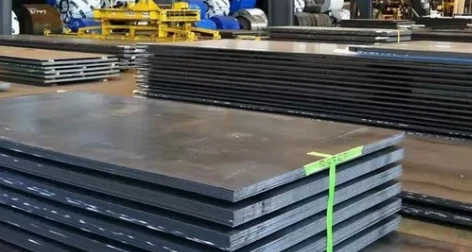
 A516 Grade 70 is a type of pressure vessel steel plate designed for use in moderate and lower temperature service conditions. It is part of the ASTM A516 specification, which covers carbon-manganese-silicon steels suitable for fusion welding. This grade is known for its good notch toughness and strength, making it suitable for applications where pressure containment is critical. The material is commonly used in the fabrication of boilers, storage tanks, and pressure vessels that handle liquids or gases under various operating pressures. Its composition and heat treatment are optimized to provide reliable performance and resistance to brittle fracture, even in environments where temperature fluctuations may occur.
Yield/Tensile Strength
|
Metric |
Imperial |
|
|
Tensile Strength, Ultimate |
482 – 620 MPa |
70 – 90 ksi |
|
Tensile Strength, Yield |
262 MPa |
38 ksi |
|
Elongation |
17 |
17 |
Material Chemistry
|
C |
MN |
P |
SI |
S |
|
0.27 – 0.31% |
1 – 1.7% |
0.025% |
0.15 – 0.40% |
0.025% |
 processing
1. Initial Processing
Cutting: Primarily processed using Oxy-fuel, Plasma, or Laser cutting. For precision components, Waterjet cutting is used to avoid a Heat Affected Zone (HAZ).
Edge Preparation: Beveling (V, U, or X-grooves) is typically performed using milling or grinding to ensure full-penetration welding for pressure vessel seams.
2. Heat Treatment
This is the most critical stage for achieving the required mechanical properties in 2026 standards:
Normalizing: Mandatory for plates with thickness > 1.5 inches (38 mm). The plate is heated to 1,650–1,750°F (900–950°C) and air-cooled to refine grain structure and enhance low-temperature toughness.
Stress Relieving (PWHT): Post-Weld Heat Treatment is performed at approximately 1,150°F (620°C). The soaking time is usually 1 hour per inch of thickness to eliminate residual stresses from welding.
3. Forming
Cold Forming: A516-70 exhibits good formability. However, due to its high strength, it requires high-capacity rolling machines for cylindrical shells.
Hot Forming: If the deformation exceeds 5% strain, the material is often hot-formed above its critical temperature. If hot-formed, the plate may require re-normalizing to restore its original notch toughness.
4. Welding
A516-70 is highly weldable but requires specific protocols:
Preheating: Essential for thick sections (usually 200°F/95°C or higher) to prevent hydrogen-induced cracking.
Filler Metals: Typically utilizes E7018 (low hydrogen electrodes) for SMAW or ER70S-6 for GMAW/GTAW processes.
Hydrogen Control: Low-hydrogen practices must be strictly maintained throughout the welding process.
5. Supplementary Testing & Inspection
To ensure the integrity of the processed part:
Ultrasonic Testing (UT): Performed per ASTM A435 or A578 to detect internal laminations or inclusions.
Charpy V-Notch (CVN) Impact Test: Conducted to verify toughness at specific low temperatures (e.g., -50°F).
HIC & SSC Testing: For "Sour Service" (oil & gas), testing for Hydrogen Induced Cracking and Sulfide Stress Cracking resistance is required.

Primary Applications
Energy & Power Generation: Used for critical components like industrial boilers, steam drums, and nuclear reactor shells due to its ability to handle high pressure and heat.
Oil, Gas & Petrochemical: Extensive use in separators, distillation columns, reactors, and heat exchangers.
Sour Service: Specially tested (HIC/SSC) variants are used in wet 𝐻2𝑆 environments to prevent hydrogen-induced cracking.
Low-Temperature Storage: Essential for cryogenic storage tanks and arctic pipelines, as it remains ductile and resistant to brittle fracture down to -46°C (-50°F).
Heavy Infrastructure: Found in bridges, buildings, railroad tank cars, and heavy-duty construction equipment where structural integrity under load is paramount.
Key Advantages
High Tensile Strength: Boasts the highest strength among the A516 grades, with a tensile range of 70–90 ksi (485–620 MPa).
Superior Notch Toughness: Its fine-grain structure (typically achieved via normalizing) provides excellent resistance to impact, even in freezing temperatures.
Excellent Weldability: Low carbon content allows for robust, high-quality welds using standard processes like SMAW, GMAW, or SAW, which is vital for high-pressure welded assemblies.
Environmental Versatility: Capable of operating across a wide thermal spectrum from -46°C to 538°C (-50°F to 1000°F).
Cost-Efficiency: As a carbon steel, it provides a high performance-to-cost ratio compared to more expensive alloy steels for most moderate-temperature pressure vessel applications.
Proven Reliability: Adheres to strict ASME Boiler and Pressure Vessel Code (BPVC) and NACE standards, ensuring global safety compliance.
For more details about GNEE's steel products, contact us at beam@gneesteelgroup.com. We look forward to working with you.
Is A516 Grade 70 corrosion-resistant?
It has certain corrosion resistance to atmosphere and fresh water, but is not resistant to corrosion by strong acids, strong alkalis and chlorine-containing media. In corrosive working conditions, measures such as coating, lining or cathodic protection need to be taken to improve corrosion resistance and extend service life.
What is the usual thickness specification range of A516 Grade 70 steel plates?
The common thickness specification is 6mm-200mm, the width is generally 1500mm-4000mm, and the length is 3000mm-12000mm. Special specifications can be customized according to equipment manufacturing needs, and communication with the steel mill in advance is required.
What is the complete execution standard number for A516 Grade 70?
The complete version number is ASTM A516/A516M-22, where "A516" is the main standard number, "M" indicates metric units, and "22" is the latest version year. This standard specifies various technical requirements for the material.
Can A516 Grade 70 be used to manufacture boiler drums?
Yes, because it has good medium and low temperature strength, toughness and fatigue resistance, which meets the requirements of boiler drums for pressure-bearing materials. During manufacturing, strict control of welding quality and non-destructive testing is required to ensure safe operation.
What is the elongation requirement for A516 Grade 70?
The elongation (δ5) is ≥21%. The elongation index reflects the plastic deformation capacity of the steel plate. A higher elongation allows the steel plate to be less prone to fracture when stressed and facilitates processing and forming (such as bending and stamping).
What electrode should be selected for welding A516 Grade 70?
The commonly used electrode is E7018 (low hydrogen type), which matches the strength and toughness of the base metal. During welding, the electrode needs to be dried (350-400℃, heat preservation for 1-2 hours) to avoid welding defects such as porosity and cracks, and ensure joint quality.
What are the similarities and differences between A516 Grade 70 and Q345R materials?
Both are pressure vessel steel plates. Q345R is a national standard (GB/T 713) with a yield strength of 345MPa, which is higher than that of Grade 70; the latter is an American standard with better low-temperature toughness. Their applicable scenarios and execution standards are different and cannot be replaced arbitrarily.
What are the surface quality requirements for A516 Grade 70 steel plates?
The surface shall be free of harmful defects such as cracks, bubbles, scars and folds. Minor pitting and scratches are allowed, and the depth of defects shall not exceed half of the thickness tolerance of the steel plate. Inspection shall be carried out by visual inspection or non-destructive testing.
Can A516 Grade 70 be strengthened by heat treatment?
It can undergo heat treatments such as normalizing and tempering. Normalizing can refine grains and improve toughness, while tempering can eliminate welding stress. However, this material is carbon steel, and the quenching strengthening effect is limited, so quenching treatment is generally not adopted.
What are the advantages of A516 Grade 70 in natural gas storage tank manufacturing?
The advantages are good weldability, which facilitates the welding and forming of large storage tanks; excellent medium and low temperature toughness, which is suitable for the low-temperature working conditions of natural gas storage; strength meets pressure-bearing requirements, and the cost is relatively lower than that of alloy steel plates.