


A992 H section steel is a type of American-standard H-beam, with a cross-sectional shape similar to British-standard H-beams, but differing in dimensions and structural details.
Due to its excellent mechanical properties and stability, A992 Wide Flange H Beam is widely used in bridges, buildings, ships, vehicles, and other structural applications.
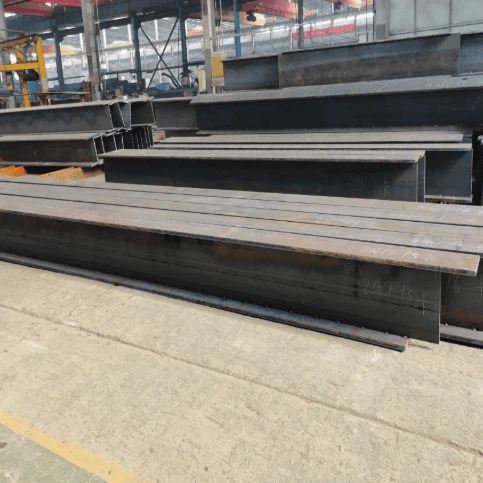
A992 H section steel
A992 Structural Steel Beam provides high strength and rigidity, capable of withstanding significant compressive and bending forces, while also exhibiting excellent fatigue resistance and corrosion performance.
Contact now to get an A992 H Beam Quote
Mechanical Properties of A992 H section steel
| Property | Typical Value |
|---|---|
| Yield Strength (Fy) | 345 MPa (50 ksi) |
| Tensile Strength (Fu) | 450 MPa (65 ksi) |
| Elongation (in 8 in) | ≥ 18% |
| Modulus of Elasticity (E) | 200 GPa |
| Poisson's Ratio (ν) | 0.3 |
Typical Chemical Composition (Weight %) of A992 H section steel
| Element | C | Mn | P | S | Si | V |
|---|---|---|---|---|---|---|
| Max | 0.23 | 1.35 | 0.035 | 0.035 | 0.40 | 0.12 |
| Min | - | 0.50 | - | - | - | - |
A992 H Section Steel Standard Sizes
| Designation | Depth (D, in / mm) | Flange Width (B, in / mm) | Web Thickness (tw, in / mm) | Flange Thickness (tf, in / mm) | Weight (lb/ft / kg/m) | Section Area (in² / cm²) |
|---|---|---|---|---|---|---|
| W8×10 | 8.03 / 204 | 8.03 / 204 | 0.23 / 5.8 | 0.44 / 11.2 | 10 / 15 | 2.93 / 18.9 |
| W10×12 | 10.08 / 256 | 10.08 / 256 | 0.26 / 6.6 | 0.46 / 11.7 | 12 / 18 | 3.52 / 22.7 |
| W12×14 | 12.17 / 309 | 12.17 / 309 | 0.29 / 7.3 | 0.50 / 12.7 | 14 / 21 | 4.05 / 26.1 |
| W14×22 | 14.02 / 356 | 14.02 / 356 | 0.30 / 7.6 | 0.60 / 15.2 | 22 / 33 | 6.27 / 40.4 |
| W16×26 | 16.00 / 406 | 16.00 / 406 | 0.34 / 8.6 | 0.62 / 15.7 | 26 / 39 | 7.41 / 47.7 |
| W18×35 | 18.02 / 458 | 16.50 / 419 | 0.37 / 9.4 | 0.75 / 19.1 | 35 / 52 | 9.97 / 64.2 |
| W21×44 | 21.00 / 533 | 16.50 / 419 | 0.39 / 9.9 | 0.88 / 22.4 | 44 / 66 | 12.5 / 80.4 |
| W24×55 | 24.00 / 610 | 16.00 / 406 | 0.44 / 11.2 | 1.03 / 26.2 | 55 / 82 | 15.6 / 100.2 |
| W27×84 | 27.00 / 686 | 16.00 / 406 | 0.50 / 12.7 | 1.15 / 29.2 | 84 / 126 | 23.8 / 152.9 |
| W30×90 | 30.00 / 762 | 16.00 / 406 | 0.50 / 12.7 | 1.25 / 31.8 | 90 / 135 | 25.5 / 163.7 |
Contact now to get an A992 H Beam Quote
American Standard H-beam A992 exhibits exceptionally high-strength properties, making it ideal for environments subject to heavy loads and high pressure.
In industries such as heavy machinery, bridges, and construction, A992 H section steel effectively bears and distributes external forces, ensuring the stability and safety of structures. This characteristic makes A992 an indispensable material in many large-scale engineering projects.

A992 H section steel also offers excellent toughness, maintaining structural integrity under impact or vibration. During the operation of machinery, structures inevitably encounter various shocks and vibrations, and the toughness of A992 reduces the risk of deformation and damage, enhancing the overall stability and reliability of equipment.
Additionally, A992 H section steel features outstanding weldability. Welded joints exhibit high strength and consistent quality, meeting the requirements of complex structural connections.
Since welding is a common method of joining components in machinery manufacturing, the superior weldability of A992 facilitates more convenient and efficient production.
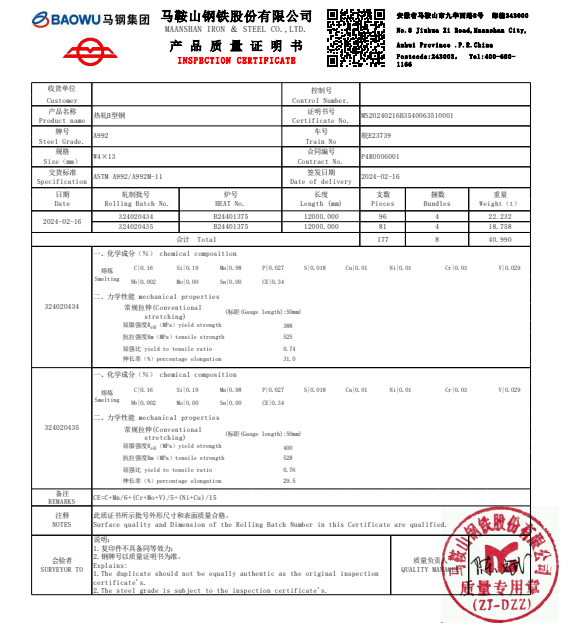
We supply premium A992 H section steel beams, manufactured under strict quality control to ensure uniform mechanical properties, high strength, excellent weldability, and reliable performance.
Get your premium A992 H Beam quote today and ensure your project meets the highest standards.
Contact now to get an A992 H Beam Quote
Q: What are the mechanical properties of A992 steel beams?
A: A992 H-Beams have a minimum yield strength of 345 MPa (50 ksi) and tensile strength ranging from 450 to 620 MPa (65–90 ksi). This high strength allows for smaller cross-sections, reducing structural weight while maintaining load-bearing capacity and stability.
Q: How is the weldability of A992 H-Beams?
A: A992 steel has a low carbon equivalent, which ensures excellent weldability. It can be welded using standard techniques such as SMAW, GMAW, and FCAW, with minimal preheating or post-weld heat treatment required, making it ideal for on-site construction.
Q: What makes A992 steel suitable for seismic or dynamic load applications?
A: The steel exhibits excellent toughness and ductility, allowing it to absorb and dissipate energy under dynamic or seismic loads. This reduces the risk of brittle failure and enhances structural safety in high-rise buildings, bridges, and industrial facilities.
Q: Can A992 H-Beams contribute to sustainable construction?
A: Yes, A992 steel is 100% recyclable, and its high strength allows for smaller structural sections, reducing material usage. Efficient manufacturing and construction, combined with a long service life, make it a sustainable choice for modern building projects.
Q: What are the mechanical properties of A992 steel beams?
A: A992 H-Beams have a minimum yield strength of 345 MPa (50 ksi) and tensile strength ranging from 450 to 620 MPa (65–90 ksi). This high strength allows for smaller cross-sections, reducing structural weight while maintaining load-bearing capacity and stability.
Q: How is the weldability of A992 H-Beams?
A: A992 steel has a low carbon equivalent, which ensures excellent weldability. It can be welded using standard techniques such as SMAW, GMAW, and FCAW, with minimal preheating or post-weld heat treatment required, making it ideal for on-site construction.
Q: What makes A992 steel suitable for seismic or dynamic load applications?
A: The steel exhibits excellent toughness and ductility, allowing it to absorb and dissipate energy under dynamic or seismic loads. This reduces the risk of brittle failure and enhances structural safety in high-rise buildings, bridges, and industrial facilities.
Q: Can A992 H-Beams contribute to sustainable construction?
A: Yes, A992 steel is 100% recyclable, and its high strength allows for smaller structural sections, reducing material usage. Efficient manufacturing and construction, combined with a long service life, make it a sustainable choice for modern building projects.