


P275N pressure vessel steel plate is the product you should prioritize. Among all EN 10028-3 grades, P275N is not just a technical option - it is the most commonly purchased and applied steel grade for standard pressure vessel projects worldwide. It delivers exactly what most buyers need: reliable strength, easy processing, and controlled cost.

P275N pressure vessel steel plate
At Gnee Steel, P275N is one of our core export products. Every year, we supply large quantities of P275N steel plates to contractors and distributors who want to avoid over-specification while still meeting safety standards.
If your application does not involve extreme temperatures, choosing P275N is not a compromise - it is a strategic decision to maximize project efficiency and profitability.
What is P275N Pressure Vessel Steel?
P275N is a normalized fine-grain non-alloy steel designed for pressure vessels and industrial equipment.
- Yield strength: ≥ 275 MPa
- Tensile strength: 390 – 530 MPa
- Standard: EN 10028-3
- Delivery condition: Normalized
It provides a balanced combination of strength, ductility, and weldability, making it suitable for most general-purpose pressure applications.
Chemical Composition of P275N Steel
| Element | Content (%) |
|---|---|
| C | ≤ 0.20 |
| Si | ≤ 0.40 |
| Mn | 0.90 – 1.50 |
| P | ≤ 0.025 |
| S | ≤ 0.015 |
| N | ≤ 0.012 |
This composition ensures low welding crack sensitivity and stable performance in fabrication.
Mechanical Properties of P275N Steel Plate
| Thickness (mm) | Yield Strength (MPa) | Tensile Strength (MPa) | Elongation (%) |
|---|---|---|---|
| ≤ 16 | ≥ 275 | 390 – 530 | ≥ 22 |
| 16 – 40 | ≥ 265 | 390 – 530 | ≥ 22 |
| 40 – 60 | ≥ 255 | 390 – 530 | ≥ 22 |
| 60 – 100 | ≥ 245 | 390 – 530 | ≥ 22 |
These properties ensure strong pressure resistance while maintaining flexibility, which is critical for safe operation.
Why P275N is More Practical Than Other P275 Grades
While P275NH, P275NL1, and P275NL2 are designed for special conditions, they are often unnecessarily expensive for standard projects.
| Grade | Feature | Cost Impact |
|---|---|---|
| P275N | Standard applications | Most economical |
| P275NH | High temperature | +10–15% |
| P275NL1 | Low temp (-20°C) | +15–25% |
| P275NL2 | Extreme low temp (-50°C) | +25–35% |
In real procurement scenarios, over-specification can significantly increase total project cost without improving actual performance.
That is why experienced buyers often return to P275N as the baseline and most efficient choice.
Key Advantages of P275N Steel Plate
Cost Control
Using P275N can reduce overall material costs by up to 20–30% compared to higher grades.
Easy Fabrication
Excellent weldability improves production speed and reduces defect rates.
Stable Supply
P275N is widely produced, ensuring shorter lead times and better availability.
Proven Performance
Used globally in thousands of projects, P275N offers reliable and predictable performance.
Why Choose Gnee Steel?
When sourcing P275N, consistency and delivery reliability matter more than anything. At Gnee Steel, we supply thousands of tons of P275N steel plates annually, making it one of our most mature and stable product lines.
This volume allows us to maintain consistent quality and competitive pricing.
We support a full size range:
- Thickness: 6–100 mm
- Width: up to 3500 mm
- Length: up to 12000 mm
All products can be delivered with EN 10204 3.1 certification, ensuring full traceability and compliance.
Our processing capability allows:
- Precision cutting (±1 mm tolerance)
- Custom sizes to reduce waste
- Faster fabrication for your project
Delivery is another key advantage. Our standard lead time is 7–20 days, helping clients avoid delays in project schedules.
By working directly with us, you eliminate middle costs and gain:
- Factory-direct pricing
- Stable long-term supply
- Faster response and technical support
This is why many clients choose Gnee not just once, but as a long-term supplier.
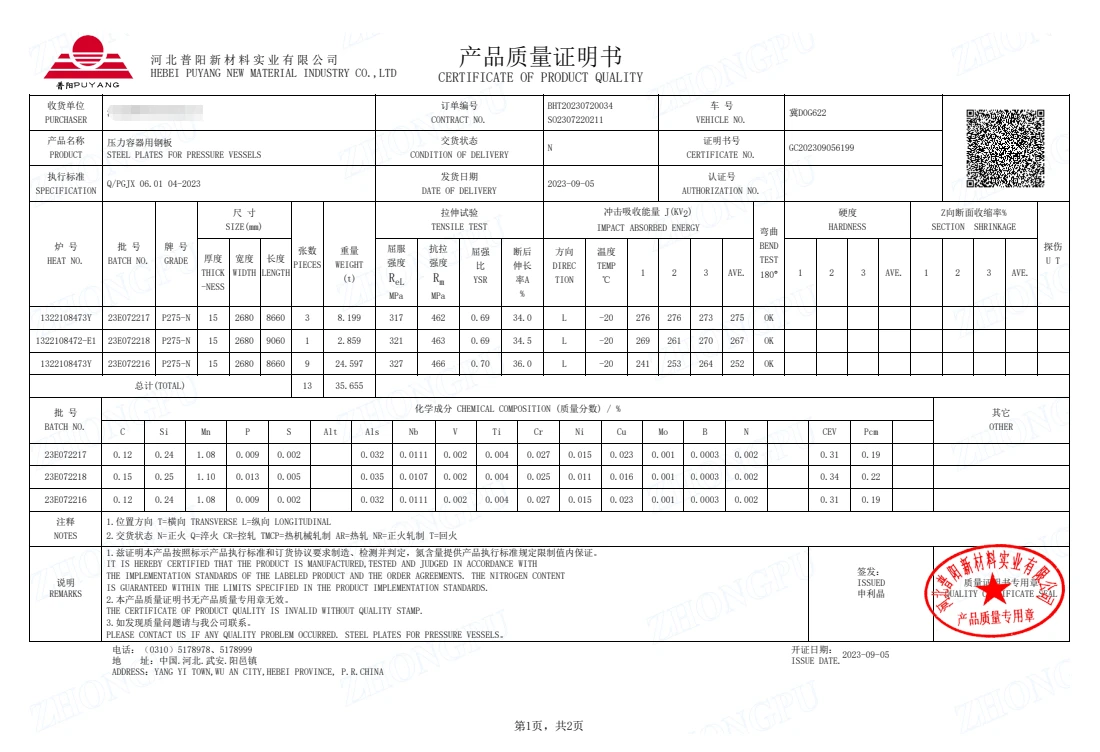
If your project requires a reliable and cost-controlled pressure vessel material, then P275N is not just an option - it is the most practical choice available.
Choosing a higher grade may increase your budget, but it will not necessarily improve your project outcome. Choosing P275N means you are making a balanced and professional procurement decision.
Now is the right time to secure your supply. Send us your requirements today, and you will receive:
- Latest factory price for P275N
- Available stock and sizes
- Mill Test Certificate (MTC)
- Fast delivery plan
The difference between a good project and a profitable project often comes down to material selection and supplier choice.
Contact now to get P275N steels Quote

What are the core differences between P275N, P275NH, P275NL1, and P275NL2?
The core differences lie in impact test temperature and applicable working conditions. All four grades have a minimum yield strength of ≥275MPa (for thickness ≤16mm) and comply with the EN 10028-3 standard:
P275N: Impact test at -20°C, suitable for normal-temperature pressure vessels and general industrial pipelines;
P275NH: Impact test at -20°C, optimized for high-temperature performance, adaptable to medium-to-high temperature pressure equipment below 350°C;
P275NL1: Impact test at -40°C, suitable for low-temperature storage tanks and separators in cold regions;
P275NL2: Impact test at -50°C, offering the best ultra-low temperature toughness, adaptable to cryogenic equipment such as liquid nitrogen/LNG systems.
What are the corresponding numerical designations for these four grades?
P275N: 1.0483;
P275NH: 1.0485;
P275NL1: 1.0488;
P275NL2: 1.1104.
Does thickness affect performance?
Yes, it does. When the thickness exceeds 16mm, the yield strength gradually decreases (e.g., ≥245MPa for 63~100mm), and the low-temperature toughness also slightly declines. For ultra-low temperature working conditions with thickness >40mm, it is recommended to prioritize P275NL2 and increase the sampling ratio for impact tests.
What are the key mechanical property indicators of the four grades?
Yield Strength (ReH): ≥275MPa for thickness ≤16mm, slightly decreasing with increasing thickness (e.g., ≥255MPa for 40~63mm);
Tensile Strength (Rm): 410~560MPa;
Impact Energy (KV): ≥27J for each corresponding impact temperature (regular supply meets ≥40J to enhance safety redundancy);
Elongation (A): ≥22%~24% (adjusted with thickness).
What is the range of available dimensions?
Thickness: 6mm~300mm;
Width: 1500mm~4800mm;
Length: 6000mm~18000mm;
Customized cutting, drilling, and beveling services are available, with a minimum cutting size of 500×500mm.
How is the weldability, and what are the welding recommendations?
It has excellent weldability (CEV ≤0.43%), with recommended solutions:
Welding Consumables: E5515-C1 for manual arc welding, H08MnA+F55A4 flux for submerged arc welding, and ER50-6 for gas metal arc welding;
Preheating Requirement: No preheating required for thickness ≤30mm; preheat to 100~150°C for thickness >30mm;
Interpass Temperature: ≤250°C, with heat input controlled at 15~35kJ/cm;
Post-Weld Heat Treatment (PWHT): Recommended for thick plates (>50mm) – stress relief annealing at 580~620°C for 2 hours.
Can the P275 series be substituted for ASTM A516 Gr70 (American standard) or Q345R (Chinese standard)?
vs. ASTM A516 Gr70: Similar strength, but the P275 series offers better low-temperature toughness  . The P275 series is preferred for European projects, while ASTM A516 Gr70 is suitable for North American projects;
vs. Q345R (GB 713): Q345R has higher yield strength (≥345MPa), but the P275 series excels in low-temperature performance (-20°C impact) and high-temperature stability. For international projects, it is recommended to select according to the EN standard first.
What are the differences between P275NL1/NL2 and 16MnDR (Chinese standard)?
16MnDR (GB 3531): Impact test at -40°C, yield strength ≥315MPa, suitable for domestic low-temperature projects;
P275NL1: Impact test at -40°C, yield strength ≥275MPa, belonging to the European standard system with higher international recognition;
P275NL2: Impact test at -50°C, offering better low-temperature toughness than 16MnDR, adaptable to more severe cryogenic working conditions.
| Other steel plate | ||||
| Name | Material | Specification (mm) | Tons | Remark |
| Clad steel plate | P265GH+410,S355JR+410,A516Gr70+316, A537CL1+304L,Q235B+304L,Q345B+304, A516Gr70(NACE)+410,A537CL1+904L, A537CL1+316L,A516Gr70+304L,A537CL1+304 ,A516Gr70+410,A516Gr70+904L |
2-300mm(Based plate),1-50mm(Composited plate) | / | UT, AR, TMCP.Normalized, Quenched and Tempered,Z Direction Test, Charpy V-Notch impact TestThe Third Party Test , Coated or Shot Blasting and Painting. |
| Low Alloy | Q345A, Q345B, Q345C, Q345D, Q345E, Q390, Q420, Q460C, ST52-3, S355J2+N, SS400, SA302GrC, S275NL, 35CrMo | 6 - 350 | 5788.56 | Normalizing, tempered ,controlled rolling, hot rolling , Hot rolling,1st inspection, 2nd inspection, 3rd inspection |
| Pressure Vessel Plate | Q245R, Q345R, Q370R, 16MnDR, 09MnNiDR, 15CrMoR, 14Cr1MoR, 12Cr2Mo1R, SA516Gr60, SA516Gr70, SA516Gr485, SA285, SA387Gr11, SA387Gr12, SA387Gr22, P265,P295,P355GH,Q245R(R-HIC),Q345R(R-HIC) | 3 - 300 | 8650 | Normalizing, tempered ,controlled rolling, hot rolling , Hot rolling,1st inspection, 2nd inspection, 3rd inspection |
| High-Strength Plate | WH785D/E,Q960D/E, Q890D/E,WH60D/E,WH70B,Q550D,Q590D,Q690D/E | 8 - 120 | 3086.352 | Quenched and tempered |
| Wear-Resistant Plate | NM360, NM400, NM450, NM500 | 6 - 150 | 3866.297 | Quenched and tempered |
| Bridge Plate | Q235qC, Q345qC, Q370qC, Q420qC, Q345qDNH, Q370qDNH, A709 - 50F - 2, A709 - 50T - 2 | 8 - 200 | 2853.621 | Hot rolling, normalized ,hot rolling controlled rolling, quenched and tempered + toughness and brittleness |