


SA387 Grade 22 Class 2 is a high-strength, chromium-molybdenum alloy steel plate, specified by ASTM A387/ASME SA-387, primarily used for manufacturing elevated-temperature pressure vessels, boilers, and heat exchangers in industries like oil, gas, and petrochemicals, offering superior weldability, corrosion resistance, and mechanical strength compared to Class 1, thanks to its higher chromium and molybdenum content, supplied normalized and tempered for demanding service.
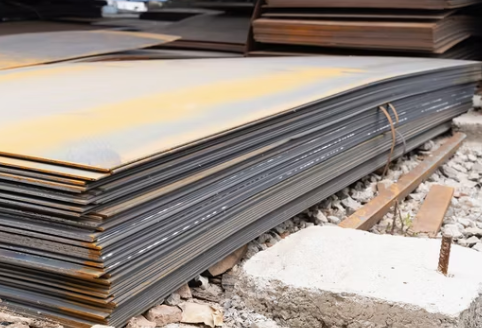
Key Characteristics:
Type:
Chrome-Moly (Chromium-Molybdenum) Alloy Steel Plate.
Application:
High-temperature service in pressure vessels, boilers, and heat exchangers.
Key Alloying Elements:
~2.25% Chromium (Cr) and ~1% Molybdenum (Mo) for strength and high-temp performance.
Mechanical Properties (Class 2):
Higher strength than Class 1, with tensile strength typically 515-690 MPa (75-100 ksi) and minimum yield 310 MPa (45 ksi).
Condition:
Always supplied in the normalized and tempered condition.
Why it's Used:
High-Temperature Performance:
Excellent resistance to creep and oxidation at elevated temperatures (up to around 600°C or 1100°F).
Corrosion Resistance:
Increased chromium content improves corrosion and oxidation resistance, suitable for sour gas environments.
Strength:
Offers high tensile and yield strength for demanding pressure applications.
Chemical Composition of SA387 GR.22 CL.2 Plate
| C | Mn | P | S | Si | Cr | Mo |
| 0.04 - 0.15 | 0.25 - 0.66 | 0.035 | 0.035 | 0.5 max | 1.88 - 2.62 | 0.85 - 1.15 |
Mechanical Properties of SA 387 GR.22 CL.2 Plate
| Tensile Strength | Yield Strength | Elongationin 50mm (%) | Reduction of area in % |
| 75-100 ksi, 515-690 MPa | 45 Ksi, 310 MPa | 18 | 45 |
 Why Choose Us :
You can get the perfect material according to your requirement at the least possible price.
We also offer Reworks, FOB, CFR, CIF, and door to door delivery prices. We suggest you to do deal for shipping which will be quite economical.
The materials we provide are completely verifiable, right from raw material test certificate to the final dimensional statement.(Reports will show on requirement)
We guarantee to give a response within 24hours(usually in the same hour)
You can get stock alternatives, mill deliveries with minimizing manufacturing time.
We are fully dedicated to our customers. If it will not possible to meet your requirements after examining all options, we will not mislead you by making false promises which will create good customer relations.
Get an valued quotation for SA 387 GR.22 CL.2, Contact GNEE Steel.
What is SA 387 GR 22 material?
The SA 387 Grade 22 Steel is a pressure vessel steel made up of high-quality raw material and high technology. Commonly used for high-temperature tasks based on its high heat tolerance this steel plate can be exposed up to 600° while maintaining superb oxidation and corrosion resistance.
What is A387 GR 22 equivalent to?
Among the ASTM A387 Grade 22 equivalent steel grades, SA387 Grade 22, 10CrMo9-10 is more popular than other equivalents. SA387 Grade 22 steel is under ASME SA387/ SA387M standard. The chemical performance and technical requirements of SA387 Grade 22 steel is almost same with ASTM A387 Grade 22 steel.
Is SA 387 carbon steel?
Engineered for use in elevated temperature service, ASME SA387 Grade 12 is a chrome molybdenum carbon alloy steel for use in weldable pressure vessels and industrial boilers.
What inspection and testing are required for SA 387 Gr. 22 Cl. 2?
Typical requirements include ultrasonic testing (UT), radiographic testing (RT), tensile testing, bend testing, and impact testing as specified in ASTM A387/A387M and customer specifications.
What PWHT is required after welding SA 387 Gr. 22 Cl. 2?
A post-weld heat treatment of around 620–680°C for a sufficient duration is commonly applied to relieve residual stresses and improve toughness and creep properties.
How does SA 387 Gr. 22 Cl. 2 compare to SA 387 Gr. 91 Cl. 2 in high-temperature service?
SA 387 Gr. 91 Cl. 2 is a 9Cr-1Mo-V steel that offers significantly higher creep strength at temperatures above 600°C, making it suitable for advanced power plants and ultra-supercritical boilers. SA 387 Gr. 22 Cl. 2, while not as strong at very high temperatures, is more cost-effective and widely used in refineries and petrochemical plants for service up to 593°C. Gr. 22 also has better weldability and requires less complex heat treatment compared to Gr. 91, which is more susceptible to embrittlement if not processed correctly.
Is SA 387 Gr. 22 Cl. 2 suitable for welding?
Yes, it is readily weldable using common welding processes such as SMAW, GMAW, FCAW, and SAW. Proper preheating and post-weld heat treatment (PWHT) are recommended to prevent cracking.
What is the difference in application between SA 387 Gr. 22 Cl. 2 and SA 387 Gr. 22 Cl. 1?
SA 387 Gr. 22 Cl. 2 is used in more critical and demanding applications where toughness is essential, such as thick-walled pressure vessels, boilers, reformers, and high-temperature reactors. Its stricter impact testing requirements make it suitable for low-temperature startup, thermal cycling, and high-stress conditions. SA 387 Gr. 22 Cl. 1, with its lower toughness requirements, is typically used in less critical applications such as non-essential pressure vessels, storage tanks, and components where failure consequences are less severe.
What are the common applications of SA 387 Gr. 22 Cl. 2?
It is widely used in refinery equipment, petrochemical reactors, boilers, heat exchangers, and other pressure vessels operating at high temperatures and pressures.