


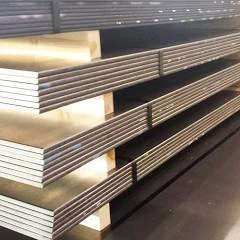
A515 Grade 70 is a high-strength, carbon-silicon steel plate (ASTM A515 Grade 70) used for pressure vessels, boilers, and tanks operating at moderate to higher temperatures, known for good weldability, machinability, and ductility with a minimum tensile strength of 70 ksi (485 MPa) and good impact resistance. It's a common choice when higher strength than Grade 60 or 65 is required.
ASTM A515 Grade 70 Plates Chemical Composition
|
Grade |
C |
Mn |
P |
S |
Si |
|
A515 Grade 70 |
0.30-0.35 |
1.30 max |
0.035 max |
0.035 max |
0.13-0.45 |
ASTM A515 Grade 70 Sheets, Plates Mechanical Properties
|
Grade |
Thickness |
Yield |
Tensile |
Elongation |
|
A515 Grade 70 |
50-200mm |
MPa -551 min |
MPa – 485-620 |
17-21% |
ASTM A515 Grade 70 Sheets, Plate & Coils Application Industries
Off-Shore Oil Drilling Companies
Power Generation
Petrochemicals
Gas Processing
Specialty Chemicals
Pharmaceuticals
Pharmaceutical Equipment
Chemical Equipment
Sea Water Equipment
Heat Exchangers
Condensers
Pulp and Paper Industry

Steel Plate Manufacturing Process
Steelmaking: Molten steel is produced via an Electric Arc Furnace (EAF) or Basic Oxygen Furnace, then undergoes ladle refining for chemistry control and degassing. The steel must be "killed" and produced to a coarse austenitic grain size practice.
Casting: Molten steel is continuously cast into slabs.
Reheating & Descaling: Slabs are heated in a furnace and then passed through a scale breaker to remove iron oxide layers.
Hot Rolling: Computer-controlled mills reduce the slab to the required thickness.
Heat Treatment (Standard Dependent):
≤ 50 mm (2 in): Usually supplied in as-rolled condition.
> 50 mm (2 in): Must be normalized (heated to approx. 900–950°C and air-cooled) to refine grain structure.
Optional: Normalizing + tempering, or quenching and tempering (Q+T) if specified.
Fabrication Flow (For Vessels/Boilers)
Cutting & Profiling: Using laser, plasma, or oxy-propane flame cutting to reach desired shapes.
Forming: Can be cold-formed or hot-worked (typically between 900°C and 200°C).
Welding: Readily weldable using standard techniques like SMAW, GMAW (MIG), and GTAW (TIG). For heavy sections, pre-heating and post-weld heat treatment (PWHT) are advised.
Surface Finishing: Shot blasting, painting, or oiling as required for corrosion protection.
Inspection & Testing: Includes tensile testing, ultrasonic examination (per ASTM A435/A578), and simulated PWHT of test coupons if required.
For more details about GNEE's steel products, contact us at beam@gneesteelgroup.com. We look forward to working with you.
Is heat treatment mandatory for A515 Grade 70?
No. It is usually supplied in the as-rolled or normalized condition. Normalization is optional but recommended for thicker plates to improve toughness and microstructure uniformity.
What is the purpose of LF furnace refining in A515 Grade 70 production?
LF (ladle furnace) refining improves steel cleanliness by slag refining, adjusts chemical composition precisely, and maintains molten steel temperature stability.
Why is VD vacuum degassing used in some A515 Grade 70 production?
VD (vacuum degassing) reduces gas content (e.g., hydrogen, oxygen) in molten steel, minimizing internal defects and enhancing the steel's internal purity and mechanical stability.
What surface defects are removed during A515 Grade 70 slab cleaning?
Surface defects such as oxide scale, cracks, scratches, and segregation layers are removed by scarfing, grinding, or shot blasting.
What inspection methods are used for A515 Grade 70 finished plates?
Common methods include dimensional inspection, visual inspection, ultrasonic testing (UT) for internal defects, tensile testing, impact testing, and hardness testing.
What is the maximum thickness of A515 Grade 70 plates per ASTM A515?
It can be supplied up to 8 inches (203 mm) thick, with specific mechanical property requirements adjusted for thicker sections.
Can A515 Grade 70 be welded?
Yes. It is designed for welded structures and has good weldability when proper welding procedures (e.g., preheating, post-heat treatment) are followed.
What is the difference between A515 Grade 70 and A516 Grade 70?
A515 is for boiler and pressure vessel plates used at moderate/elevated temperatures, while A516 has stricter impact toughness requirements and is suitable for lower-temperature service.
What applications is A515 Grade 70 commonly used for?
It is widely used in the fabrication of welded boilers, pressure vessels, storage tanks, and heat exchangers for petrochemical, power generation, and industrial sectors.
What is the acceptable phosphorus (P) content limit for A515 Grade 70?
The maximum P content is 0.035% (by weight) to avoid brittleness and improve mechanical properties.
How is the grain structure of A515 Grade 70 controlled during production?
Controlled rolling and normalization (if applied) are used to refine the grain structure, enhancing the steel's strength and toughness.
What marking requirements apply to A515 Grade 70 plates?
Each plate must be marked with grade (A515 Grade 70), heat number, thickness, manufacturer's logo, and compliance with ASTM A515 for traceability.