


What is the hardness of ST52-3 material in HRC It requires a crucial clarification upfront:
ST52-3 (modern S355JR) is NOT typically hardened to a specific Rockwell C (HRC) hardness, nor is it measured that way in its standard delivery condition. HRC is a scale for hardened steels (like tool steels or heat-treated alloy steels).
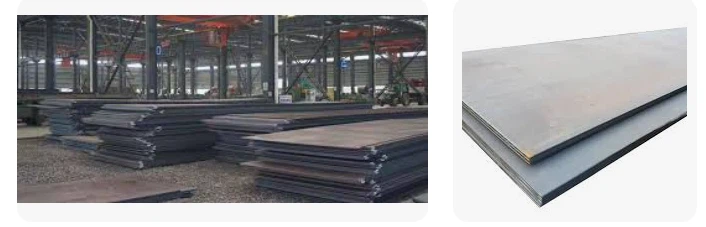
Here's the detailed explanation and what you need to know:
1. Standard Delivery Condition & Hardness
ST52-3/S355JR is supplied in the hot-rolled (R) or normalized (N) condition. It is a structural steel, designed for strength, toughness, and weldability, not for wear resistance through high surface hardness.
Typical Hardness Range: In this condition, its hardness is most commonly measured on the Brinell (HBW) scale.
Approximate Brinell Hardness: ~130 - 180 HBW (depending on exact chemistry and thickness).
Why not HRC? The HRC scale is for materials above ~200 HBW. ST52-3's hardness in its standard state is too low for an accurate or meaningful HRC reading. Attempting to measure it would likely use the HRB (Rockwell B) scale, which is for softer materials.
2. If You Must Have an HRC Equivalent
If forced to give a very rough and theoretical equivalent on the high end of its hardness range, you could use a conversion chart:
180 HBW converts to approximately ~18 HRC.
However, this is highly misleading. Reporting an HRC value for this material in its standard state is technically incorrect and not practiced in engineering or metallurgy. It signals a misunderstanding of the material's purpose.
3. What "Hardness" Means for ST52-3 - Key Properties
For structural steel, "hardness" is often discussed indirectly through these more critical properties:
Yield Strength (ReH): ≥ 355 MPa - This is its defining mechanical property for design (resistance to permanent deformation).
Tensile Strength (Rm): 510 - 680 MPa
Impact Toughness (KV): ≥ 27 J at +20°C - This is actually more important than hardness; it measures resistance to brittle fracture.
4. Can ST52-3/S355 be Hardened to a High HRC?
Not effectively. It is a low-carbon, low-alloy steel.
Carbon Content is only about 0.20% max, which is far too low to achieve significant through-hardening. Even if quenched, it would not form enough martensite to reach high HRC values (like 50-60 HRC seen in tool steels).
Surface Hardening: It can undergo case hardening processes like carburizing or nitriding to create a hard, wear-resistant surface layer (potentially 55-65 HRC) while retaining a tough core. However, after such treatment, it is no longer "ST52-3" in a conventional sense; it becomes a specially processed part.
Summary & Correct Answer
For ST52-3 / S355JR in its standard structural, hot-rolled condition:
1. It does NOT have a specified or meaningful Rockwell C (HRC) hardness value.
2. Its hardness is correctly specified as a Brinell Hardness (HBW), typically in the range of 130-180 HBW.
3. Its primary specifications are its Yield Strength (≥355 MPa) and Impact Toughness, not its hardness.
If you are inspecting a part made from this material and require a hardness check, you should use a Brinell or Vickers hardness tester. If a drawing or specification calls for an HRC value on ST52-3, it is almost certainly an error, and the intended specification should be clarified (perhaps it refers to a surface-hardened layer, or the material specification is wrong).