


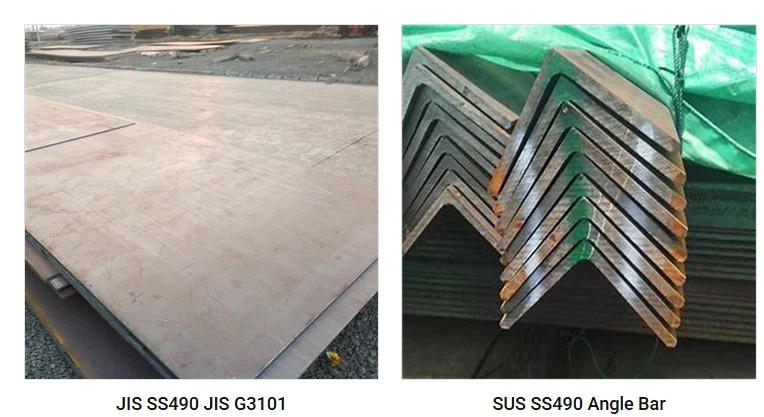
SS490 has poor inherent corrosion resistance and absolutely requires surface treatment for most applications. It is a carbon-manganese structural steel with no alloying elements (like Chromium or Nickel) to provide corrosion protection.
1. Corrosion Resistance of SS490
Type of Steel: It is a plain carbon steel, not a stainless or weathering steel.
Mechanism: In the presence of moisture and oxygen, it will form iron oxide (rust) rapidly. The rust layer is porous, non-adherent, and does not protect the underlying metal, allowing corrosion to progress.
Corrosion Rate: The rate depends heavily on the environment:
Dry Indoor: Very low corrosion.
Humid Indoor / General Atmosphere: Moderate, uniform corrosion.
Coastal / Marine: High corrosion due to chloride ions.
Industrial: High corrosion due to acidic pollutants (SO₂, NOₓ).
Key Point: SS490 has no meaningful "corrosion resistance" in exposed environments. It is considered susceptible to corrosion.
2. Surface Treatment – Absolutely Required
To prevent corrosion and ensure the structure's durability and safety, SS490 must be protected with a surface treatment system. The choice depends on the environment and required service life.
Common Surface Treatment Systems for SS490:
| Method | Process / Description | Typical Use Case | Pros & Cons |
|---|---|---|---|
| Paint Coating | Primer + Intermediate + Topcoat layers. | Most common for buildings, bridges, industrial structures. | Pros: Versatile, wide color choice, repairable. Cons: Requires maintenance, surface prep is critical. |
| Hot-Dip Galvanizing | Dipping steel in molten zinc (≈450°C). | Outdoor structures, transmission towers, guardrails, ductwork. | Pros: Excellent, long-term protection (20-50+ years), sacrificial anode effect. Cons: Higher initial cost, size limited by bath, can affect very thick sections. |
| Metallization (Zinc/Aluminum Spray) | Spraying molten zinc or aluminum onto grit-blasted surface. | Large field structures, repairs, high-temperature environments. | Pros: Good protection, no size limits. Cons: Requires skilled application, porous coating often needs paint sealer. |
| Primer Only (Shop Coat) | Single layer of anti-corrosive primer (e.g., zinc-rich epoxy). | For temporary protection before final coating on-site, or for hidden/interior members. | Pros: Low cost, easy. Cons: Not a complete system for long-term exposure. |
3. Procedure: Essential Steps Before Treatment
Effective protection relies on proper surface preparation, which is often more important than the coating itself.
Surface Preparation (Critical Step):
Degreasing: Remove oil and contaminants.
Abrasive Blasting (e.g., Sa 2½): The gold standard. Creates a clean, rough anchor profile for coating adhesion.
Hand/Power Tool Cleaning (St2, St3): For less critical or maintenance work.
Application: Apply the chosen coating system under controlled humidity and temperature conditions.
Inspection: Check coating thickness (e.g., with a dry film thickness gauge) and adhesion.
4. Alternative: Using Weathering Steel (A Corrosion-Resistant Option)
If periodic painting is undesirable, consider weathering steel as an alternative material from the start.
What it is: A steel alloyed with Cu, P, Cr, Ni (e.g., JIS G 3114 SMA490AW).
How it works: Forms a dense, adherent rust patina that inhibits further corrosion. It is "self-protecting" after initial weathering.
Important Note: It is not maintenance-free in all environments (not recommended for chloride-rich or constantly wet/dry cyclic conditions) and initial runoff can stain.
Summary & Answer
Corrosion Resistance: SS490 has very poor corrosion resistance. It will rust quickly if left unprotected in any environment with moisture.
Surface Treatment Required? Yes, it is mandatory for any exposed application. The treatment system must be selected based on the environmental aggressiveness and the required design life of the structure.
Standard Practice: For permanent steel structures, a multi-layer paint system over a blast-cleaned surface or hot-dip galvanizing are the industry-standard methods for protecting SS490.
Neglecting surface protection on SS490 will lead to progressive section loss, reduced load-bearing capacity, and ultimately, structural failure. Always specify both the material (SS490) and its corrosion protection specification (e.g., "SS490, surface prepared to Sa 2½ and painted with 75μm zinc-rich epoxy primer + 125μm polyurethane topcoat").