


Q500E and Q550E are both low-alloy high-strength structural steels of grade E in China, which can maintain reliable impact toughness at -40℃ and are widely used in various key projects and equipment manufacturing. The 50MPa gap in yield strength makes them have subtle differences in chemical composition proportion, process precision control, cost, and application scenarios.

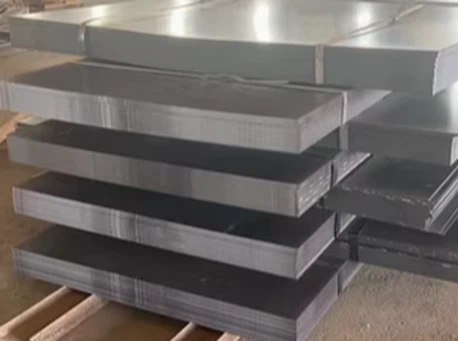
Chemical Composition
Both steels adopt low-carbon design and rely on micro-alloy elements to improve performance, but Q550E has a more refined proportion of alloy elements to achieve higher strength. The specific comparisons are as follows:
| Element | Q500E | Q550E |
|---|---|---|
| Carbon (C) | 0.10%-0.20% | ≤0.18% |
| Silicon (Si) | ≤0.50% | ≤0.6% |
| Manganese (Mn) | ≤1.70% | ≤2.00% |
| Phosphorus (P) | ≤0.025%-0.030% | ≤0.025% |
| Sulfur (S) | ≤0.015%-0.025% | ≤0.02% |
| Micro-alloy elements | Nb≤0.06%, V≤0.12%, Ti≤0.05%, which refine grains and improve strength and toughness through precipitation strengthening | Nb≤0.060%, V≤0.120%, Ti≤0.20%, with higher Ti content, and the strengthening effect of micro-alloy elements is more prominent |
| Other alloy elements | Cr≤1.5%, Ni≤2.0%, which enhance corrosion resistance and low-temperature toughness | Cr≤1.20%, Ni≤0.30%, Cu≤0.30%, with added Mo≤0.10% to further improve high-temperature strength |
Mechanical Properties
The core difference between the two lies in the yield strength. Q550E has higher strength, while Q500E has better ductility and toughness. The specific mechanical property indicators are as follows:
| Performance Indicator | Q500E | Q550E |
|---|---|---|
| Yield strength | ≥500MPa (for thickness ≤50mm) | ≥550MPa (for thickness ≤50mm) |
| Tensile strength | 580 - 780MPa | 600 - 800MPa |
| Elongation | ≥17% | ≥16% |
| Impact toughness | ≥27J at -40℃ (longitudinal), some products can reach ≥47J | ≥34J at -40℃ |
| Bending performance | The minimum bending diameter is 4 times the plate thickness | The pressing head diameter is 3 times the plate thickness, and the bending performance is excellent |
Production and Processing Processes
Both can adopt TMCP thermo-mechanical control process or quenching and tempering process, but Q550E has stricter requirements on process parameters to ensure stable high strength:
- Q500E: It can be produced by TMCP process alone. When adopting the quenching and tempering process, the quenching temperature is 880 - 920℃ and the tempering temperature is 550 - 650℃. The requirements for temperature control are relatively loose. The fluctuation range of mechanical properties can be controlled within ±20MPa by means of controlled rolling and cooling technology. Its welding preheating temperature is 150 - 200℃, and the welding joint strength can reach more than 95% of the base metal.
- Q550E: It often relies on the combination of micro-alloying and quenching and tempering processes. The control of heating and cooling rates in the production process is more precise to avoid performance reduction caused by uneven structure. It is suitable for various welding methods such as manual arc welding and submerged arc welding. Although it has good welding performance, due to its higher strength, it needs to pay more attention to controlling heat input during welding to prevent softening of the heat-affected zone.
Application Scenarios
The two are differentiated in application based on strength requirements and cost considerations. Q500E is widely used in general high-strength fields, while Q550E is more inclined to high-stress components:
- Q500E: It has a high cost performance ratio and is widely used in many fields. In engineering machinery, it is used to make the boom of the SY950H excavator, which can reduce weight by 15% compared with Q460 material. In bridge construction, it is used for the chord and web members of long-span bridges, such as the auxiliary structures of the Hong Kong-Zhuhai-Macao Bridge. In the new energy field, it is used as the steel pipe pile of offshore wind power projects, and its service life can reach 30 years with anti-corrosion coating.
- Q550E: It is suitable for components bearing higher stress. In construction, it is used as the core load-bearing frame of super high-rise office buildings to reduce the amount of steel used and expand the internal space. In the field of engineering machinery, it is used to make the boom of large excavators that bear frequent impact loads. In shipbuilding, it is applied to the hull parts that need to resist the impact of waves and ice blocks, ensuring the safety of ships in harsh sea conditions.
Production Cost and Market Status
- Q500E: The production process is mature. The TMCP process can reduce the demand for heat treatment. Most medium and large steel mills can produce it stably. The market supply is sufficient, and the price is relatively stable, generally around 8000 - 10000 yuan/ton. It is a mainstream high-strength steel in the market.
- Q550E: It has higher requirements for the proportion of alloy elements and process precision. The cost of alloy elements and heat treatment is higher. Its market price is about 10% - 20% higher than that of Q500E. At present, it is mainly produced by key steel mills such as Wuyang Iron and Steel. The market demand is concentrated in high-end equipment manufacturing, and the demand volume is slightly less than that of Q500E.
In low-temperature engineering projects in alpine regions, which one is more suitable between Q500E and Q550E, and why?
The choice depends on the specific load-bearing requirements. If it is a general structural part such as a bridge's auxiliary support, Q500E is more suitable. It has excellent impact toughness at -40℃ and better ductility, which can avoid brittle fracture under low-temperature conditions. If it is a key load-bearing component such as the main beam of a large-span bridge in an alpine region, Q550E is preferred. It not only meets the low-temperature toughness requirements but also has higher yield strength, which can better withstand the combined load of low-temperature shrinkage and vehicle pressure.
What are the differences in the processing difficulty of Q500E and Q550E in the production of engineering machinery parts?
Q500E is easier to process. Its elongation rate of ≥17% makes it not easy to crack during bending and cutting. When making general crane booms, ordinary processing equipment can complete forming. Q550E has slightly lower elongation. When processing parts with complex shapes such as the excavator's moving arm, it is necessary to control the bending speed and cooling rate strictly. During welding, it is necessary to match special welding materials to ensure the strength of the welding joint, so the processing difficulty and precision requirements are higher.
Why does Q500E have more advantages in the field of offshore wind power than Q550E?
On the one hand, the offshore wind power field has a large demand for steel, and Q500E has a lower price, which can significantly reduce the overall project cost. On the other hand, Q500E contains higher Ni content, which has better corrosion resistance in the salt-fog marine environment. Although Q550E has higher strength, the strength of Q500E is enough to meet the requirements of wind power tower tubes and steel pipe piles. The advantage of Q550E cannot be fully exerted, so Q500E is more widely used.