


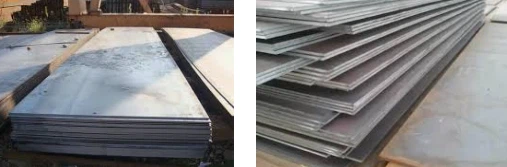
SA36 steel is a general-purpose carbon structural steel specification defined by ASTM International, widely used for riveted, bolted, or welded construction of bridges, buildings, and general structural purposes.
The "SA" prefix specifically indicates that the material conforms to the ASME Boiler and Pressure Vessel Code (BPVC) version of the ASTM specification, meaning it is accepted for use in pressure vessel and boiler construction. For all practical mechanical and chemical properties, SA36 is identical to the more commonly referenced ASTM A36 steel.
Key Characteristics Of SA36/A36:
Type: Low-carbon, mild steel.
Yield Strength: Minimum 36,000 psi (250 MPa).
Tensile Strength: 58,000 - 80,000 psi (400 - 550 MPa).
Key Feature: It is a "strength-only" grade. Unlike many European grades (e.g., S355J2), it has no mandatory impact toughness (Charpy) requirements in its base specification.
Weldability: Excellent, due to its low carbon content.
Common Forms: Plates, bars, structural shapes (beams, angles, channels).
International Equivalents (Approximate):
European: S235JR (EN 10025-2) is the closest match in terms of yield strength (235 MPa nominal) and general application.
Important Note: SA36/A36 does not have a direct equivalent to European grades like S355 due to the significant difference in strength and lack of mandatory toughness.
In essence, SA36 is the versatile, economical "workhorse" steel of general construction and fabrication in North America, prized for its ease of fabrication and weldability rather than high strength or specialized properties.

SA36 steel (identical to ASTM A36) is most commonly and practically equivalent to European grade S235JR/S235J0 and other international grades with a nominal 235 MPa yield strength. However, "equivalent" must be carefully defined, as it depends on the specific property being matched.
Here is a breakdown of its closest equivalents across different standards:
1. Closest General Equivalents (Based on Yield Strength & Application)
| Region/Standard | Equivalent Grade | Key Similarities | Important Notes |
|---|---|---|---|
| Europe (EN) | S235JR (EN 10025-2) | • Nominal Yield Strength: 235 MPa (vs. A36's 250 MPa/36 ksi). • General purpose structural steel. • Good weldability and formability. |
This is the most accepted direct equivalent. The ~15 MPa strength difference is often negligible in design. S235JR also has a Charpy impact requirement (27J at +20°C). |
| Europe (EN) | S235J0 | • Nominal Yield: 235 MPa. • General structural use. |
Similar to S235JR but with impact tested at 0°C. |
| Japan (JIS) | SS400 | • Minimum Tensile: 400 MPa. • Widely used general structural steel. |
SS400 is a tensile-based standard, not yield-based. It has no specified minimum yield, making it a functional but not property equivalent. |
| China (GB) | Q235B | • Yield Strength: 235 MPa. • Most common general structural steel. |
Very close match in terms of chemistry, strength, and application. |
2. Important Non-Equivalents & Clarifications
NOT Equivalent to S355: A common mistake is equating A36 to S355 (nominal 355 MPa yield). S355 is significantly stronger and is equivalent to higher-strength US grades like ASTM A572 Gr. 50.
Toughness Difference: Unlike many European grades, SA36/A36 has no mandatory impact toughness requirement in its base specification. An equivalent must consider if low-temperature toughness is needed. If so, a grade like S235J2 (tested at -20°C) would be specified.
ASME "SA" Designation: The SA36 prefix itself has a direct equivalent: ASTM A36. They are the same material; "SA" denotes it is produced to ASME code quality.
3. How to Specify a True Equivalent
To select an equivalent, you must match the critical design property:
For General Strength & Fabrication: S235JR is the standard European choice.
For ASME Code Fabrication (Non-pressure parts): You must specify SA36 itself (or its direct material equivalent A36).
If Impact Toughness is Required: Do not use standard A36/SA36. Instead, specify a grade with mandated Charpy testing, such as S235J2 or, in the US, ASTM A36 with Supplemental Impact Requirements.
1. What Is SA36 Steel?
SA36 is a carbon structural steel specification from ASTM International, commonly used for general construction, bolted or welded structures, and miscellaneous steel parts.
2. What Is The Yield Strength Of SA36?
The minimum yield strength of SA36 steel is 36,000 psi (250 MPa) for plates and bars up to 8 inches (200 mm) thick.
3. Is SA36 Weldable?
Yes, SA36 steel has good weldability using most common methods (SMAW, GMAW, etc.), as it is a low-carbon steel with no mandatory impact toughness requirements.
4. What Is The Difference Between SA36 And A36?
There is no technical difference. A36 is the standard specification for structural steel, while SA36 is the prefix used when the material is included in the ASME Boiler and Pressure Vessel Code. Their mechanical and chemical properties are identical.
5. Can SA36 Be Galvanized?
Yes, SA36 is an excellent candidate for hot-dip galvanizing due to its simple carbon-silicon composition, which reacts predictably with molten zinc to form a protective coating.
6. What Are The Mechanical Properties Of SA36?
Key properties include a minimum yield strength of 36 ksi (250 MPa), minimum tensile strength of 58-80 ksi (400-550 MPa), and a minimum elongation of 20% (in 8 inches). Impact testing is not required.
7. What Is SA36 Steel Equivalent To?
SA36/A36 is commonly considered equivalent to European grades like S235 (structural steel) and EN 10025-2 S235JR, based on similar yield strength and general application.
8. Where Is SA36 Steel Used?
It is widely used in general construction (building frames, platforms), industrial fabrication, base plates, truck frames, and non-critical components of bridges and structures.
9. What Is The Chemical Composition Of SA36?
It is a low-carbon steel with maximum limits of: Carbon (0.26%), Manganese (0.80-1.20%), Phosphorus (0.04%), and Sulfur (0.05%). It may contain copper for corrosion resistance.
10. Is SA36 A High-Strength Steel?
No, SA36 is considered a mild steel or general-purpose structural steel. Its 36 ksi yield strength is relatively low compared to high-strength low-alloy (HSLA) steels like A572 Grade 50 (50 ksi yield).
Full specification and details are available on request. The above information is provided for guidance purposes only. For specific design requirements please contact our technical sales staff.
