


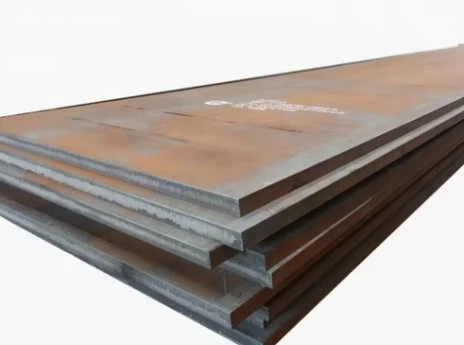
ASTM A537 Class 2 is a heat-treated carbon-manganese-silicon steel plate, quenched and tempered for increased strength, used primarily for fusion-welded pressure vessels, boilers, tanks (like API 650/620), and structures in the oil, gas, and petrochemical industries where higher yield and tensile strength are needed. It offers improved notch toughness and good weldability, with typical mechanical properties resulting from its controlled chemical composition and heat treatment.
ASME SA537 Class 2 Equivalent Standard :
| Steel Grade | JIS | Germany |
| ASTM/ASME | G3115 | DIN17155 |
| A537 / SA537 | SPV36 | 19Mn5 |
ASTM A537 Class 2 Chemical Composition :
| C | Mn | P | S | Si | Cr | Cu | Ni | Mo | |
| ≤ 40 mm | > 40 mm | ||||||||
| 0.24 max | 0.70/1.35 | 1.00/1.60 | 0.035 | 0.035 | 0.15/0.50 | 0.025 | 0.35 | 0.25 | 0.080 |
ASME SA537 / ASTM A537 - Class 2 Mechanical Properties :
| Grade | Heat Treatment | Tensile (MPa) | Yield (MPa) | Elongation |
| SA537 Class 2 | Quenched and tempered | 550–690 | 415 | 22% |
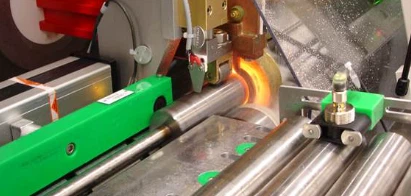
process
1. Steelmaking & Refining
Melting: Produced via Electric Arc Furnace (EAF) or Basic Oxygen Furnace (BOF).
Refining: Secondary refining (LRF/VD) is performed to control sulfur, phosphorus, and gas content.
Grain Practice: The steel must be killed and conform to fine austenitic grain size requirements per ASTM A20/A20M.
2. Casting & Reheating
Casting: Continuous casting or ingot casting.
Reheating: Slabs are reheated in a furnace to a uniform rolling temperature (typically 1150°C to 1250°C).
3. Rolling (Hot Rolling)
Sizing: The steel is rolled to the specified thickness and width.
Control: For high-end applications, Thermo-Mechanical Controlled Processing (TMCP) may be used prior to heat treatment to refine the initial structure.
4. Heat Treatment (The Core Step: Q&T)
ASTM A537 Class 2 specifically requires a two-stage heat treatment:
Quenching: The plates are heated to an austenitizing temperature (approx. 860°C – 900°C) and then rapidly cooled in water or another liquid medium. This creates a hard, high-strength martensitic or bainitic microstructure.
Tempering: The plates are reheated to a temperature of not less than 1100°F (595°C). This stage reduces internal stresses and enhances ductility and toughness while maintaining the required strength levels.
5. Finishing & Inspection
Leveling & Cutting: Plates are leveled for flatness and cut to the final dimensions.
Mechanical Testing:
Tensile Test: Verification of Yield Strength (min 415-310 MPa) and Tensile Strength (485-690 MPa).
Impact Test: Charpy V-Notch impact testing to ensure low-temperature toughness.
Non-Destructive Testing (NDT): Ultrasonic Testing (UT) is often performed to ensure internal integrity (e.g., to ASTM A435 or A578).
Why Choose Us :
You can get the perfect material according to your requirement at the least possible price.
We also offer Reworks, FOB, CFR, CIF, and door to door delivery prices. We suggest you to do deal for shipping which will be quite economical.
The materials we provide are completely verifiable, right from raw material test certificate to the final dimensional statement.(Reports will show on requirement)
We guarantee to give a response within 24hours(usually in the same hour)
You can get stock alternatives, mill deliveries with minimizing manufacturing time.
We are fully dedicated to our customers. If it will not possible to meet your requirements after examining all options, we will not mislead you by making false promises which will create good customer relations.
Contact us at beam@gneesteelgroup.com for pricing, technical support, or customized solutions. We are always ready to support your project.
Does A537 Class 2 require post-weld heat treatment (PWHT)?
PWHT is not mandatory but recommended for thick sections (>1.5 inches) or high-stress applications. It relieves welding residual stresses, reduces cracking risk, and improves dimensional stability. PWHT involves heating to 1100-1200°F (593-649°C) and holding before cooling.
How is A537 Class 2 inspected for quality?
Quality inspection includes chemical analysis (spectroscopy), mechanical testing (tensile, impact, bend), ultrasonic testing (for internal defects), and visual inspection. Certificates (MTC) are provided to confirm compliance with ASTM A537 standards, ensuring material reliability.
Is A537 Class 2 magnetic?
Yes, it is magnetic due to its ferritic microstructure (body-centered cubic). This property allows magnetic particle inspection (MPI) for surface defects, a common non-destructive testing method in pressure vessel manufacturing and maintenance.
How is A537 Class 2 stored to prevent degradation?
It should be stored in a dry, covered area to avoid moisture and rust. Plates are stacked on wooden supports to allow air circulation, preventing contact with wet surfaces. Protective films or oils may be applied for long-term storage to preserve surface quality.
What is the yield-to-tensile ratio of A537 Class 2?
The yield-to-tensile ratio is approximately 0.63 (38 ksi yield / 60 ksi tensile). A moderate ratio indicates good ductility and reserve strength, allowing the material to deform before reaching tensile failure, critical for pressure vessel safety.
What industries use A537 Class 2?
Key industries include oil and gas (storage tanks, pipelines), petrochemicals (reactors, separators), power generation (boiler components), and marine (ship hulls, pressure vessels). Its pressure resistance and weldability make it ideal for harsh industrial environments.
What welding processes are compatible with A537 Class 2?
It is compatible with common welding processes: SMAW (stick welding), GMAW (MIG), GTAW (TIG), and SAW (submerged arc welding). Preheating (150-300°F/65-149°C) may be needed for thick sections to prevent cold cracking, with post-weld heat treatment optional for stress relief.
What industries use A537 Class 2?
Key industries include oil and gas (storage tanks, pipelines), petrochemicals (reactors, separators), power generation (boiler components), and marine (ship hulls, pressure vessels). Its pressure resistance and weldability make it ideal for harsh industrial environments.