


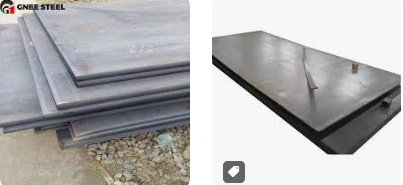
S690Q is a high-strength quenched and tempered structural steel with a minimum yield strength of 690 MPa, offering a balanced combination of strength, toughness, and weldability for heavy-duty applications like cranes, mining equipment, and offshore structures.
S890Q is an ultra-high-strength quenched and tempered structural steel with a minimum yield strength of 890 MPa, designed for extreme weight-critical applications such as advanced crane booms, military vehicles, and high-performance machinery, though it requires stricter welding and fabrication controls due to its lower toughness and higher sensitivity to cracking.
The comparison between S890Q and S690Q centers on the trade-off between ultimate strength and overall manufacturability, toughness, and cost. Both are quenched and tempered structural steels per EN 10025-6, but they serve different segments of high-strength applications.
Here's a direct comparison:
| Aspect | S690Q | S890Q |
|---|---|---|
| Yield Strength | 690 MPa (minimum) | 890 MPa (minimum) – ~29% stronger |
| Tensile Strength | ~770–940 MPa | ~940–1100 MPa |
| Ductility (Elongation) | Higher (~14–16%) | Lower (~10–12%) – more brittle |
| Impact Toughness | Generally better at low temperatures for equivalent sub‑grades (e.g., QL) | Lower toughness at same temperature; more sensitive to notches and cracks |
| Weldability | Challenging but well‑established procedures; preheat ~100–150°C | More difficult; requires stricter preheat (often 150–200°C), tighter control of heat input, higher risk of HAZ softening/cracking |
| Machinability | Difficult but manageable with proper tooling | Very difficult; higher tool wear, requires robust setups and cooling |
| Weight‑Saving Potential | Significant vs. mild steel (~50% lighter for same load) | Extreme – allows further ~20–25% weight reduction vs. S690Q |
| Cost | High, but relatively more available | Very high – premium material with more complex alloying/processing |
| Primary Applications | Cranes, mining equipment, heavy structures in cold climates | Ultra‑high‑performance crane booms, advanced mining drill rigs, military vehicle frames, specialized offshore components |
Key Engineering Trade-offs:
Strength vs. Toughness:
S890Q provides higher strength but with reduced toughness and ductility. This makes S890Q more susceptible to brittle fracture if not designed and fabricated carefully.
Fabrication Complexity:
Welding and machining S890Q are more demanding than S690Q. It requires stricter preheat, lower heat input, and often post-weld heat treatment to avoid cracking or softening in the heat‑affected zone.
Design Philosophy:
S690Q is often used as a reliable high‑strength workhorse for a wide range of heavy‑duty applications.
S890Q is a niche material selected only where weight reduction is absolutely critical (e.g., mobile crane booms where extra length/capacity is gained) and where cost and fabrication challenges can be justified.
Economic Consideration:
S890Q is substantially more expensive both in material cost and fabrication. It is typically used only for key components rather than entire structures.
When to Choose Which:
Choose S690Q for most high‑strength applications requiring good toughness, weldability, and a balance of cost and performance.
Choose S890Q when maximum strength‑to‑weight ratio is the overriding design driver, and the engineering team can manage its fabrication complexities and higher sensitivity to stress concentrations.
In short, S890Q pushes the performance envelope further than S690Q but at the expense of tougher fabrication, reduced toughness, and higher cost.
What is S890Q steel?
S890Q is a very high-strength quenched and tempered structural steel with a minimum yield strength of 890 MPa, designed for extreme load-bearing applications.
What are the properties of S890Q steel?
It offers exceptional strength, good toughness at low temperatures, and weldability with proper procedures, though it is more brittle than lower-grade steels.
Where is S890Q steel used?
S890Q is used in heavy-duty crane booms, advanced mining equipment, high-performance military vehicles, and specialized structural components where maximum strength-to-weight ratio is critical.
How does S890Q compare to S690Q?
S890Q has a higher yield strength (890 MPa vs. 690 MPa) but lower toughness and weldability, making it suitable for more demanding, lightweight designs.
What welding procedures are required for S890Q?
Welding S890Q requires strict preheating (often 150-200°C), low-hydrogen electrodes, controlled heat input, and post-weld stress relief to avoid cracking.
Is S890Q steel corrosion resistant?
No, S890Q is not corrosion-resistant and requires protective coatings like painting or galvanizing for use in exposed environments.
What standards cover S890Q steel?
It is primarily specified under the European standard EN 10025-6 for quenched and tempered high-strength structural steels.
Can S890Q be machined easily?
Machining S890Q is difficult due to its extreme hardness and strength; it requires robust tooling, slow speeds, and ample cooling.
What is the price of S890Q steel plate?
S890Q is significantly more expensive than lower-strength grades, with prices varying based on thickness, quantity, and certification requirements.
Full specification and details are available on request. The above information is provided for guidance purposes only. For specific design requirements please contact our technical sales staff.
