


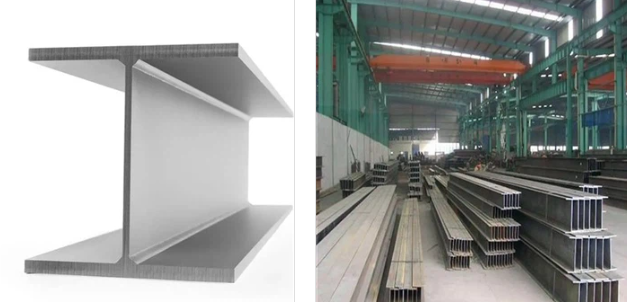
S275JR is a non-alloy, low-carbon structural steel grade defined under the European standard EN 10025-2. It is one of the most widely used steel grades in construction and engineering due to its balanced mechanical properties and cost-effectiveness.
Key Specifications
The designation "S275JR" provides a technical summary of the material's properties:
S: Indicates it is a Structural steel.
275: Specifies a minimum yield strength of 275 MPa (for thicknesses ≤ 16mm).
JR: Indicates a Charpy V-notch impact test requirement of at least 27 Joules at room temperature (+20°C).
Applications
S275JR is primarily used for manufacturing long and flat products for welded or riveted structures. Common uses include:
Construction: Beams, columns, and plates for buildings and bridges.
Engineering: Low-load machine parts like bushings, shafts, and axles.
Industry: Storage tanks, oil and gas platforms, and rail industry components.
Key Advantages
Weldability: Its low carbon content makes it exceptionally easy to weld using standard methods.
Machinability: Offers good machining performance similar to other mild steels.
Formability: Can be easily curved, folded, or cold-formed for various structural shapes.

The price of S275JR structural steel is influenced by a combination of global market forces, production inputs, and specific transaction factors. Here are the key determinants:
1. Raw Material Costs (Primary Driver)
Iron Ore & Coking Coal Prices: As the base materials for steelmaking, their global market prices directly set the cost floor for all steel products, including S275JR.
Scrap Steel Prices: Electric Arc Furnace (EAF) production, common in many regions, relies heavily on scrap metal. High scrap demand increases costs.
2. Energy & Production Costs
Energy Prices: Steel production is energy-intensive. Volatility in electricity, natural gas, and oil prices significantly impacts manufacturing costs, especially in blast furnace operations.
Manufacturing & Processing Costs: Expenses related to casting, rolling, heat treatment (normalizing for S275JR), cutting, and quality testing.
3. Market Demand & Supply Dynamics
Global & Regional Construction Activity: Strong demand from the construction, infrastructure, and heavy machinery sectors pushes prices up.
Global Supply Conditions: Trade policies (e.g., tariffs, quotas), export restrictions from major producers (like China), and logistical disruptions can tighten supply and increase prices.
Inventory Levels: Low stock at mills and distributors often leads to price premiums.
4. Product Form & Specifications
Form & Dimensions: Price varies significantly by product form:
Sheets/Plates: Generally lower cost per ton than complex sections.
Sections (Beams, Channels, Angles): Higher cost due to more complex rolling and lower production volumes.
Custom Sizes/Cutting: Non-standard dimensions or pre-cut lengths incur additional processing charges.
Quantity & Order Size: Large bulk orders (truckload or shipload) typically benefit from substantial discounts compared to small retail purchases.
Certification & Testing: Orders requiring additional 3.1 mill certificates, specific testing, or traceability beyond standard EN 10025-2 requirements add cost.
5. Geopolitical & Macroeconomic Factors
Trade Policies & Tariffs: Import/export duties and trade disputes directly affect regional prices.
Currency Exchange Rates: S275JR is traded globally. A weak local currency against the US Dollar (in which raw materials are often priced) increases import costs.
Inflation & Economic Policy: General inflation and central bank interest rates influence overall industrial costs and investment in steel-intensive projects.
6. Logistics & Location
Transportation Costs: Distance from mill to customer, fuel prices, and freight availability impact final delivered cost.
Region/Country: Prices differ between regions (e.g., EU, North America, Asia) due to varying local market conditions, energy costs, and trade policies.
1. What is S275JR steel?
S275JR is a non-alloy structural steel grade per EN 10025-2, with a minimum yield strength of 275 MPa and guaranteed impact toughness at room temperature (+20°C).
2. What is the yield strength of S275JR?
The minimum yield strength of S275JR is 275 MPa for material thickness up to 16 mm, decreasing slightly for thicker sections as per the standard.
3. What is the difference between S235JR and S275JR?
S275JR has a higher minimum yield strength (275 MPa vs. 235 MPa), providing greater load-bearing capacity for similar dimensions and applications.
4. What does the 'JR' mean in S275JR?
The 'JR' indicates that the steel is Charpy V-notch impact tested at +20°C with a minimum absorbed energy of 27 Joules, ensuring room temperature toughness.
5. Is S275JR equivalent to ASTM A36?
While close in strength, S275JR (275 MPa yield) is slightly stronger than standard A36 (250 MPa yield) and includes a mandatory impact test, so they are not direct equivalents.
6. What is S275JR used for?
It is widely used in general construction, structural frames, machinery components, bridges, and industrial applications requiring higher strength than S235 grades.
7. Can S275JR be welded?
Yes, S275JR offers good weldability using common methods like SMAW, MAG, or TIG, without requiring pre-heating under normal conditions and moderate thicknesses.
8. What is the chemical composition of S275JR?
Its composition typically includes max 0.21% C, max 1.50% Mn, and controlled limits for phosphorus and sulfur (e.g., P ≤ 0.035%, S ≤ 0.035%).
9. Is S275JR corrosion resistant?
No, S275JR is not corrosion-resistant. Like other carbon structural steels, it requires protective coatings such as painting or galvanizing for outdoor use.
10. What are the mechanical properties of S275JR?
Key properties include a yield strength ≥275 MPa (for t≤16mm), tensile strength of 410-560 MPa, and minimum elongation of 22-23% depending on thickness.
Full specification and details are available on request. The above information is provided for guidance purposes only. For specific design requirements please contact our technical sales staff.
