


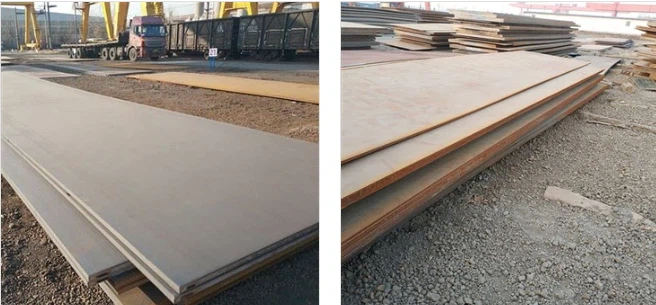
S355J2 is a widely used European standard (EN 10025-2) high-strength, low-carbon structural steel. It is characterized by its excellent weldability, toughness, and high yield strength.
Key Specifications & Meaning
The designation "S355J2" breaks down as follows:
S: Indicates Structural steel.
355: Represents the minimum Yield Strength of 355 MPa (for thicknesses ≤ 16mm).
J2: Specifies Impact Toughness. It must reach a minimum of 27 Joules during a Charpy V-notch impact test at -20°C.
1.0577: The numeric material number assigned under the EN system.
Mechanical & Physical Properties
Tensile Strength: Typically ranges from 470 to 630 MPa.
Weldability: Highly weldable with a maximum Carbon Equivalent Value (CEV) of approximately 0.47.
Common Delivery Conditions: Often supplied as S355J2+N, where "+N" indicates it has been normalized (rolled or heat-treated to a normalized state) to improve grain structure and toughness.
Common Applications
Due to its strength-to-weight ratio and durability in low temperatures, it is used in:
Civil Engineering: Bridges, buildings, and transmission towers.
Heavy Machinery: Cranes, excavators, mining equipment, and trailers.
Maritime/Energy: Offshore structures, shipbuilding, and wind turbines.
Industrial: Pressure vessels, railway axles, and connecting rods.
Global Equivalents
While not identical, S355J2 is often compared to the following international grades:
USA (ASTM): A572 Grade 50 is the closest equivalent.
UK (Former BS): 50D.
Germany (Former DIN): St52-3.
China (GB): Q355D or Q345D.
Chemical composition % of steel S355J2 (1.0577): EN 10025-2-2004
| Nominal thickness =< 40(mm) C max = 0.20 Nominal thickness =< 30(mm) CEV max = 0.45 |
| C | Si | Mn | P | S | Cu | CEV |
| max 0.22 | max 0.55 | max 1.6 | max 0.03 | max 0.03 | max 0.55 | max 0.47 |
Mechanical properties of steel S355J2 (1.0577)
| Nominal thickness (mm): | to 3 | 3 - 100 | 100 - 150 | 150 - 250 | 250 - 400 |
| Rm - Tensile strength (MPa) Flat and long products | 510-680 | 470-630 | 450-600 | 450-600 | 450-600 |
| Nominal thickness (mm): | to 16 | 16 - 40 | 40 - 63 | 63 - 80 | 80 - 100 | 100 - 150 | 150 - 200 | 200 - 250 |
| ReH - Minimum yield strength (MPa) Flat and long products | 355 | 345 | 335 | 325 | 315 | 295 | 285 | 275 |
| KV - Impact energy (J) longitud., | -20° 27 |
0° 27 |
+20° 27 |
| Nominal thickness (mm): | to 1 | 1 - 1.5 | 1.5 - 2 | 2 - 2.5 | 2.5 - 3 |
| A - Min. elongation Lo = 80 mm (%) parallel, | 14 | 15 | 16 | 17 | 18 |
| Nominal thickness (mm): | 3 - 40 | 40 - 63 | 63 - 100 | 100 - 150 | 150 - 250 |
| A - Min. elongation Lo = 5,65 √ So (%) parallel, | 22 | 21 | 20 | 18 | 17 |
Equivalent grades of steel S355J2 (1.0577)
Warning! Only for reference
| EU EN |
USA - |
Germany DIN,WNr |
Japan JIS |
France AFNOR |
England BS |
European old EN |
Italy UNI |
China GB |
Sweden SS |
Czechia CSN |
|||||||||||||
| S355J2 |
|
|
|
|
|
|
|
|
|
|
1. What is S355J2 steel?
S355J2 is a European standard structural steel with a minimum yield strength of 355 MPa and guaranteed impact toughness of 27 Joules at -20°C, making it suitable for low-temperature applications.
2. What is the difference between S355J0 and S355J2?
The key difference is the impact test temperature. S355J0 is tested at 0°C, while S355J2 is tested at -20°C, giving S355J2 better low-temperature toughness for colder environments.
3. What does the 'J2' mean in S355J2?
The 'J2' indicates the steel's impact toughness grade. 'J' means the minimum Charpy V-notch impact energy is 27 Joules, and '2' signifies the test is conducted at -20°C.
4. What is the yield strength of S355J2?
The minimum yield strength is 355 MPa for thicknesses up to 16mm, but it decreases for thicker sections (e.g., 345 MPa for 16-40mm, 335 MPa for 40-63mm) as per EN 10025-2.
5. Is S355J2 equivalent to ASTM A572 Grade 50?
They are generally comparable in strength, but S355J2 has a mandatory toughness requirement at -20°C, while ASTM A572 Gr. 50 requires impact testing only if specified by the purchaser.
6. Can S355J2 be welded?
Yes, S355J2 has good weldability. However, proper procedures-such as using suitable low-hydrogen electrodes and applying preheat for thicker sections-must be followed to maintain its mechanical properties.
7. What is S355J2+N?
The '+N' means the steel is supplied in a normalized or normalized rolled condition. This process refines the grain structure, improving toughness and making the steel more forgiving for welding, especially in thicker sections.
8. What are the chemical properties of S355J2?
S355J2 has controlled levels of carbon, manganese, silicon, phosphorus, and sulfur. Its maximum Carbon Equivalent (CEV) is also limited, typically around 0.40-0.45, to ensure good weldability.
9. What is the tensile strength of S355J2?
For common thicknesses (≤ 40mm), the tensile strength ranges from 470 MPa to 630 MPa, as specified in the EN 10025-2 standard.
10. Where is S355J2 steel used?
It's widely used in structural applications exposed to colder climates, such as bridges, building frames, offshore structures, cranes, and heavy equipment where low-temperature toughness is critical.
11. What is the density of S355J2?
Like most structural carbon steels, the density of S355J2 is approximately 7,850 kg/m³ (or 7.85 g/cm³).
12. Is S355J2 corrosion resistant?
No, S355J2 is not a corrosion-resistant (weathering) steel. It is a carbon steel that will rust if exposed to the elements unless protected by paint, galvanizing, or other coatings.
Full specification and details are available on request. The above information is provided for guidance purposes only. For specific design requirements please contact our technical sales staff.
