


Is 420 a good knife steel?
Yes, 420 stainless steel is a very common and good knife steel, particularly for budget-friendly, corrosion-resistant, and easy-to-maintain knives. However, its performance is highly specific-it excels in some areas and is mediocre in others.
Here's a detailed breakdown of its pros, cons, and best uses.
Overview: 420 Stainless Steel (AISI 420 / EN 1.4021)
Type: Martensitic Stainless Steel (can be hardened by heat treatment).
Key Alloy: Chromium (~12-14%) – provides stainless (rust-resistant) properties.
Carbon Content: Low (~0.15-0.40%) – this is the critical factor limiting its performance.
Advantages (Why it's "Good")
Excellent Corrosion Resistance: One of the most rust-resistant knife steels. It's ideal for:
Dive/Water Sports Knives
Kitchen Knives that will be frequently washed or used with acidic foods.
Outdoor/Pocket Knives in humid, salty, or wet environments.
Requires minimal maintenance to prevent rust.
Very Easy to Sharpen: Its relatively soft nature means you can get a sharp edge back quickly with a basic sharpening rod or stone, even in the field.
High Toughness & Durability: Resists chipping, cracking, and breaking very well. It can withstand prying, twisting, and impact better than many harder, more brittle steels. Great for hard-use survival knives where reliability is key.
Low Cost & High Availability: Makes it the default choice for mass-produced budget knives, multi-tools (like many Victorinox/Swiss Army Knife blades), and disposable utility blades.
Takes a Fine, "Toothy" Edge: While it doesn't hold it long, it can be sharpened to a very aggressive, grippy edge that works well for slicing rope or cardboard.
Disadvantages (Where it Falls Short)
Poor Edge Retention: This is its biggest weakness. Due to its low carbon content and resulting low hardness (typically HRC 50-55, where premium knife steels are HRC 58-65), the edge dulls quickly under use. It's not suitable for tasks requiring prolonged sharpness like processing game, detailed woodworking, or daily kitchen prep for a professional.
Low Maximum Hardness: It cannot achieve the high hardness of steels like VG-10, S30V, or M390. This directly limits its sharpness potential and wear resistance.
Cannot Hold a Very Fine ("Polished") Edge: The edge tends to break down and micro-roll rather than stay razor-sharp.
Common Knife Applications
Budget/Entry-Level Folding & Fixed-Blade Knives
Dive Knives & Fishing Fillet Knives
Swiss Army Knives & Multi-Tools
Machetes & Survival Knives (where toughness is prioritized over edge-holding)
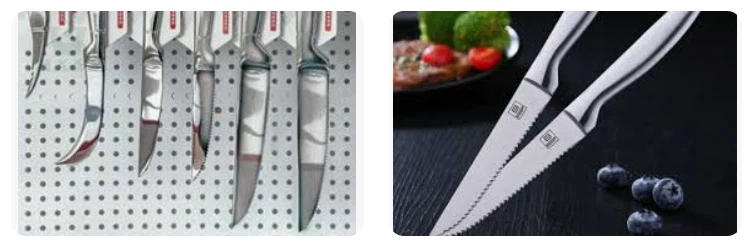
Kitchen Steak Knives & Low-Cost Chef's Knives
Surgical Scalpels (where extreme sharpness is secondary to sterility and corrosion resistance)
Comparison to Common Knife Steels
| Steel | Hardness (HRC) | Edge Retention | Corrosion Resistance | Toughness | Ease of Sharpening | Best For |
|---|---|---|---|---|---|---|
| 420 | 50-55 | Poor | Excellent | Excellent | Very Easy | Wet environments, budget knives, hard-use beaters |
| 440A | 55-58 | Fair | Very Good | Very Good | Easy | Step-up budget knives, better corrosion resistance |
| 8Cr13MoV | 57-59 | Fair-Good | Good | Good | Easy | Best value (China), great all-rounder for price |
| AUS-8 | 57-59 | Fair-Good | Good | Good | Easy | Reliable mid-range steel (common in Japanese knives) |
| VG-10 | 59-61 | Good | Very Good | Good | Moderate | Premium kitchen/gentleman's knives |
| D2 | 59-61 | Very Good | Fair (Semi-Stainless) | Good | Difficult | Tool knives where edge retention is critical |
| S30V | 58-61 | Excellent | Excellent | Good | Difficult | High-end EDC/outdoor knives |
The 420 Family: Important Sub-Grades
420J2: The most common variant in cheap knives. Has the lowest carbon.
420HC (High Carbon): A superior variant (used by Buck Knives). Has a slightly higher carbon content (~0.46%) and is heat-treated expertly (Buck's "Bos" treatment) to achieve HRC 57-58. 420HC is a dramatically better performer than basic 420 and is a respected, reliable steel for the price.
Verdict: Is it a "Good" Knife Steel?
For the average user / as a first knife: Yes, it's perfectly adequate. It gets sharp, doesn't rust, and is cheap to replace.
For an enthusiast or professional: No, it's considered low-tier. Its poor edge retention is a deal-breaker for any serious cutting task.
For specific uses: It's excellent for knives that will get wet, abused, or lost (dive, fishing, survival).
Think of it this way:
420 steel is the "Honda Civic" of knife steels. It's reliable, inexpensive, corrosion-resistant, and easy to maintain. It won't win any races (hold an edge like a super steel), but it will get the job done for most people without fuss. If your priority is never worrying about rust and you don't mind frequent sharpening, it's a good choice. If you value long-lasting sharpness, look for steels like 440C, VG-10, or 8Cr13MoV at a minimum.