


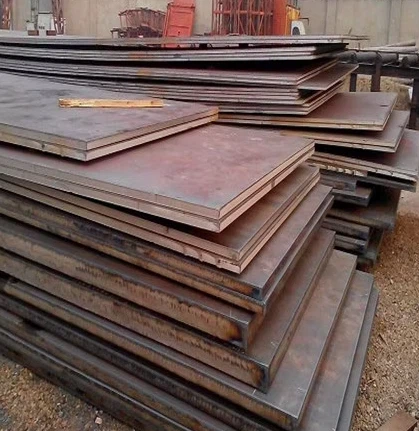
ASTM A387 Grade 22 Class 2 is a chromium-molybdenum alloy steel plate used for high-temperature, high-pressure applications like welded boilers and pressure vessels in the oil, gas, and chemical industries, known for its excellent corrosion/oxidation resistance and strength, supplied in normalized and tempered condition with higher tensile strength requirements than Class 1. Key elements are ~2.25% Chromium (Cr) and ~1.00% Molybdenum (Mo), with specific mechanical properties like 75-100 ksi tensile strength and 45 ksi yield strength.
|
A387 Gr.22 CL.2 Chemical Composition |
|||||||
|
Grade |
The Element Max (%) |
||||||
|
C |
Si |
Mn |
P |
S |
Cr |
Mo |
|
|
A387 Gr.22 Cl.2 |
0.04-0.15 |
0.50 |
0.30-0.60 |
0.035 |
0.035 |
1.88-2.62 |
0.85-1.15 |
|
Grade |
A387 Gr.22 CL.2 Mechanical Property |
|||
|
Thickness |
Yield |
Tensile |
Elongation |
|
|
A387 Gr.22 Cl.2 |
mm |
Min Mpa |
Mpa |
Min % |
|
t≦50 |
310 |
515-690 |
18 |
|
|
50<t≦200 |
- |
- |
- |
|
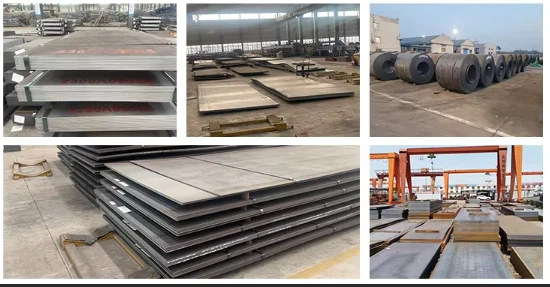
Production Process
1. Steelmaking & Refining
Melting: Typically produced via Electric Arc Furnace (EAF).
Refining: Utilizing Ladle Furnace (LF) and Vacuum Degassing (VD/VOD) to minimize impurities (P, S, Sn, Sb, As) and reduce hydrogen content. This is critical to prevent "temper embrittlement" and hydrogen-induced cracking.
Casting: The steel is cast into ingots or continuous slabs.
2. Hot Rolling
Heating: Slabs are reheated to a specific temperature range (usually 1150°C–1250°C).
Rolling: The steel is rolled to the required thickness. Precision control systems monitor the reduction ratios to ensure a uniform internal structure.
3. Heat Treatment (The Defining Stage)
For Class 2, the heat treatment is mandatory to achieve the required mechanical properties:
Normalizing: Heating to a range of 900°C – 980°C (1650°F – 1800°F) followed by air cooling to refine the grain size.
Tempering: Heating to a minimum of 675°C (1250°F). For advanced applications (like hydrogen service), tempering is often done at 700°C–760°C to enhance toughness and lower hardness.
Alternative: Accelerated cooling (Quenching) followed by Tempering is also permitted if agreed upon between the manufacturer and the purchaser.
4. Testing and Inspection
Mechanical Testing: Verification of Tensile Strength (75–100 ksi / 515–690 MPa) and Yield Strength (≥ 45 ksi / 310 MPa).
Impact Testing: Charpy V-notch tests are conducted (often at -18°C or -30°C) to ensure low-temperature toughness.
Non-Destructive Testing (NDT): Ultrasonic Testing (UT) per ASTM A578 is standard to detect internal laminations or defects.
5. Fabrication Requirements (Post-Mill)
When fabricators use these plates to build pressure vessels:
Preheating: Welding requires preheating (typically 150°C – 250°C) to prevent cold cracking.
PWHT (Post-Weld Heat Treatment): Mandatory stress-relieving at approximately 680°C – 720°C to ensure the weld zone achieves the same properties as the base metal.
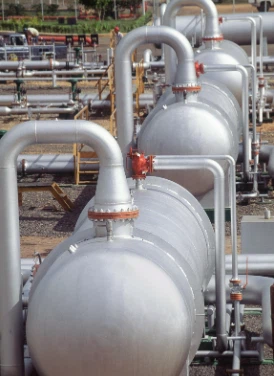 applications
1. Oil, Gas, and Petrochemical Industry
Pressure Vessels: Specifically used for reactors (e.g., hydrocrackers and hydrogenation units).
Heat Exchangers: Components that transfer heat between fluids in refineries.
Storage Tanks: Safe containment for hot liquids and pressurized chemicals.
Piping Systems: High-pressure pipelines for transporting steam and hydrocarbons.
2. Power Generation
Industrial Boilers: Used for boiler drum shells and superheaters that handle extreme steam pressures.
Steam Components: Steam headers, turbine casings, and high-temperature ducting.
3. Chemical Processing
Chemical Reactors: Equipment designed to withstand continuous thermal cycling and corrosive chemical attacks.
Industrial Furnaces: Structural parts requiring high-temperature mechanical stability.
4. Specialized Components
Fittings and Hardware: Fabrication of flanges, valves, pipe clamps, and adapters.
Harsh Environment Service: Offshore and onshore platforms, condensers, and equipment for underwater or marine services.
Get an valued quotation for ASTM A387 Grade 22 Class 2, Contact GNEE Steel.
What is the minimum tensile strength of A387 Grade 22 Class 2 as per ASTM standards?
According to ASTM A387, its minimum tensile strength is 415 MPa (60,000 psi), and the minimum yield strength reaches 205 MPa (30,000 psi), meeting the mechanical requirements for pressure vessel use.
What is the main advantage of A387 Grade 22 Class 2 over carbon steel in high-temperature environments?
Compared with carbon steel, it has better creep and oxidation resistance at elevated temperatures, avoiding deformation and degradation over long-term service, thus ensuring more stable performance in high-temperature scenarios.
What types of components are typically manufactured from A387 Grade 22 Class 2?
Common components made from it include pressure vessel shells, heads, flanges, heat exchanger tubesheets and piping, all designed for high-temperature and high-pressure working conditions.
Does A387 Grade 22 Class 2 require corrosion protection in specific environments?
It resists oxidation and mild corrosion in high-temperature gases, but in aggressive media like acidic or chloride-rich environments, additional protection such as cladding or coating is needed.
What standard governs the specification of A387 Grade 22 Class 2?
Its specification is governed by ASTM A387, a standard specifically formulated for chromium-molybdenum alloy steel plates used in pressure vessels and boilers, ensuring product quality and applicability.
What is the recommended preheating temperature for welding A387 Grade 22 Class 2?
The recommended preheating temperature ranges from 150°C to 200°C (302°F to 392°F), which varies based on the material thickness and the specific welding process adopted to ensure welding quality.
What post-weld heat treatment (PWHT) is required for A387 Grade 22 Class 2?
PWHT is usually conducted at 620°C to 675°C (1150°F to 1247°F). The holding time depends on material thickness, aiming to relieve residual stresses and enhance the toughness of welded joints.
Can A387 Grade 22 Class 2 be normalized and tempered?
Yes, normalization and tempering are common for it. Normalization involves heating to 890-925°C then air cooling, and tempering follows PWHT parameters to optimize its mechanical properties comprehensively.
How does the service temperature range of A387 Grade 22 Class 2 compare to 316L stainless steel?
Grade 22 Class 2 has a higher max service temperature (593°C vs 450°C of 316L). But 316L outperforms it in corrosion resistance against aggressive media like chlorides.
What is the difference in material cost between A387 Grade 22 Class 2 and carbon steel (A516 Grade 70)?
Grade 22 Class 2 is more costly than A516 Grade 70 due to chromium and molybdenum. The cost premium is reasonable for its superior high-temperature performance in critical applications.
How does the impact toughness of A387 Grade 22 Class 2 compare to A387 Grade 5 Class 2 at low temperatures (-20°C)?
Their low-temperature impact toughness is similar, but Grade 22 Class 2 is slightly better due to heat-treated refined microstructure. Neither is suitable for service below -29°C.