


h beam
H-beams, also known as W-beams because of their wide flanges, are significantly different from I-beams. The flanges of H-beams are equal and parallel, making welding easier than the angled flanges of I-beams. The cross-sectional properties of H-beams are superior to those of conventional I-beams, channels and angles. The name of this structural member is derived from the letter "H", reflecting its cross-sectional shape.
i beam
I-beams are characterized by an "I" shape with the inner surfaces of the top and bottom flanges sloped, which allows the use of thicker I-beams, but this structural design can limit torsional resistance.
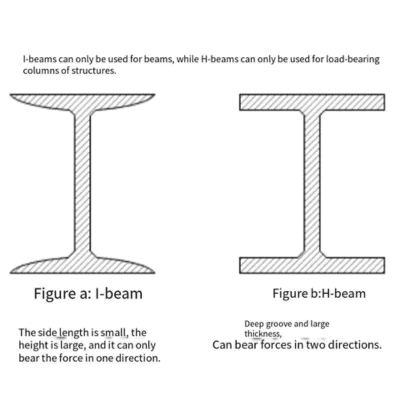
| Feature | H-Beam | I-Beam |
| Cross-Section Shape | Wide flanges, nearly square cross-section resembling the letter "H." | Narrow flanges, tapered edges resembling the letter "I." |
| Web Thickness | Thicker web, providing greater resistance to shear forces. | Thinner web, making it lighter but less resistant to shear forces. |
| Flange Width | Wider flanges, offering better load distribution and bending resistance. | Narrower flanges, suitable for vertical loads but less effective for bending. |
| Strength-to-Weight Ratio | Higher strength-to-weight ratio, ideal for heavy-duty applications. | Lower strength-to-weight ratio, better for lighter loads. |
| Load-Bearing Capacity | Superior load-bearing capacity, suitable for both vertical and horizontal loads. | Good for vertical loads but less effective for horizontal loads. |
| Resistance to Buckling | More resistant to buckling due to wider flanges and thicker web. | Less resistant to buckling, especially under heavy loads. |
| Torsional Strength | Higher torsional strength, suitable for applications with twisting forces (e.g., bridges, heavy platforms). | Lower torsional strength, not ideal for twisting forces. |
| Surface Area | Larger surface area, providing better resistance to compression and bending. | Smaller surface area, weaker resistance to compression and bending. |
| Manufacturing Process | Typically fabricated by welding three steel plates, resulting in higher strength. | Rolled or hot-rolled as a single piece, simpler process but lower strength. |
| Span Length | Can span longer distances (up to 330 feet) without additional support. | Typically used for shorter spans (up to 100 feet), may require additional support. |
| Applications | Suitable for high-rise buildings, bridges, industrial platforms, and heavy structures. | Commonly used in residential construction, elevator frames, and trailer supports. |
| Cost | More cost-effective for large-scale projects due to material efficiency. | May be more economical for smaller projects with lighter loads. |
Which structural beam should you choose?
As a key component of steel buildings, these beams are important in ensuring strength and stability. Whether you need guidance on beam selection, have a specific H-beam requirement, or are planning a complete steel structure project, we are here to support you.
At GNEE Steel, we offer:
Expert Advice: Let us help you determine the type of beam that best meets your structural needs.
Adequate Supply: With a total steel production capacity of 600,000 tons per year, we provide high-quality materials at very competitive prices.
One-Stop Solution: From planning, design, manufacturing to project completion, our 18 years of experience and more than 1,000 successful global projects ensure that your steel structure is in the hands of experts.
Customized Service: Structural steel can be manufactured and supplied to your specific requirements. We can produce and customize any type and size of steel beams to your requirements.
Adequate inventory: We have spot inventory of materials such as S355JR, S275JR, S355J2, S355J0, S355NL, S355ML, A36, A572GR50, A992, etc.

