


When comparing A992 H Beam with European structural steel grades such as S355 (including S355JR and S355J2), many buyers notice that both materials share a similar strength level.
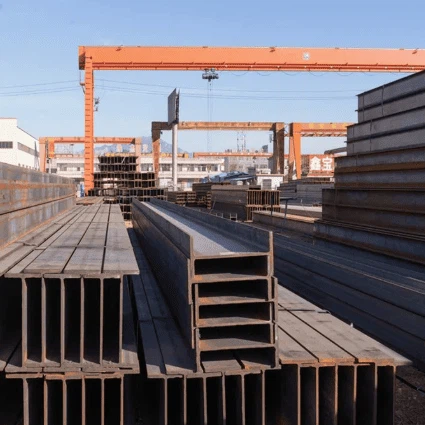
A992 H Beam
However, in real engineering applications, their differences go beyond basic mechanical properties and extend to standard systems, impact toughness requirements, and project suitability.
Strength Comparison Between A992 H Beam and S355 Steel
At the most basic level, both materials are designed to meet similar strength requirements. This is why they are often considered interchangeable in certain projects.
| Property | A992 H Beam | S355 Steel (EN 10025) |
|---|---|---|
| Yield Strength | ≥ 345 MPa (50 ksi) | ≥ 355 MPa |
| Tensile Strength | 450–620 MPa | 470–630 MPa |
Although S355 shows a slightly higher nominal yield strength, the difference is minimal in practical applications. From a structural design perspective, both materials can satisfy most load-bearing requirements.
A992 H Beam vs S355JR / S355J2
The more important difference lies in impact toughness classification, especially under low-temperature conditions.
European standards (EN 10025) divide S355 into multiple subgrades based on Charpy V-notch impact testing:
| Grade | Impact Test Requirement |
|---|---|
| S355JR | 27J at +20°C |
| S355J0 | 27J at 0°C |
| S355J2 | 27J at -20°C |
This means S355 provides clear and mandatory impact toughness levels, which are critical in cold environments or dynamically loaded structures.
In contrast, A992 H Beam does not always require full impact testing by default unless specified in the project requirements.
| Aspect | A992 H Beam | S355 Steel |
|---|---|---|
| Impact Test | Optional (if specified) | Mandatory by grade |
| Classification | Not subdivided | JR / J0 / J2 levels |
| Low-Temperature Use | Needs specification | Clearly defined |
This difference is important for buyers:
If your project involves low-temperature environments or strict EN compliance, S355J2 may be required.
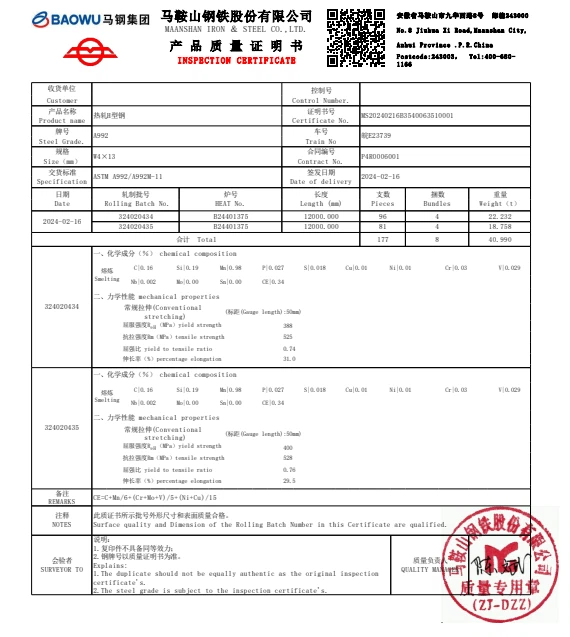
A992 MTC
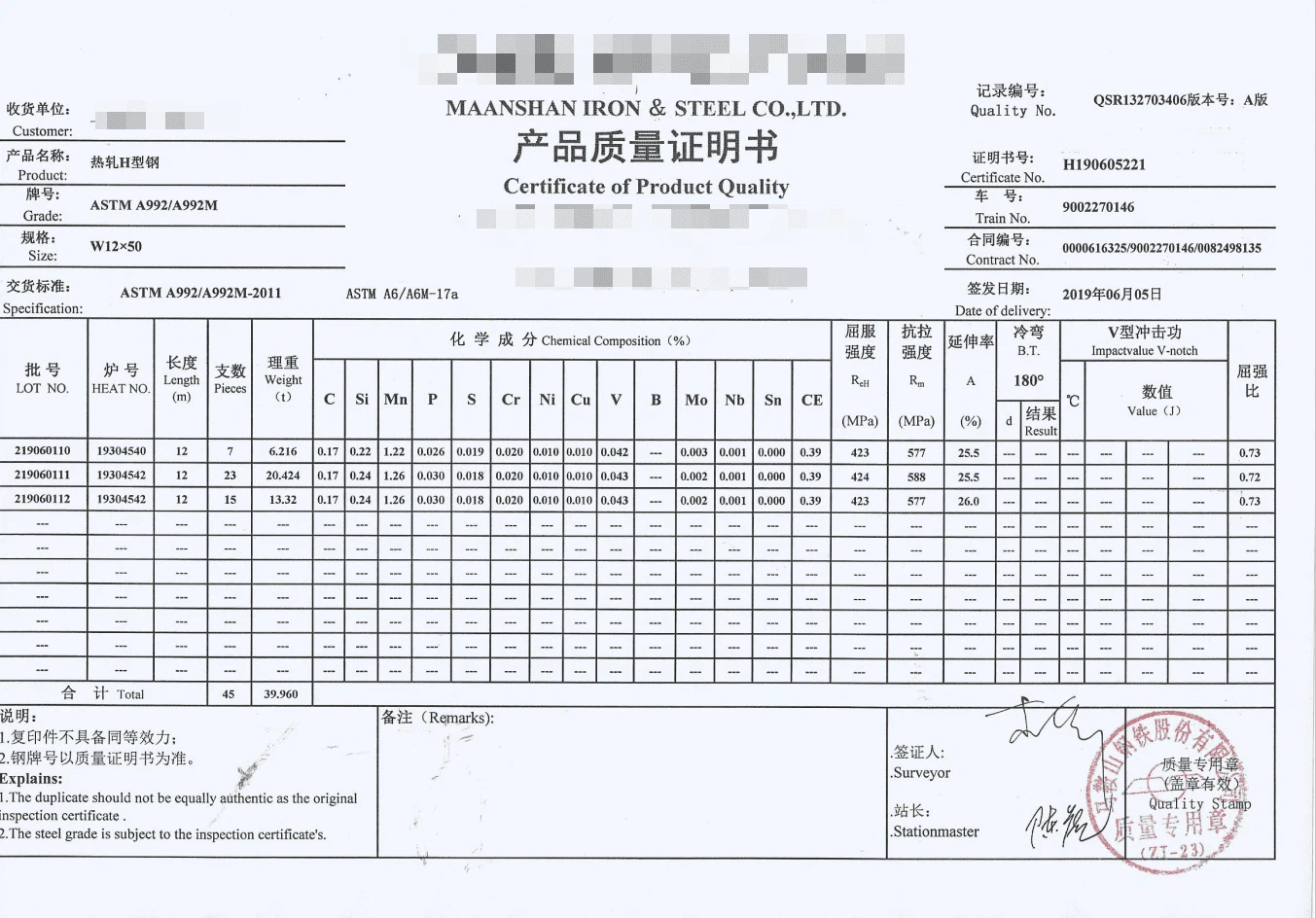
S355JR MTC
Standard System and Global Application Difference of A992 H Beam and S355 beam
Another critical distinction is the standard system itself.
| Aspect | A992 H Beam | S355 Steel |
|---|---|---|
| Standard | ASTM (USA) | EN 10025 (Europe) |
| Main Application | Americas, global EPC projects | Europe, EU projects |
| Certification | ASTM-based | CE / EN compliance |
In international projects, especially those following American codes, A992 H Beam is often specified as the default material for wide flange beams. It is widely accepted in global EPC projects and offers strong compatibility with design standards.
Structural Performance of A992 H Beam
Beyond strength, structural engineers also consider ductility and deformation capacity. One advantage of A992 H Beam is its controlled yield-to-tensile ratio, which improves predictability in structural behavior.
| Factor | A992 H Beam | S355 Steel |
|---|---|---|
| Yield Ratio Control | ≤ 0.85 (controlled) | Not strictly limited |
| Ductility | High | Good |
| Structural Stability | Excellent | Good |
Why Choose Gnee A992 H Beam for Global Projects
From a procurement perspective, the choice between A992 and S355 often depends on project standards. However, many international contractors prefer A992 H Beam due to its consistency and structural reliability.
At Gnee, we provide:
| Advantage | Benefit |
|---|---|
| ASTM Certified A992 | Meets global project requirements |
| Stable Mechanical Properties | Predictable performance |
| Wide Supply Range | Flexible project support |
| Technical Assistance | Material selection guidance |
This ensures that customers can confidently use A992 H Beam in demanding structural applications.
Although A992 H Beam and S355 steel share similar strength levels, their differences in impact toughness classification and standard systems make them suitable for different types of projects.
- For EN-standard or low-temperature applications → S355J2 is often required
- For ASTM-based or international EPC projects → A992 H Beam is preferred
Choosing the right standard ensures compliance, safety, and long-term project success.
Contact now to get A992 and S355 H Beam Quote
What is the difference between A992 and Grade 50?
A992 is primarily available as structural shapes, not plates or bars, and is the standard for wide-flange beams in the U.S. Key Difference: A572 Gr 50 is a broader specification for various forms and general structural use, while A992 is tailored for wide-flange shapes in building construction with enhanced properties.
What is the ultimate strength of A992?
Tensile yield strength, 345 MPa (50 ksi); tensile ultimate strength, 450 MPa (65 ksi); strain to rupture (sometimes called elongation) in a 200-mm-long test specimen, 18%; strain to rupture in a 50-mm-long test specimen, 21%. ASTM A992 is currently the most available steel type for structural wide-flange beams.
What is the difference between A992 and A572?
A992 steel exhibited a slightly higher (4-7% difference) DIF for yield strength than A572-50, but less than 1% difference for UTS. A572-50 steel exhibited an increase in yield strength up to 35% and ultimate tensile strength up to 20% as strain rate increased.