


Where is A537 Class 3 commonly used?
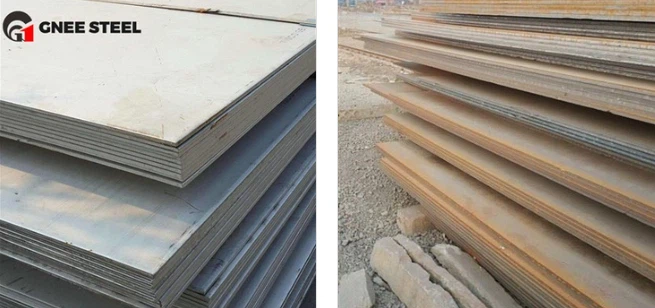
A537 Class 3 (or ASTM A537/ASME SA537 Class 3) refers to a heat-treated, quenched, and tempered carbon-manganese-silicon steel plate designed for fusion-welded pressure vessels and boilers, offering higher strength (Yield 380 MPa / 55 ksi min) and toughness than Class 1, ideal for moderate temperature services in oil, gas, and chemical industries. It's known for balanced strength and improved impact properties, with specific tempering requirements (not less than 1150°F / 620°C).
1. Cryogenic Pressure Vessels & Storage Tanks
This is the primary application. Class 3 is used for vessels containing liquefied gases at extremely low temperatures.
Examples: Tanks and pressure vessels for Liquefied Natural Gas (LNG), ethylene, ethane, ammonia, and other refrigerated liquids.
Reason: Its certified toughness at temperatures as low as -75°F (-60°C) and below prevents brittle fracture under stress at these cryogenic conditions.
2. Arctic & Severe Cold Climate Offshore Structures
Examples: Offshore oil & gas platforms, topside modules, and sub-zero processing equipment in regions like the North Sea, Alaska, or Arctic Canada.
Reason: It provides the necessary structural integrity and impact resistance for components exposed to low ambient temperatures combined with high wave/wind loads.
3. Critical Mining & Heavy Equipment
Examples: Structural components for mining trucks, excavators, and drilling rigs operating in polar or high-altitude environments.
Reason: Withstands impact and shock loading in extremely cold conditions where standard steels become brittle.
4. Specialized Transportation
Examples: Frameworks and containment systems for cryogenic railcars or ISO containers.
Reason: Combines high strength (allowing for lighter weight design) with guaranteed toughness to survive dynamic transport conditions at low temperatures.
5. High-Strength, Low-Temp Structural Components
Examples: Support structures, access platforms, and lifting gear in cold storage facilities, LNG plants, or chemical processing plants where temperatures routinely fall below -50°F (-46°C).
Key Technical Reason for Use:
The selection of Class 3 over Class 2 is driven by design codes and fracture mechanics analysis. When the required minimum design metal temperature (MDMT) falls below the typical capability of Class 2 (e.g., below -50°F) and/or when the thickness and stress levels create a high risk of brittle fracture, engineers specify Class 3 for its enhanced and guaranteed lower transition temperature.
In essence, A537 Class 3 is the material of choice for the most severe low-temperature engineering challenges, where failure is not an option. Its use is always tied to explicit purchase specifications for impact testing at the project's specific design temperature.
1.What is A537 Class 3?
A537 Class 3 is a high-strength, heat-treated carbon-manganese-silicon steel plate designed for welded pressure vessels, offering superior notch toughness and higher strength than Class 1 and Class 2 for specific thickness ranges.
2.What are the mechanical properties of A537 Class 3?
For plates up to 2.5 inches thick, A537 Class 3 typically has a minimum yield strength of 80 ksi (550 MPa) and a minimum tensile strength of 95 ksi (655 MPa), with impact toughness requirements often more stringent than Class 2.
3.What is the heat treatment for A537 Class 3?
A537 Class 3 is supplied in the quenched and tempered condition, similar to Class 2, but may involve stricter process controls to achieve enhanced toughness properties.
4.What is the difference between A537 Class 2 and Class 3?
The key difference lies in toughness requirements and sometimes strength for thicker plates. Class 3 is specified for enhanced low-temperature impact toughness, often with stricter Charpy V-Notch requirements, making it suitable for more critical low-temperature applications.
5.What is the Charpy impact requirement for A537 Class 3?
While specific values depend on thickness and ordering requirements, Class 3 generally requires Charpy V-Notch testing at lower temperatures (e.g., -75°F/-60°C) with higher absorbed energy minima (e.g., 40-50 ft-lbs) compared to Class 2.
6.Where is A537 Class 3 commonly used?
It is used in critical low-temperature applications such as liquefied gas storage tanks, offshore platforms in arctic environments, and pressure vessels subject to extremely cold service conditions.
7.Is A537 Class 3 weldable?
Yes, but it requires strict welding procedures similar to Class 2, including the use of low-hydrogen electrodes, controlled preheat, and often post-weld heat treatment to maintain toughness in the heat-affected zone.
8.What is the maximum thickness available for A537 Class 3?
The standard covers plates up to 6 inches (150 mm), but mechanical properties, especially toughness, are thickness-dependent and must be verified per ASTM A537 tables for Class 3.
9.Is A537 Class 3 suitable for cryogenic service?
Yes, its enhanced toughness qualifications make it suitable for cryogenic and sub-zero applications, often down to -75°F (-60°C) or lower, depending on specified impact test requirements.
10.How does A537 Class 3 compare to ASTM A553 Type I?
Both are quenched and tempered steels for low-temperature service. A553 Type I is a 9% nickel alloy steel for extremely low temperatures, while A537 Class 3 is a carbon-manganese-silicon steel with enhanced toughness for moderately low temperatures, offering a more cost-effective solution for specific ranges.
Full specification and details are available on request. The above information is provided for guidance purposes only. For specific design requirements please contact our technical sales staff.
