


Chemical Composition of Q235A vs Q235B H Beams
Q235A and Q235B are two commonly used grades of Q235 carbon structural steel, frequently used to manufacture High Structural Steel H Beams.
Their difference lies mainly in sulfur content and mechanical performance, which directly affect the reliability of H-beams used for load-bearing structures.
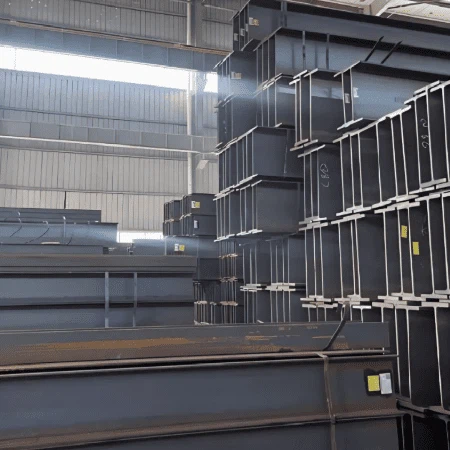
Chemical Composition Comparison
Q235A typically has a higher sulfur content, while Q235B contains a lower sulfur amount, improving its toughness and welding performance.
Chemical Composition Table (Used for H Beam Manufacturing)
| Grade | C | Si | Mn | S | P |
|---|---|---|---|---|---|
| Q235A | ≤0.22% | ≤0.35% | ≤1.4% | ≤0.050% | ≤0.045% |
| Q235B | ≤0.20% | ≤0.35% | ≤1.4% | ≤0.045% | ≤0.045% |
Key Point:
Higher sulfur content in Q235A reduces toughness. Lower sulfur in Q235B improves impact resistance, making Q235B more suitable for structural H-beams used in demanding environments.
Mechanical Properties of Q235A vs Q235B H Beams
Although yield and tensile strength remain the same, the most important difference is the impact test requirement.
Mechanical Property Table for Q235 H Beams
| Grade | Yield Strength (MPa) | Tensile Strength (MPa) | Elongation (%) | Impact Test |
|---|---|---|---|---|
| Q235A H Beam | ≥235 | 370–500 | ≥26 | Not Required |
| Q235B H Beam | ≥235 | 370–500 | ≥26 | Required (20 °C, ≥27J) |
Key Takeaway
✔ Q235B H Beams require a 20°C impact test
✔ Q235A H Beams do not
This is the most critical difference.
Even though both have similar strength, Q235B is certified for toughness, making it more reliable for major structures.
Cost of Q235A vs Q235B H Beams
The price difference between Q235A and Q235B H beams depends on:
Stricter composition control
Additional impact testing (for Q235B)
Market supply and demand
Regional production conditions
Required structural performance
Generally:
Q235B H Beams are slightly more expensive due to higher quality requirements.
However, the cost gap is small compared with the improved performance, especially for safety-critical projects.
If you need real-time pricing, feel free to contact us for a Q235 H Beam quotation.
Applications of Q235A vs Q235B H Beams
Q235A H Beam Applications
Used where structural demand is lower:
General metal structures
Light-duty building frames
Supports, brackets, fences
Non-critical welded components
Projects not exposed to impact or low temperature
Q235B H Beam Applications
Suitable for more demanding structural engineering:
Load-bearing building frameworks & columns
Bridges and walkway structures
Machinery frameworks and equipment bases
Ships, vehicles, trailers
Welded structures exposed to vibration or dynamic loads
Projects requiring guaranteed toughness at room temperature
Why the Impact Test Matters for H Beams
The Charpy impact test measures a steel's ability to absorb energy when subjected to sudden impact.
Q235B H Beams
Higher toughness
Better resistance to cracking
Safer under vibration, shock loads, and temperature variations
Q235A H Beams
No guaranteed toughness
May behave brittle under impact
Suitable only for static-load applications
Real-world safety implication:
H beams are used as key load-bearing members. Toughness greatly affects the structural integrity of buildings, bridges, and machinery.
How to Choose the Right H Beam: Simple Decision Guide
Choose Q235A H Beam if your project requires:
General fabrication
Light structural frames
Cost-sensitive applications
Non-critical supports and partitions
No dynamic stress or low-temperature exposure
Choose Q235B H Beam if your project requires:
Structural load-bearing frameworks
Reliable welding performance
Safety-critical applications (buildings, bridges, machinery)
Structures subject to vibration, impact, or dynamic loads
Higher toughness and better long-term performance
Note:
Q235B's slightly higher cost is a worthwhile investment for enhanced safety and durability.
