


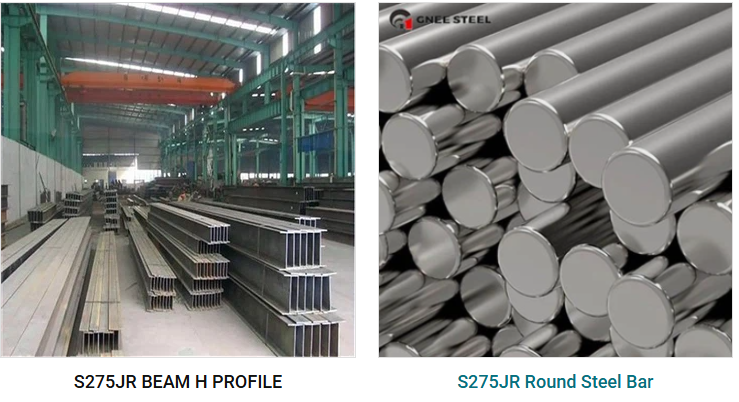
S275JR is a popular European (EN 10025) carbon structural steel grade known for its good formability, weldability, and moderate strength, featuring a minimum yield strength of 275 MPa for thinner sections, indicated by the 'JR' meaning it's impact tested at 20°C. It's widely used in construction (beams, frames, bridges), shipbuilding, and for non-critical machine parts like bushings, offering a cost-effective solution for general engineering needs.
Key Differences Between A36 (ASTM) and S275JR (EN)
While A36 (USA/ASTM) and S275JR (Europe/EN) are often considered functional equivalents for general structural use, they have important technical distinctions in their standards, property guarantees, and composition.
Here is a direct comparison in table format:
| Aspect | ASTM A36 | S275JR (EN 10025-2) | Practical Implication |
|---|---|---|---|
| 1. Governing Standard | ASTM A36/A36M (American) | EN 10025-2 (European) | Different certification & test reports. |
| 2. Key Strength Property | Minimum Tensile Strength: 400-550 MPa (58-80 ksi). Yield Strength is ≥250 MPa (36 ksi) for shapes/plates ≤ 200mm thick. |
Minimum Yield Strength (ReH): 275 MPa for thickness ≤ 16mm. For thicker sections, it decreases (e.g., 265 MPa for 40mm). Tensile: 410-560 MPa. | A36 is defined by tensile strength; S275JR by yield strength. For design, S275JR offers a slightly higher guaranteed yield strength in thin sections. |
| 3. Toughness Requirement | No mandatory impact (Charpy) testing in the base standard. | Mandatory impact test: ≥ 27 Joules at +20°C (Room Temperature). | S275JR has a guaranteed basic toughness; A36 does not unless supplementary requirements are specified (e.g., for bridges). |
| 4. Chemical Composition | Limits are broader, with maximums only. C: ≤ 0.26% (plates ≤ 20mm: 0.25%) Mn: ≤ - (0.80-1.20% typical) P: ≤ 0.04% S: ≤ 0.05% |
Tighter, product-thickness-dependent limits. C: ≤ 0.21% (for t ≤ 40mm) Mn: ≤ 1.50% P: ≤ 0.045% S: ≤ 0.045% Also requires fine-grain practice (e.g., Al min). |
S275JR has stricter control on carbon and impurities, and mandated grain refinement for consistency. A36 chemistry is more variable. |
| 5. Key Metallurgical Parameter | Carbon Equivalent (CE) not specified. | Carbon Equivalent (CEV) calculated. Typical range: ~0.30-0.38. | S275JR's controlled CEV more explicitly ensures good weldability. A36's weldability is good but less formally quantified in the standard. |
| 6. Product Forms & Thickness Rules | Covers plates, bars, shapes. Strength values do not decrease with thickness within the standard's range (up to 200mm). | Strength values decrease with increasing thickness in defined steps. Must always reference the correct value for the product thickness. | For thick sections, A36's constant 250 MPa yield may be more favorable than S275JR's reduced yield (e.g., 255 MPa for 80mm plate). |
| 7. Common Applications | General construction, bridges, buildings, machinery frames (US & global projects using ASTM). | General construction, building frames, engineering structures (European & international projects using EN). | Functionally interchangeable for many non-critical applications, but not directly substitutable in code-regulated designs without recalculation. |
Quick Decision Guide
| Scenario | Preferred Material / Consideration |
|---|---|
| Designing to US Codes (AISC, AWS) | Use ASTM A36 - it is the native material for US design manuals. |
| Designing to Eurocodes (EN 1993) | Use S275JR - it is the native material for European design codes. |
| Requiring Guaranteed Room-Temperature Toughness | Choose S275JR (impact test is mandatory). For A36, you must specify supplemental requirements. |
| Working with Thick Sections (> 40mm) | Compare guaranteed yields: A36 may offer a higher minimum yield strength for the thickness. |
| Cost & Availability | In North America, A36 is cheaper and more available. In Europe/Middle East/Asia, S275JR is standard. |
| Welding & Fabrication | Both are excellent. S275JR's controlled chemistry may give more consistent welding results. |
Summary
They are not the same steel, but they occupy the same functional role as common, weldable, general-purpose structural steels.
The core difference is philosophical: A36 is a tensile-strength-defined steel with simple chemistry rules, while S275JR is a yield-strength-defined steel with mandatory toughness and stricter compositional control.
For global projects, the choice is typically dictated by the governing design code and local availability, not by a significant performance advantage of one over the other.
