


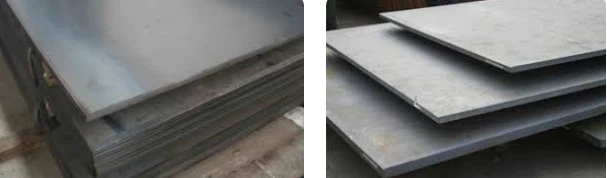
S355J2+N is a high-strength, non-alloy structural steel (EN 10025-2 standard) known for good weldability, toughness, and formability, featuring a minimum yield strength of 355 MPa and excellent impact resistance at -20°C, commonly used in construction, machinery, and bridges, with the "+N" indicating it's supplied in a normalized condition for consistent properties, especially good for general fabrication in temperate climates.
Key Characteristics
S355: "S" for Structural, "355" for minimum yield strength of 355 N/mm² (or MPa).
J2: Indicates a minimum impact energy of 27 Joules at a test temperature of -20°C, ensuring toughness in cold conditions.
+N: Signifies that the steel is supplied in a normalized condition, offering improved uniformity and mechanical properties.
Properties & Uses
High Strength: Offers high tensile strength (490-630 MPa) suitable for load-bearing applications.
Good Formability: Easily bent, curved, and shaped.
Weldable: Low carbon content makes it easy to weld.
Applications: Building frameworks, bridges, cranes, machinery, and general fabrication where performance in moderate conditions is needed.
In essence, it's a reliable, versatile steel for many structural needs, balancing strength, toughness, and cost.

1. Decoding the Name:
S355: Minimum yield strength of 355 MPa (for thicknesses ≤ 16mm).
J2: Guaranteed impact toughness of 27 Joules at -20°C.
+N: The crucial suffix meaning "Normalized or Normalized Rolled".
2. What Does "+N" (Normalized/Normalized Rolled) Mean?
It refers to a specific heat treatment or controlled rolling process applied after the initial hot-rolling.
Normalized: The steel is reheated to about 900°C and then air-cooled. This refines the grain structure, making it more uniform.
Normalized Rolled (often implied by +N): The final rolling passes are completed within a specific temperature range that achieves a similar grain-refining effect as normalizing, but directly during the rolling process.
3. Key Benefits & Improved Properties:
Compared to standard "as-rolled" S355J2, the "+N" version offers:
Superior Toughness: Finer grain structure provides better impact resistance, especially in the Heat-Affected Zone (HAZ) after welding.
Better Through-Thickness Properties: More consistent mechanical properties throughout thicker plates/sections, reducing the risk of weakening.
Enhanced Weldability: The refined microstructure is less prone to cracking during welding. Preheating requirements can often be reduced or eliminated for many thicknesses.
Lower Residual Stresses: Results in better dimensional stability after fabrication.
4. Typical Applications:
S355J2+N is specified for more demanding applications where reliability is critical:
Highly stressed welded structures in cold climates (e.g., bridges, offshore modules).
Critical components in cranes, wind turbine towers, and heavy machinery.
Structures using thick plates (typically >30-40mm) where standard as-rolled material might have property variations.
5. Important Distinction:
S355J2 (as-rolled): Standard delivery condition. Good for general use.
S355J2+N: A superior delivery condition with guaranteed refined microstructure. It is often considered a more forgiving and reliable material for fabrication.
In summary, S355J2+N is a premium version of S355J2 where the "+N" process ensures finer grain structure, leading to better toughness, easier welding, and more consistent performance-making it the preferred choice for critical, thick, or heavily welded structures in low-temperature environments.
1. What Is S355J2 Steel?
S355J2 is a European standard structural steel with a minimum yield strength of 355 MPa and guaranteed impact toughness of 27 Joules at -20°C, making it suitable for low-temperature applications.
2. What Is The Difference Between S355J0 And S355J2?
The key difference is the impact test temperature. S355J0 is tested at 0°C, while S355J2 is tested at -20°C, giving S355J2 better low-temperature toughness for colder environments.
3. What Does The 'J2' Mean In S355J2?
The 'J2' indicates the steel's impact toughness grade. 'J' means the minimum Charpy V-notch impact energy is 27 Joules, and '2' signifies the test is conducted at -20°C.
4. What Is The Yield Strength Of S355J2?
The minimum yield strength is 355 MPa for thicknesses up to 16mm, but it decreases for thicker sections (e.g., 345 MPa for 16-40mm, 335 MPa for 40-63mm) as per EN 10025-2.
5. Is S355J2 Equivalent To ASTM A572 Grade 50?
They are generally comparable in strength, but S355J2 has a mandatory toughness requirement at -20°C, while ASTM A572 Gr. 50 requires impact testing only if specified by the purchaser.
6. Can S355J2 Be Welded?
Yes, S355J2 has good weldability. However, proper procedures-such as using suitable low-hydrogen electrodes and applying preheat for thicker sections-must be followed to maintain its mechanical properties.
7. What Is S355J2+N?
The '+N' means the steel is supplied in a normalized or normalized rolled condition. This process refines the grain structure, improving toughness and making the steel more forgiving for welding, especially in thicker sections.
8. What Are The Chemical Properties Of S355J2?
S355J2 has controlled levels of carbon, manganese, silicon, phosphorus, and sulfur. Its maximum Carbon Equivalent (CEV) is also limited, typically around 0.40-0.45, to ensure good weldability.
9. What Is The Tensile Strength Of S355J2?
For common thicknesses (≤ 40mm), the tensile strength ranges from 470 MPa to 630 MPa, as specified in the EN 10025-2 standard.
10. Where Is S355J2 Steel Used?
It's widely used in structural applications exposed to colder climates, such as bridges, building frames, offshore structures, cranes, and heavy equipment where low-temperature toughness is critical.
11. What Is The Density Of S355J2?
Like most structural carbon steels, the density of S355J2 is approximately 7,850 kg/m³ (or 7.85 g/cm³).
12. Is S355J2 Corrosion Resistant?
No, S355J2 is not a corrosion-resistant (weathering) steel. It is a carbon steel that will rust if exposed to the elements unless protected by paint, galvanizing, or other coatings.
Full specification and details are available on request. The above information is provided for guidance purposes only. For specific design requirements please contact our technical sales staff.
