


The most common and widely accepted US equivalent to European standard S275JR is ASTM A36.
However, it is crucial to understand that this is a commercial and functional equivalent, not an exact chemical or mechanical match. For critical applications, a design engineer must approve the substitution based on the specific requirements.
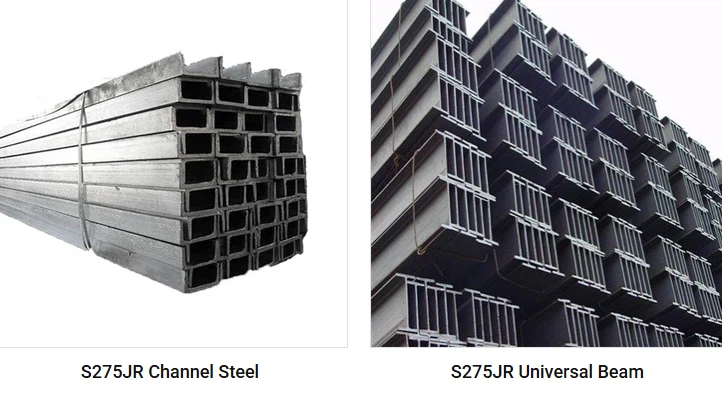
The table below provides a detailed comparison.
S275JR vs. ASTM A36: Equivalent Comparison
| Aspect | European Standard: S275JR (EN 10025-2) | US Standard: ASTM A36 / A36M | Notes on Equivalency |
|---|---|---|---|
| Primary Specification Basis | Minimum Yield Strength (ReH) | Minimum Yield Strength & Tensile Strength | Both are yield-strength-driven grades for general structural use. |
| Minimum Yield Strength | 275 MPa (for thickness ≤ 16 mm) Decreases with thickness. |
250 MPa (36 ksi) (for all shapes, plates, bars up to 200 mm thick). | S275JR is ~10% stronger in its nominal thickness range. This is the most significant difference for designers. |
| Tensile Strength | 410 - 560 MPa | 400 - 550 MPa | The ranges overlap almost entirely, making them very similar in ultimate strength. |
| Elongation | ≥ 23% (for t ≤ 40mm) | ≥ 20% (in 200mm gauge length) ≥ 23% (in 50mm gauge length) |
Comparable ductility. S275JR's requirement is slightly more standardized for common plate thicknesses. |
| Impact Toughness (Charpy) | Mandatory: ≥ 27 J at +20°C (Room Temp) | Not a default requirement. Can be specified as a Supplementary Requirement (e.g., S30). | Key Distinction: S275JR has a guaranteed baseline toughness. For low-temperature service, A36 is not suitable unless impact tests are explicitly ordered. |
| Typical Chemical Composition | C ≤ 0.21%, Mn ≤ 1.50%, P ≤ 0.035%, S ≤ 0.035% | C ≤ 0.26%, Mn ≤ (varies by form), P ≤ 0.04%, S ≤ 0.05% | A36 has higher permissible carbon and sulfur. This gives S275JR slightly better weldability and through-thickness properties. |
| Carbon Equivalent (CEV) | Typically ≤ 0.36 | Typically ≤ 0.40 - 0.45 | Confirms S275JR's generally superior weldability without pre-heat for most sections. |
| Common Forms | Plates, sections (beams, channels), bars, hollow sections. | Plates, structural shapes (W-beams, angles), bars. | Availability is identical; both are "commodity" structural steels. |
| Main Applications | General construction (frames, trusses), machinery, platforms, non-critical parts. | General construction (bridges, buildings), machinery, platforms. | Directly interchangeable in most general fabrication where precise mechanicals are not critical. |
Important Considerations for Substitution
1. For General Fabrication (Non-Critical):
A36 is the direct substitute. Most workshops and fabricators will treat them interchangeably for brackets, frames, platforms, and supports where design margins are ample.
2. When Strength is the Governing Design Factor:
The 10% higher yield strength of S275JR must be accounted for. Simply replacing S275JR with the same thickness of A36 could lead to over-stressing. The designer may need to increase the thickness of the A36 component.
3. For Applications Requiring Toughness / Low Temperature:
S275JR provides a basic 27J at 20°C guarantee.
Standard A36 has no toughness guarantee. If the application is outdoors or subject to dynamic loading, you must specify an A36 grade with supplemental Charpy V-notch requirements (e.g., ASTM A36 with Supplementary Requirement S30, which is 20 ft-lbf [27 J] at 70°F [21°C]).
For cold environments, the European system offers clear subgrades (J0, J2). The equivalent would be specifying A36 with impact tests at lower temperatures (e.g., 0°F / -18°C), or using a different ASTM grade like A572 Gr. 50, which often has better notch toughness.
4. Other Close US Grades:
ASTM A572 Grade 50: This is a High-Strength Low-Alloy (HSLA) steel with a 345 MPa (50 ksi) minimum yield, making it stronger than S275JR. It is not a direct equivalent but is a common step-up when higher strength is needed.
ASTM A529 Gr. 55: Another carbon-manganese steel similar to A36 but with a higher strength (380 MPa min yield), sometimes used as a bridge between A36 and HSLA steels.
Summary Answer
The standard US equivalent of S275JR is ASTM A36. However, engineers must note that:
S275JR has a higher minimum yield strength (275 vs. 250 MPa).
S275JR has a mandatory toughness requirement; A36 does not unless specified.
For formal substitution in regulated construction (e.g., bridges, buildings), the relevant design code (AISC, EN) and local authority approval are required. The mill certificate of the supplied A36 material should be checked to ensure it meets the project's specific needs.
